WS Type Socket Clevis Extended Type
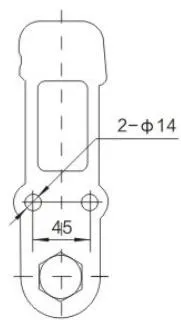
Models: WS-7AG, WS-16A, WS-21B · Nominal Failure Load: 70–210 kN · Reference Weight: 2.1–4.7 kg · Fork gap C: 18–30 mm
Two Lengths Instead of One
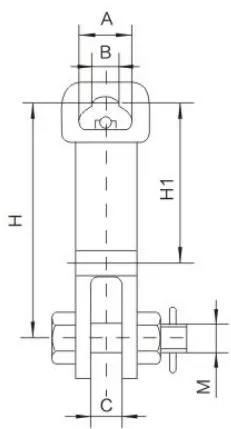
The plain WS socket clevis publishes one length, H. This sheet publishes two. Both start at the same top face: H runs all the way down to the bottom bolt centre, H1 stops at the shoulder where the body steps in. So H1 is the depth of the head, and H − H1 is the height of the fork below it.
That second number is the whole reason this page exists. On a long-body fitting, one overall length does not tell you whether the extra metal is in the head or in the fork, and those two mean different things on the line.
Three Sizes, Three Different Suffix Styles
| Model | C | H | M | H1 | A / B | Mark | Load | Weight |
|---|---|---|---|---|---|---|---|---|
| WS-7AG | 18 | 105 | 16 | 51.5 | 34.5 / 19.2 | 16 | 70 kN | 2.1 kg |
| WS-16A | 26 | 195 | 24 | 135.5 | 42.5 / 23.0 | 20 | 160 kN | 4.3 kg |
| WS-21B | 30 | 195 | 27 | 95.0 | 42.5 / 23.0 | 20 | 210 kN | 4.7 kg |
The suffixes are AG, A and B on three lines — three styles for one family, and the “Models” heading reads like a continuous range when it is not. Read the three numbers off the table, not off the code.
Same Length, Different Split
WS-16A and WS-21B are the interesting pair. H is 195 mm on both, and the bowl is identical: A 42.5, B 23.0, coupling mark 20. So they take the same ball, hang the same distance down, and have the same fork gap family.
Then H1 is 135.5 mm on the 160 kN and 95.0 mm on the 210 kN — 40 mm apart. With the overall length fixed at 195 mm, that means the shoulder sits 40 mm higher on the stronger part, and the fork below it is 100 mm tall against 59.5 mm. The 210 kN also carries the bigger bolt, M 27 against M 24, and 0.4 kg more weight. Head and fork are split differently on the two parts even though both hang the same distance.
If you are choosing between these two on a drawing, H will not separate them. H1 will.
Twice the Weight of the Plain WS
| WS-7 | WS-7AG | |
|---|---|---|
| C | 20 (18 on the other sheet) | 18 |
| H | 70 | 105 |
| Load | 70 kN | 70 kN |
| Weight | 0.97 kg | 2.1 kg |
Thirty-five millimetres of extra length cannot double the weight of a 1 kg fitting. The extended type is a different body, not a stretched WS — the reach comes from a longer casting, and the extra kilogram is in the section around it.
Practical consequence: this is the part to use when the string has to clear something, and it costs you twice the weight and roughly twice the material. Do not specify it for a normal suspension point.
Technical Parameters
| Model | Main Dimensions (mm) | Coupling Mark | Nominal Failure Load (kN) | Reference Weight (kg) | |||||
|---|---|---|---|---|---|---|---|---|---|
| C | H | M | H1 | A | B | ||||
| WS-7AG | 18 | 105 | 16 | 51.5 | 34.5 | 19.2 | 16 | 70 | 2.1 |
| WS-16A | 26 | 195 | 24 | 135.5 | 42.5 | 23.0 | 20 | 160 | 4.3 |
| WS-21B | 30 | 195 | 27 | 95.0 | 42.5 | 23.0 | 20 | 210 | 4.7 |
Related Pages
Standard body: WS socket clevis. Solid-eye bottom: W socket clevis. Long body with the ball lock published: WSJ. Stirrup version: WSY.
Note: H1 is the second length — measured from the same top face down to the shoulder where the body steps in. WS-16A and WS-21B share H = 195 mm and the same bowl but differ by 40 mm in H1; only H1 tells them apart on a drawing. The extended body weighs about twice the plain WS at the same rating.