ZH Arcing Horn
Models: ZH-01 – ZH-32 (8 models) · Voltage: 110–230 kV · Weight: 0.86–2.10 kg
Four Tables, Four Different Column Sets
Two models per table, and the tables do not agree on what to print:
| Table | Columns |
|---|---|
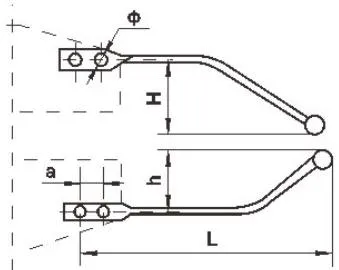
| 1 — ZH-01, ZH-02 | L, H, h, D, Ø |
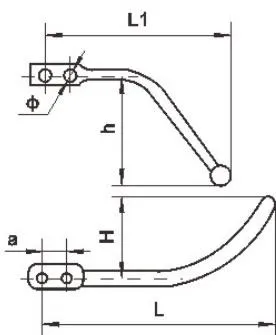
| 2 — ZH-11, ZH-12 | L, H, a, D, Ø |
| 3 — ZH-21, ZH-22 | L, H, h, a, Ø |
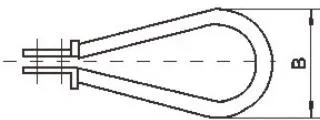
| 4 — ZH-31, ZH-32 | L, L1, H, h, a, B, Ø |
So the third dimension is h on one table and a on another, and only table 4 has L1 and B. A number in that position is not the same dimension across the sheet — reading down a column tells you nothing, and the four tables are four different mounting arrangements rather than four sizes of one horn.
Only Ø 14.5 mm is common to all eight, and it is the same on every row — so it is a fixing or a rod end, not a size that varies with the horn.
H Is Always Larger Than h — Except On ZH-32
On seven rows the overall height exceeds the internal dimension:
| Model | H | h | |
|---|---|---|---|
| ZH-01 | 197 | 114 | ✓ |
| ZH-21 | 270 | 203 | ✓ |
| ZH-31 | 372 | 270 | ✓ |
| ZH-32 | 114 | 197 | ✗ |
ZH-32 prints H smaller than h. A dimension h that sits inside the horn cannot be larger than the overall height H, and every other row on the sheet has them the right way round.
The two figures are also exactly the h and H of ZH-01 — 114 and 197 — carried across in the opposite order. ZH-31’s neighbours in the same table use 372 and 270.
Read ZH-32 as H 197, h 114 and confirm with us before using the row. As printed, the drawing cannot be built.
The Voltage Column Mixes Three Formats
The column headed Voltage Level (kV) holds:
- a single number — 138, 161
- a range — 161~230
- a cell with a broken character — “110□ 138” on ZH-21
- and 203 twice, on the two largest rows
The ”□” in ZH-21 is a missing glyph, not a dimension; read the row as covering 110 and 138 kV.
203 appears in the voltage column of two rows, and those same two rows are the ones with seven dimensions in table 4. It is not one of the nominal levels printed elsewhere on the sheet (110, 138, 161, 220, 230), so read those two rows by the horn length and the arc gap rather than by the code, and state the system voltage on the enquiry — the horn is cut to the length and the gap you need, and the level is confirmed on the drawing that travels with the offer.
Note also that the same horn length covers a range on one row and a single level on another: ZH-02 at L 762 covers 161~230 kV, while ZH-01 at L 712 covers 138. Length alone does not fix the voltage class.
Doubling The Horn Length Adds Five Per Cent Of Mass
Compare the two 138 kV rows:
| Model | L | Weight |
|---|---|---|
| ZH-11 | 356 mm | 1.15 kg |
| ZH-01 | 712 mm | 1.20 kg |
Twice the length for 0.05 kg more. A 356 mm aluminium rod of any sensible diameter weighs more than 50 g, so the mass of a horn is almost entirely in its brackets and fittings — the rod itself is a small fraction.
That has a practical consequence: the weight column tells you nothing about the horn’s length, and freight or a structural check has to use L and the drawing rather than kilograms. It also means a longer horn is nearly free in material, so the choice between ZH-01 and ZH-11 is about clearance and mounting, not cost.
The Two Largest Rows Are Assemblies
ZH-31 and ZH-32 are the only rows with L1 and B, and they weigh 2.00 and 2.10 kg against 0.86 to 1.26 for the rest.
So table 4 is not a bigger horn — it is a complete assembly with a second length L1 and a width B, and the extra kilogram is the mounting hardware. If a project needs a 203 kV horn and the design has its own bracket, table 4 may be more than is required; if it has no bracket, table 4 is the only complete option on the sheet.
What Is Missing
- No material — aluminium or galvanised steel changes both the weight and the arcing behaviour, and nothing on the page says which.
- No gap setting — the arcing gap is the functional dimension of a horn and it is not printed on any row.
- No rated current or fault level.
- No mounting detail — Ø 14.5 is printed but not named, and the bolt or pin it takes is not specified.
Technical Parameters
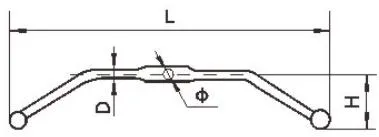
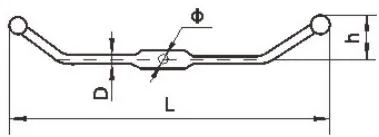
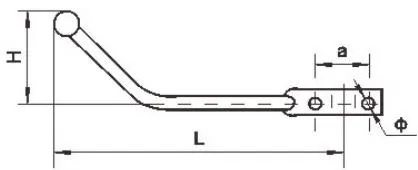
| Model | Main Dimensions(mm) | Voltage Level(kV) | Reference Weight(kg) | ||||
|---|---|---|---|---|---|---|---|
| L | H | h | D | Ø | |||
| ZH-01 | 712 | 197 | 114 | 16 | 14.5 | 138 | 1.20 |
| ZH-02 | 762 | 197 | 114 | 16 | 14.5 | 161~230 | 1.26 |
| Model | Main Dimensions(mm) | Voltage Level(kV) | Reference Weight(kg) | ||||
|---|---|---|---|---|---|---|---|
| L | H | a | D | Ø | |||
| ZH-11 | 356 | 197 | 60 | 16 | 14.5 | 138 | 1.15 |
| ZH-12 | 385 | 197 | 60 | 16 | 14.5 | 161 | 1.20 |
| Model | Main Dimensions(mm) | Voltage Level(kV) | Reference Weight(kg) | ||||
|---|---|---|---|---|---|---|---|
| L | H | h | a | Ø | |||
| ZH-21 | 340 | 270 | 203 | 45 | 14.5 | 110□ 138 | 0.86 |
| ZH-22 | 372 | 270 | 203 | 45 | 14.5 | 161 | 1.03 |
| Model | Main Dimensions(mm) | Voltage Level(kV) | Reference Weight(kg) | ||||||
|---|---|---|---|---|---|---|---|---|---|
| L | L1 | H | h | a | B | Ø | |||
| ZH-31 | 434 | 372 | 203 | 270 | 45 | 203 | 14.5 | 203 | 2.00 |
| ZH-32 | 445 | 381 | 114 | 197 | 45 | 203 | 14.5 | 203 | 2.10 |
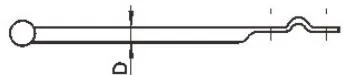
Related Pages
Grading rings that work with an arcing horn: FJ grading ring, FJV, FJ grading ring. Attachment hardware at the same point: GD attachment point fitting, BL yoke plate. Insulating covers for the terminals: PZ insulating cover.
Note: Eight horns in four tables with four different column sets — the third dimension is h in one table and a in another, and only table 4 has L1 and B. Ø 14.5 is the only dimension common to all eight and never varies. ZH-32 prints H 114 against h 197, the wrong way round and identical to ZH-01’s pair reversed; read it as H 197, h 114. The voltage column mixes a single value, a range and a broken glyph, and prints 203 twice where the rest of the sheet uses 110, 138, 161, 220 and 230. ZH-01 is twice the length of ZH-11 for 0.05 kg more, so the mass is in the fittings. No material, gap setting, fault level or mounting detail printed.