FJ Grading Ring
Models: FJ-760×660D, FJ-1026×676S, FJ-660 · Rows: 3 · Reference Weight: 5.0–8.5 kg
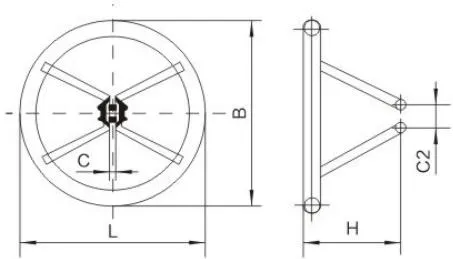
What the Letters Measure
A grading ring is an open loop of tube held out from the hardware it protects. The columns describe exactly that:
- L × B — the two outside dimensions of the ring itself, in the plane of the loop. 760×660 is an ellipse 760 mm one way and 660 the other; 660 is a plain circle.
- H — the height of the ring plane above the mounting face. This is the dimension that sets how far the ring stands off the fitting, and on these three rows it varies by more than 2:1.
- a — the bracket offset, 80 mm on all three.
- C — the diameter of the ring’s own conductor, the tube the loop is bent from. It is the only section on the sheet, and therefore the only thing that tells you how much metal is in the ring.
C is not the tube for the fitting, and it is not a clearance. It is the ring bar. Two rings of the same L×B with different C are different weights and different corona behaviour, and nothing else on the sheet shows it.
The Smallest Ring Has the Thickest Tube
| Model | L × B | H | C | Weight |
|---|---|---|---|---|
| FJ-1026×676S | 1026 × 676 | 290 | 20 | 8.5 kg |
| FJ-760×660D | 760 × 660 | 500 | 20 | 7.6 kg |
| FJ-660 | 660 × 660 | 220 | 38 | 5.0 kg |
The two big rings use a 20 mm tube. The 660 mm ring uses a 38 mm one — nearly four times the wall section on the smallest loop in the family.
That is not a mistake: a shorter loop of the same tube has a smaller radius of curvature, which raises the surface gradient. Thickening the tube is how the designer buys the field strength back. On the smallest ring, C is doing the work that L does on the others.
The practical consequence is that FJ-660 is a compact, stiff ring for a tight phase spacing, not a cut-down version of the 760.
The Bar Is What You Specify
On a grading ring the bar diameter is the number that goes into a corona specification, and it is the only section the table gives. C 20 on the two large loops, C 38 on the 660 — the small ring buys its field strength back with section instead of with reach.
The 660 is a true circle, L and B equal, so it can be rotated to any position on the bracket. The two larger rings are ellipses and sit one way only.
Technical Parameters
| Model | Diagram | Main Dimensions (mm) | Reference Weight (kg) | ||||
|---|---|---|---|---|---|---|---|
| L | B | H | a | C | |||
| FJ-760×660D | 1 | 760 | 660 | 500 | 80 | 20 | 7.6 |
| FJ-1026×676S | 2 | 1026 | 676 | 290 | 80 | 20 | 8.5 |
| FJ-660 | 3 | 660 | 660 | 220 | 80 | 38 | 5.0 |
Related Pages
The single-size FJV ring: FJV grading ring. Shielding rings with a bracket kit: FP shielding ring. The full JPL and FJP range: JPL FJP grading shielding ring.
Note: L and B are the ring’s own outside dimensions, H its height above the mounting face, and C the diameter of the ring tube — the only section given, and the number a corona specification is written against. The 660 mm ring uses a 38 mm tube where the 760 and 1026 use 20 mm: a tighter radius raises the surface gradient, so the small loop carries the heavy bar. Loops are aluminium, brackets hot-dip galvanised steel.