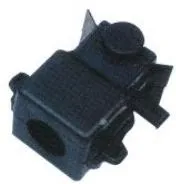
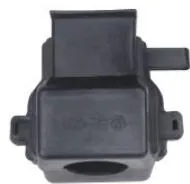
PZ 7 W 7B WS 7 SL PXP Insulating Cover
Family: 7 product codes · Use: exposed joints on overhead lines · Weathering: 1008 h tested
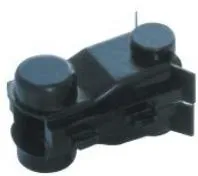
The Title Is Seven Product Codes, Not One
PZ, W, 7B, WS, 7, SL, PXP — the page is named after seven separate codes run together, and the sheet never separates them. There is no table on this page, no size list and no drawing index.
So the page tells you what the family does but not which cover fits which joint. If a specification names a PZ or an SL cover, this page cannot confirm it.
What A Cover Is For
This part is the one place on the page where the copy is specific and worth keeping. An insulating cover goes over an exposed connection — a terminal, a clamp, a jumper — to stop the joint from becoming a fault path. The failure modes it addresses are all environmental:
- Wet flashover — a water film across a bare joint
- Pollution flashover — conductive dust and salt building up on the surface
- Salt fog and chemical gas corrosion — coastal and industrial atmospheres
- Human contact — a lineman or a passer-by touching a live joint
- Small animals and debris — birds, rodents, nesting material bridging phase to phase or to earth
Any one of those produces the same result: a phase-to-phase short or an earth fault, a trip, and damage to the equipment behind it. The cover removes the exposed surface, so the failure has nowhere to start.
That is why the material matters more than the geometry: a cover that tracks or erodes in pollution is worse than no cover, because it hides the joint while failing quietly.
The Only Figure On The Page Is The Weathering Test
“After artificial weathering test 1008 hours, performance is good.”
That is the entire technical content of the page — six weeks of accelerated weathering, with a qualitative verdict.
It is a real test and worth having, but it is not a number a specification can be written against. 1008 hours tells you the material survived; it does not tell you how much it degraded, and there is no comparison against an unexposed sample, no retention figure, no surface tracking result.
For a polluted or coastal site, the figures that decide the choice are tracking resistance (CTI), UV stability and the erosion depth after ageing — none of which is printed here. Ask us for the test report rather than quoting “1008 hours” as if it were a rating.
The Material Block Describes A Different Product
The manufacturing section on this page reads:
- Material: high-quality carbon steel, cast iron, or aluminum alloy
- Surface treatment: hot-dip galvanizing to ISO 1461 / ASTM A153, minimum zinc coating 65 μm
- Dimensional accuracy ±0.5 mm on mounting interfaces, coating measured to ISO 2178
This is a galvanised steel component being described, on the page for a rubber insulating cover. An insulating cover is a moulded polymer; it is not galvanised, it has no zinc coating, and it is not made of cast iron or aluminium alloy.
The block has been copied from the metal hardware pages in this catalogue. Ignore it when specifying this product — and if a customer has read it and expects a galvanised steel part, correct them before the order, because the two are not interchangeable.
The Advantages List Is Boilerplate Too
The same problem runs through the advantages:
- “Designed to withstand rated breaking loads with appropriate safety margins” — a cover carries no load.
- “CNC machining and forging processes ensure dimensional accuracy” — covers are moulded, not forged.
- “Standardized interfaces — compatible with common insulator, conductor and support hardware” — no interface is specified anywhere on the page.
Only the weatherability note and the paragraph on failure modes are about this product. The rest of the copy has been carried over from the metal fittings.
What You Need To Order
The page cannot answer these, so they have to be asked:
- Voltage class — no rated voltage is printed anywhere.
- Which joint — terminal block, equipment clamp, parallel groove clamp, suspension clamp: the seven codes presumably distinguish them, and none is explained.
- Dimensions and wall thickness — nothing printed.
- Material grade and colour — silicone is claimed in the family but not stated on this page, and no colour is given, which matters for UV and for phase identification.
- Temperature range and flame rating — not printed.
Technical Parameters
Note: Weatherability — after an artificial weathering test of 1008 hours, performance is good.
Related Pages
Transformer terminal covers, with a full size list per connection type: power transformer terminal safety covers. The joints these cover: JFL aluminum branch clamp, JCB transformer clamp, JCD meter box clamp.
Note: The page name is seven product codes run together — PZ, W, 7B, WS, 7, SL, PXP — and nothing on the sheet separates them, so no cover can be matched to a joint from this page. The useful content is the failure-mode paragraph (wet and pollution flashover, salt fog, corrosion, contact, animals) and one figure: 1008 hours of artificial weathering, with a qualitative verdict and no retention or tracking data. The material block describes carbon steel, cast iron or aluminium with 65 μm hot-dip galvanising, and the advantages claim forged parts with breaking loads — both belong to a metal fitting, not to an insulating cover, and should be disregarded. No voltage class, dimensions, material grade, colour or temperature range is printed.