JFL Aluminum Transition Branch Clamp
Models: JFL-25 – JFL-240 (9 sizes) · Main wire: 50–240 mm² · Branch wire: 25–240 mm²
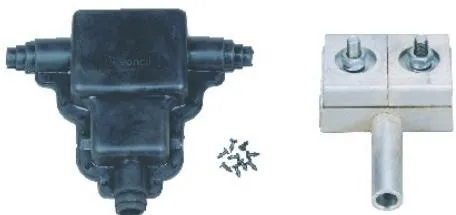
One Body, Nine Branch Grooves
Every row prints the same main range, 50~240 mm². Only the branch changes — 25, 35, 50, 70, 95, 120, 150, 185, 240 — the standard conductor ladder.
That tells you what the part is: a single body casting with a bolted main plate and a branch groove. If the main were a fixed groove it could not take 50 mm² and 240 mm², a span of nearly five times the area. So the main side is a two-plate clamp that closes onto whatever is under it, and the nine part numbers differ only in the branch groove.
It also means the sheet is quoting nine branch sizes of one clamp, not nine clamps of increasing size. Freight and stock planning should treat it that way.
The Biggest Branch Equals The Biggest Main
JFL-240 prints a 240 mm² branch against a main range that ends at 240. So the top of the range is not a branch at all — it is a joint between two equal 240 mm² conductors, which is what a parallel-groove clamp does.
The sheet draws no distinction between the two duties. If the job is tapping a small branch off a big main, the small numbers are the ones to look at; if it is jointing two equal conductors, only the last row applies. There is no row that joints, say, 185 to 185 — the table would leave you assuming JFL-185 does it, since 185 falls inside the main range on the branch side too. Ask us before using a middle size as an equal-to-equal joint.
Not One Dimension On The Page
The table has four columns: name, model, main wire, branch wire. That is all.
- No length, no width, no bolt size, no plate thickness — so you cannot check whether the clamp fits a terminal box or a bracket.
- No weight — so freight cannot be estimated, and the nine sizes cannot be compared on metal.
- No rated current, no pull-out force — for a branch connection the pull-out is the number that matters, and it is absent.
- No torque — a bolted main plate is only as good as its torque, and the sheet does not give one.
For a quotation we can supply the drawing; for a design submission, the missing ratings have to come from us in writing.
Aluminium Only — And Why That Matters
The model prefix JFL and the name column both say aluminium. The copper-aluminium version of this clamp is a separate sheet under the JFG prefix, and its table is numerically identical to this one.
That identity is the trap. Nothing in these four columns tells you which of the two clamps you are looking at. Joining a copper conductor or a copper busbar with an all-aluminium clamp puts the two metals in direct contact, and with moisture present that is a galvanic cell — the aluminium is consumed at the joint and the resistance climbs. The failure takes months and shows up as heat, not as a loose bolt.
If either side of the connection is copper, this is the wrong page. Use the copper-aluminium clamp.
Technical Parameters
| Name | Model | Main Wire (mm2) | Branch Wire (mm2) |
|---|---|---|---|
| Aluminum Branch Clamp | JFL-25 | 50~240 | 25 |
| Aluminum Branch Clamp | JFL-35 | 50~240 | 35 |
| Aluminum Branch Clamp | JFL-50 | 50~240 | 50 |
| Aluminum Branch Clamp | JFL-70 | 50~240 | 70 |
| Aluminum Branch Clamp | JFL-95 | 50~240 | 95 |
| Aluminum Branch Clamp | JFL-120 | 50~240 | 120 |
| Aluminum Branch Clamp | JFL-150 | 50~240 | 150 |
| Aluminum Branch Clamp | JFL-185 | 50~240 | 185 |
| Aluminum Branch Clamp | JFL-240 | 50~240 | 240 |
Related Pages
The copper-aluminium version of the same nine sizes: JFG copper aluminum transition branch clamp, on its own sheet. Transformer terminal clamps with the stud thread printed: SBG, SBT. Bolted service clamps: JKG / JKL.
Note: Nine branch sizes of one clamp body — the main range is 50~240 mm² on every row, so the main side must be a bolted plate rather than a fixed groove. The 240 branch equals the top of the main range, which makes that one row a parallel-groove joint rather than a tap, and no middle size is offered as an equal-to-equal joint. The sheet prints no dimensions, no weight, no bolt size, no torque and no pull-out rating. JFL is aluminium only; the copper-aluminium JFG sheet is numerically identical, so nothing in the table warns you when the wrong one is chosen.