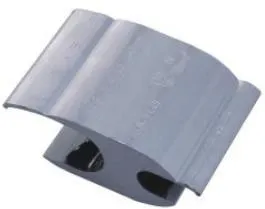
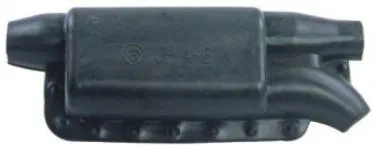
JH Clamp
Models: JH-1 – JH-6 · Main: 16–240 mm² · Branch: 16–240 mm²
Two Ways To Read Every Row
This is the only clamp sheet in the group that prints both the square millimetres and the conductor diameter for each end. That is a help and a warning.
- The mm² column is wider than the diameter column suggests. JH-2 covers 50~95 mm² on the main, but its diameter window is 8.3~14.5 mm. An LGJ-50 is 9.6 mm and an LGJ-95 is 13.6 mm, so the window has room above and below — because it also has to take covered conductor (JKLYJ-50 is 8.3 mm) and all-aluminium LJ, which are all different diameters for the same nominal area.
- So select on the diameter. A conductor that matches the mm² but sits outside the OD window will not fit the die.
Three Clamps, One Body, Two Branches
Read the middle of the table carefully, because two rows look like duplicates and are not:
| Main | Main OD | Branch | Branch OD | L | |
|---|---|---|---|---|---|
| JH-2 | 50~95 | 8.3~14.5 | 16~50 | 4.8~9.5 | 48 |
| JH-3 | 50~95 | 10.0~14.5 | 50~95 | 10.0~14.5 | 60 |
Same main range, overlapping main diameter — different branch. JH-2 taps a small branch off a 50–95 main; JH-3 joins two conductors of similar size. The main OD windows overlap between 10.0 and 14.5 mm, so a 12 mm main conductor can legitimately take either clamp — the branch decides.
The same pattern repeats higher up, and there it is even plainer:
| Main | Branch | L | |
|---|---|---|---|
| JH-4 | 95~240 | 16~70 | 51 |
| JH-5 | 95~240 | 70~150 | 51 |
Identical main range and identical 51 mm length — the same body with a different branch jaw. If you stock one, you stock half of the other.
Length Does Not Follow Size
The six lengths run 38, 48, 60, 51, 51, 89 mm.
JH-4 handles a 95–240 mm² main in 51 mm, while JH-3 handles a 50–95 mm² main in 60 mm. The bigger clamp is the shorter one.
That is not an error — JH-4 and JH-5 are the short wide-body design for tapping a branch, while JH-3 is the longer in-line joint — but it does mean the length column cannot be used to rank the clamps. If a joint has to fit in a fixed recess, read L directly and do not assume the numbers climb.
JH-6 at 89 mm is the outlier: nearly double JH-4 for the same 150–240 mm² class, because it joins two large conductors end to end rather than tapping one.
Die And Crimps Are The Tooling
Die — O, D, D, N, N, N — is the die set, and six clamps need only three dies. That matters for a crew: one tool kit covers the whole range if you carry O, D and N.
The letter does not run in the same order as the model number, and there is no size sequence to it. Take the letter from the table for the clamp you are using; do not infer it.
Crimps — 3, 3, 5, 4, 4, 5 — is the number of die bites. It does not scale with length: JH-2 takes 3 bites on 48 mm and JH-3 takes 5 on 60 mm, while JH-6 takes 5 on 89 mm. The crimp count is part of the joint procedure, so a crew changing from JH-3 to JH-4 does fewer bites on a shorter body, and one that assumes “bigger clamp, more crimps” will under-compress JH-6.
Technical Parameters
| Model | Main Line | Branch Line | Length (mm) | Die | Crimps | ||
|---|---|---|---|---|---|---|---|
| Conductor Range (mm2) | Conductor OD (mm) | Conductor Range (mm2) | Conductor OD (mm) | ||||
| JH-1 | 16~35 | 4.8~8.2 | 16~35 | 4.8~8.2 | 38 | O | 3 |
| JH-2 | 50~95 | 8.3~14.5 | 16~50 | 4.8~9.5 | 48 | D | 3 |
| JH-3 | 50~95 | 10.0~14.5 | 50~95 | 10.0~14.5 | 60 | D | 5 |
| JH-4 | 95~240 | 13.0~22.5 | 16~70 | 4.8~11.5 | 51 | N | 4 |
| JH-5 | 95~240 | 13.0~22.5 | 70~150 | 11.5~16.0 | 51 | N | 4 |
| JH-6 | 150~240 | 16.2~22.5 | 150~240 | 16.2~22.5 | 89 | N | 5 |
Related Pages
Compression T-taps: JYT jumper clamp. Bolted branch clamps: JC clamp, JKG and JKL. Splice sleeves: JT.
Note: Every row prints both mm² and conductor diameter, and the diameter window is wider than the area implies because it covers bare, all-aluminium and covered conductor. JH-2 and JH-3 share a main range with overlapping diameters and differ only in the branch; JH-4 and JH-5 are the same 51 mm body with different branches. Lengths run 38, 48, 60, 51, 51, 89 mm and do not rank by size. Three die sets (O, D, N) cover all six clamps.