BL1 Yoke Plate
Model: BL 1 -12 · Nominal Failure Load: 120 kN · Reference Weight: 9.3 kg · Span: L 400 mm
A Rectangle With a Bolting Pattern
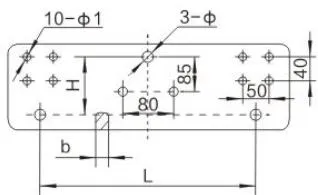
The drawing is a plain rounded rectangle, not the gable of the BL-12. Two eyes sit on the base line at the ends of L, one 3-Φ hole sits on the centre line, and the rest of the plate is taken up by 10-Φ1 holes in two blocks of five.
That count is the thing to notice. On the BL-12 the Φ1 callout means two eyes — the holes the next fitting hangs from. Here it means ten holes, drawn at 40 mm pitch with 50 mm to the end of the plate, and ten Φ1 14 holes in two symmetric blocks is a bolting pattern: the plate is meant to be clamped face to face with something else, most likely the second layer of a pair or a spacer plate.
So BL1 is a rectangle that carries 120 kN and is also a mounting face. If you only need the tension member, you are paying for holes you will not use.
Ten Holes Weigh Less Than Two
The arithmetic inverts: the BL1 has ten Φ1 holes where the BL-12 has two, and the BL1 is the lighter plate by 4.3 kg. Eight extra 14 mm holes in a 16 mm plate remove about 0.2 kg, so the drilling explains none of the gap — the difference is the body.
Back-computing: 9.3 kg on a 16 mm plate is 740 cm² of steel, about 450 × 165 mm once the holes come out. The 95 mm hole spacing plus roughly 25 mm of edge per side gives 145 mm, so the plate stands about 20 mm taller than its own H dimension — consistent with the boss drawn around the centre eye.
Read across to the BL-12 and the 4.3 kg is the body. Same load, same span, same b, same Φ 18 eyes, same Φ1 14 — 13.6 kg against 9.3. At 16 mm plate that gap is 342 cm² of steel, which is the gable standing about 240 mm above the base line against this plate’s 165 mm. Both weights are per plate.
Where It Fits
The BL1 takes the same 400 mm span and the same Φ 18 end pins as the BL-12, so the two are interchangeable on the line hardware side. The difference is the ear: H 95 here against H 70 on the BL-12, which moves the apex eye 25 mm further from the base line and gives the string a little more clearance. On a short yoke where the plate has to clear an insulator shed, 25 mm is the whole reason to pick one over the other.
For the same 120 kN the triangular L-1240 does it at 4.66 kg. If there is no need for the bolting cluster, that is where the weight is.
Technical Parameters
| Model | Main Dimensions (mm) | Nominal Failure Load(kN) | Reference Weight (kg) | ||||
|---|---|---|---|---|---|---|---|
| H | L | b | Ø | Ø1 | |||
| BL 1 -12 | 95 | 400 | 16 | 18 | 14 | 120 | 9.3 |
Related Pages
The gable version of the same rating: BL yoke plate. Heavier rectangular plates with the same idea: BN, BN1, BN2. Lighter alternatives at 120 kN: L type triangular, L double layer, LS trapezoidal.
Note: the ten Φ1 holes are a bolting pattern, not eyes; the working eyes are the two Φ 18 ends on the base line. BL1-12 matches the BL-12 on load, span, plate thickness and end eyes, and weighs 4.3 kg less because its body is 165 mm tall against the BL-12’s 240 mm — per plate, both.