PH Extension Link Integral Forged Ring
Models: PH-7 – PH-30 and PH-0780 – PH-32140 · Nominal Failure Load: 70–320 kN · Reference Weight: 0.4–2.4 kg
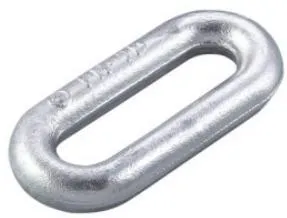
An Oval Link, Forged in One Piece
The part is a single forged oval — no weld, no machined joint. Someone looking for a short extension between two eyes does not need a clevis and a pin; they need this.
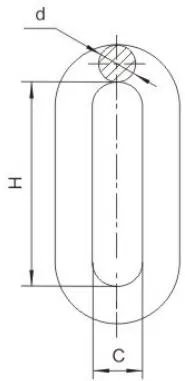
- C — the clear aperture at each end. This is the working dimension: the eye of the neighbouring fitting has to sit inside it.
- d — the stock diameter of the forged body, i.e. the steel that carries the load.
- L — the overall length, eye to eye.
The outside width is roughly C + 2d, so the aperture is not something you can open up later. Match C to the eye thickness of what goes in it: C 20 swallows the 16 mm strap that most of this catalogue uses, C 38 swallows a heavy clevis tongue. A 24 mm tongue will not enter a C 20 ring no matter how the pin is sized.
One Grid, Two Numbering Systems
The table stacks both systems in the same grid. The left column (Universal Design Model) is filled only for the top seven rows; the second column (Model) only for the bottom seven. They are two ways of naming the same product line.
Read across and the two systems agree at the bottom and part company at the top:
| Load | Universal | C / d / L | Weight | Model | C / d / L | Weight |
|---|---|---|---|---|---|---|
| 70 kN | PH-7 | 20 / 16 / 80 | 0.4 kg | PH-0780 | 20 / 16 / 80 | 0.4 kg |
| 100 kN | PH-10 | 22 / 18 / 100 | 0.6 kg | PH-10100 | 22 / 16 / 100 | 0.6 kg |
| 120 kN | PH-12 | 24 / 20 / 120 | 0.9 kg | PH-12120 | 24 / 18 / 120 | 0.8 kg |
| 160 kN | PH-16 | 26 / 22 / 140 | 1.3 kg | PH-16120 | 26 / 20 / 120 | 0.9 kg |
| 210 kN | PH-21 | 30 / 24 / 160 | 1.6 kg | PH-21130 | 26 / 20 / 130 | 1.0 kg |
| 250 kN | PH-25 | 34 / 26 / 160 | 2.0 kg | PH-25120 | 32 / 24 / 120 | 1.3 kg |
The 70 kN row is one part under two names — every cell identical. The 100 and 120 kN rows differ by 2 mm of stock and 0.1 kg, close enough to be the same forging measured twice.
From 160 kN up they are different parts. PH-21 is 60 % heavier than PH-21130 at the same 210 kN, and 30 mm longer; PH-25 is 54 % heavier than PH-25120 and 40 mm longer. The universal series grows the body with the load, the model series does not.
Two rows exist in only one system: PH-30 (300 kN, 3.0 kg) has no model-number twin, and PH-32140 (320 kN, 2.4 kg) has no universal twin.
In One System Length Follows Load, in the Other It Does Not
The universal series is orderly: L runs 80, 100, 120, 140, 160, 160, 180 from 70 kN to 300 kN. Longer link, heavier load.
The model series is not:
| Model | Load | L |
|---|---|---|
| PH-16120 | 160 kN | 120 |
| PH-21130 | 210 kN | 130 |
| PH-25120 | 250 kN | 120 |
| PH-32140 | 320 kN | 140 |
The 250 kN link is shorter than the 210 kN one and exactly as long as the 160 kN one, at two and a half times the weight. The code tells you this if you read it as load + length — that is what the six digits mean — but nothing else on the sheet does.
So: quote the model number as printed, and if the space between two fittings is tight, check L in the table rather than assuming the bigger number is the longer part.
Where These Win
At 0.4 kg for 70 kN this is the lightest way to add 80 mm to a string — the LH turnbuckle that does the same job at 2.7 kg is adjustable and costs six times the steel. Use the PH where the length is fixed and a forged single piece is acceptable; use the LH where the length has to be set on site.
Technical Parameters
| Universal Design Model | Model | Main Dimensions (mm) | Nominal Failure Load(kN) | Reference Weight (kg) | ||
|---|---|---|---|---|---|---|
| C | d | L | ||||
| PH-7 | 20 | 16 | 80 | 70 | 0.4 | |
| PH-10 | 22 | 18 | 100 | 100 | 0.6 | |
| PH-12 | 24 | 20 | 120 | 120 | 0.9 | |
| PH-16 | 26 | 22 | 140 | 160 | 1.3 | |
| PH-21 | 30 | 24 | 160 | 210 | 1.6 | |
| PH-25 | 34 | 26 | 160 | 250 | 2.0 | |
| PH-30 | 38 | 30 | 180 | 300 | 3.0 | |
| PH-0780 | 20 | 16 | 80 | 70 | 0.4 | |
| PH-10100 | 22 | 16 | 100 | 100 | 0.6 | |
| PH-12120 | 24 | 18 | 120 | 120 | 0.8 | |
| PH-16120 | 26 | 20 | 120 | 160 | 0.9 | |
| PH-21130 | 26 | 20 | 130 | 210 | 1.0 | |
| PH-25120 | 32 | 24 | 120 | 250 | 1.3 | |
| PH-32140 | 36 | 28 | 140 | 320 | 2.4 | |
Related Pages
Adjustable links: LH turnbuckle round eye, LH turnbuckle grooved clevis, DT adjustment link. Hardware to go through the aperture: U clevis, Z clevis, Y clevis.
Note: C is the clear aperture and must be larger than the eye thickness of the mating fitting; d is the forged stock, not the pin. The two numbering systems agree at 70 to 120 kN and are different parts from 160 kN up. In the model series the 250 kN link is shorter than the 210 kN one.