MGG2 Tubular Busbar Fixed Support Clamp
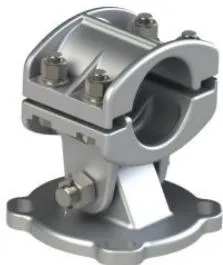
Models: 20 sizes · Reference Weight: 2.1–14.6 kg · Function: fixed support at sliding-clamp height
The Third Option Between Fixed and Sliding
This catalogue has three tubular busbar support clamps, and the difference is easier to see in a table than in the names:
| Busbar 100 mm, D 140 | H | Weight | Grips or slides |
|---|---|---|---|
| MGG | 114 mm | 4.7 kg | fixed |
| MGG2 | 135 mm | 4.9 kg | fixed |
| MGG1 | 135 mm | 5.3 kg | slides |
MGG2 sits at the sliding clamp’s height but does not slide. Same H as MGG1, weight close to MGG.
That combination exists for a specific problem: a run where the supports were designed for sliding clamps, and one position has to be fixed as the anchor point. Rather than pack up a shorter MGG to reach the same level, you drop in an MGG2 — the bus stays level and the clamp holds.
Same Heights as MGG1, Row for Row
Compare the two tables and every H and D matches:
| Model | D | H | MGG2 | MGG1 |
|---|---|---|---|---|
| 50 mm | 140 | 90 | 2.1 kg | 2.5 kg |
| 100 mm | 140 | 135 | 4.9 kg | 5.3 kg |
| 130 mm | 225 | 155 | 9.0 kg | 9.4 kg |
| 200 mm | 250 | 210 | 12.1 kg | 12.5 kg |
| 250 mm | 250 | 220 | 14.6 kg | 15.0 kg |
A consistent 0.4 kg lighter, which is the sliding plate and its guides. Nothing else changes.
So the pair is interchangeable on a drawing: same envelope, same bolt pattern, same foot sizes (140, 225, 250 mm — no 280). Only the function differs.
Bolt Size Follows the Foot
| D | Bolt C | Busbar sizes |
|---|---|---|
| 140 mm | 14 mm | 50 – 130 |
| 225 mm | 18 mm | 100 – 200 |
| 250 mm | 18 mm | 150 – 250 |
Same rule as the other two: the bigger the base plate, the bigger the anchor it takes.
How to Lay Out the Run
The standard arrangement on a tubular bus with an expansion joint at each end:
- One MGG2 or MGG at the centre of the run — the fixed point
- MGG1 sliding clamps either side at every other support
- MGGD expansion clamps at the ends where the travel accumulates
Using MGG2 as the anchor keeps every support at the same height, which is why it is usually the better choice than MGG on a new build. MGG, being 10–25 mm shorter, is for structures where the level is already set.
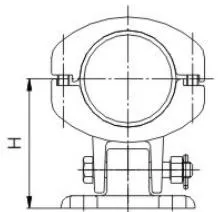
Technical Parameters
| Model | Tubular Busbar O.D. (mm) | Main Dimensions (mm) | Reference Weight (kg) | |||
|---|---|---|---|---|---|---|
| Ø | D | H | C | |||
| MGG2-50 | 50 | 50 | 140 | 90 | 14 | 2.1 |
| MGG2-60 | 60 | 60 | 140 | 100 | 14 | 2.5 |
| MGG2-70 | 70 | 70 | 140 | 115 | 14 | 3.2 |
| MGG2-80 | 80 | 80 | 140 | 120 | 14 | 3.5 |
| MGG2-90 | 90 | 90 | 140 | 125 | 14 | 4.7 |
| MGG2-100 | 100 | 100 | 140 | 135 | 14 | 4.9 |
| MGG2-110 | 110 | 110 | 140 | 145 | 14 | 5.5 |
| MGG2-120 | 120 | 120 | 140 | 145 | 14 | 5.8 |
| MGG2-130 | 130 | 130 | 140 | 155 | 14 | 8.2 |
| MGG2-100(225) | 100 | 100 | 225 | 135 | 18 | 5.8 |
| MGG2-110(225) | 110 | 110 | 225 | 145 | 18 | 6.5 |
| MGG2-120(225) | 120 | 120 | 225 | 145 | 18 | 7.0 |
| MGG2-130(225) | 130 | 130 | 225 | 155 | 18 | 9.0 |
| MGG2-150(225) | 150 | 150 | 225 | 160 | 18 | 9.4 |
| MGG2-170(225) | 170 | 170 | 225 | 180 | 18 | 9.8 |
| MGG2-200(225) | 200 | 200 | 225 | 210 | 18 | 10.5 |
| MGG2-150(250) | 150 | 150 | 250 | 160 | 18 | 10.4 |
| MGG2-170(250) | 170 | 170 | 250 | 180 | 18 | 10.8 |
| MGG2-200(250) | 200 | 200 | 250 | 210 | 18 | 12.1 |
| MGG2-250(250) | 250 | 250 | 250 | 220 | 18 | 14.6 |
Related Clamps
Sliding version at the same height: MGG1 sliding support clamp. Shorter fixed body: MGG fixed support clamp. Taller Z-frame: MGG-Z fixed clamp. Expansion joints: MGGD expansion clamp.
Note: MGG2 and MGG1 share every dimension — the difference is 0.4 kg and the sliding plate. State foot size D with the busbar OD.