MGSS Tubular Busbar Expansion Joint
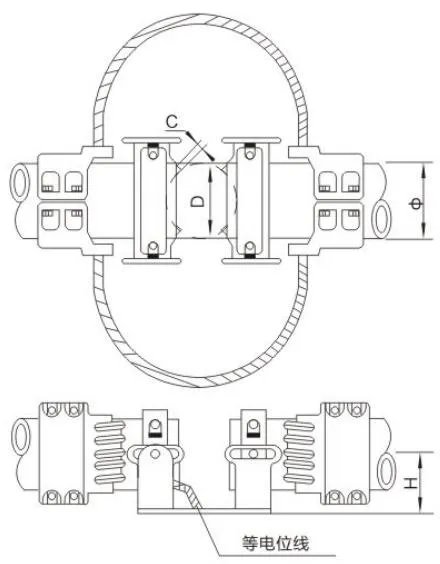
Models: 17 sizes · Reference Weight: 96.0–97.0 kg at the largest size, others not published
The Same Frame as MGG-Z
The foot sizes, the heights and the anchor bolts are identical to the MGG-Z fixed clamp, row for row: feet of 140, 225, 250 and 254 mm, H from 120 mm at 100 mm bore to 200 mm at 250 mm, bolt C 14 mm on the small foot and 18 mm above.
So the expansion element sits on a frame you can already design around. If a run is built on MGG-Z and needs an expansion point, this drops into the same footprint and the same level. What it adds is the sliding element inside — which is why it weighs what it weighs.
One Body, Two Letters, One Extra Row
The joint is catalogued as A and B. Every foot, height and bolt figure on the shared rows is identical, and the difference is a single size:
- 250 mm bore on the 225 mm foot exists only as B —
MGSS-250B(225) - On the A body a 250 mm bus is only carried on the 254 mm foot
So the letter is decided by which foot your 250 mm bus sits on — 225 mm, and it has to be B; 254 mm, and either body will do. Nothing else differs.
At the 254 mm foot the two print 97.0 kg (A) and 96.0 kg (B): same bore, same foot, same H, same bolt, one kilogram apart. One kilogram in 97 is what you would expect from two castings of the same envelope, so treat the two as one part and order the letter your drawing specifies.
One Weight in the Whole Table
The weight column is empty on fifteen of the seventeen rows. Only the 250 mm bore on the 254 mm foot carries a figure: 97.0 kg (A) / 96.0 kg (B).
Put that against the frame alone:
| Weight | |
|---|---|
| MGG-Z, 250Z(254) | 36.0 kg |
| MGSS, 250(254) | 96.0–97.0 kg |
| Expansion element | about 60 kg |
A 250 mm expansion joint carries roughly 60 kg of sliding element. That is the number for the structural load at that support, and it is inferred from the one published row — get the figure from us for the size you are actually buying, especially before a lifting plan. Do not scale it down: the element does not shrink linearly with bore.
Where the Sizes Stop
The range starts at 100 mm — there is no 50 to 90 mm version, the same as the Z frame it is built on. Note that MGG-Z’s 254 mm foot is 4 mm more than the 250, not a rounded figure; if your steel is set for a 250 mm plate, the 250 mm rows are the ones you want.
Technical Parameters
| Model | Tubular Busbar O.D. (mm) | Main Dimensions (mm) | Reference Weight (kg) | |||
|---|---|---|---|---|---|---|
| Ø | D | H | C | |||
| MGSS-100A(B)(140) | 100 | 100 | 140 | 120 | 14 | |
| MGSS-110A(B)(140) | 110 | 110 | 140 | 125 | 14 | |
| MGSS-120A(B)(140) | 120 | 120 | 140 | 130 | 14 | |
| MGSS-130A(B)(140) | 130 | 130 | 140 | 140 | 14 | |
| MGSS-100A(B)(225) | 100 | 100 | 225 | 120 | 18 | |
| MGSS-110A(B)(225) | 110 | 110 | 225 | 125 | 18 | |
| MGSS-120A(B)(225) | 120 | 120 | 225 | 130 | 18 | |
| MGSS-130A(B)(225) | 130 | 130 | 225 | 140 | 18 | |
| MGSS-150A(B)(225) | 150 | 150 | 225 | 145 | 18 | |
| MGSS-170A(B)(225) | 170 | 170 | 225 | 165 | 18 | |
| MGSS-200A(B)(225) | 200 | 200 | 225 | 175 | 18 | |
| MGSS-250B(225) | 250 | 250 | 225 | 200 | 18 | |
| MGSS-150A(B)(250) | 150 | 150 | 250 | 145 | 18 | |
| MGSS-170A(B)(250) | 170 | 170 | 250 | 165 | 18 | |
| MGSS-200A(B)(250) | 200 | 200 | 250 | 175 | 18 | |
| MGSS-250A(254) | 250 | 250 | 254 | 200 | 18 | 97.0 |
| MGSS-250B(254) | 250 | 250 | 254 | 200 | 18 | 96.0 |
Related Pages
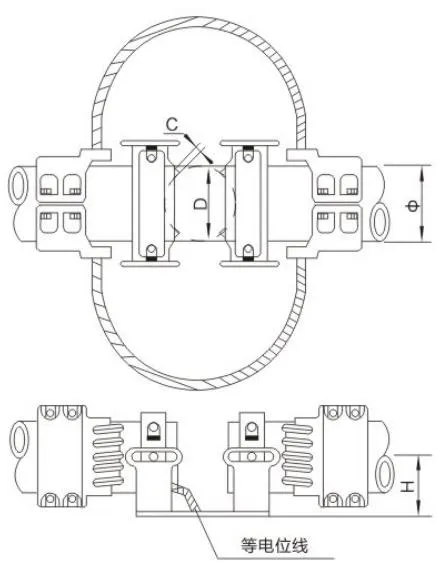
The frame without the expansion element: MGG-Z. Expansion joint on a standard foot: MGS expansion joint. Support-type clamps: MSZD, MSZS. Terminal clamp with expansion: MDS / MDSG.
Note: Dimensions are MGG-Z’s frame row for row. The A and B bodies differ by one row — the 250 mm bore on the 225 mm foot, which only B has. One published weight, 96.0–97.0 kg at 250(254); everything else is weighed to order.