NX Aluminum Alloy Energy-Saving Wedge Type Non Adjustable
Models: NX-1 – NX-3 · Conductor: 6.6–14 mm OD · Failure Load: 45–143 kN
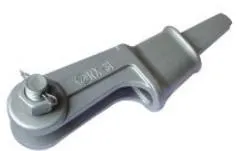
The Compact Wedge, Not The Long Tension Clamp
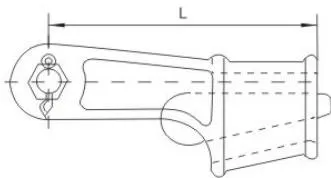
NX is a wedge clamp: a tapered body with a captive wedge that bites the conductor as tension pulls it in. It is a different animal from the NUT and UT tension clamps, and the dimensions show it — L is 150 to 195 mm against 210 to 290 mm on the fixed UT, and there is no L1 take-up column at all.
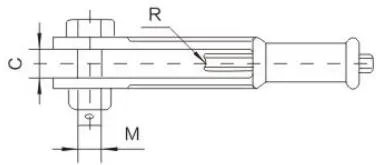
What it does have is R — 6.0, 7.3 and 8.0 mm. That is a small radius, an order of magnitude below any body length, and it is the only transverse dimension printed. R is what decides whether the wedge seats on the conductor rather than marking it.
Every Dimension Matches The Standard NX Sheet
Line this table up against the NX standard wedge sheet and the first three rows are identical in every column:
| C | M | L | R | Load | |
|---|---|---|---|---|---|
| NX-1 | 18 | 16 | 150 | 6.0 | 45 kN |
| NX-2 | 20 | 18 | 180 | 7.3 | 88 kN |
| NX-3 | 25 | 24 | 195 | 8.0 | 143 kN |
Same casting, same bolt, same rating. The only difference on the page is the weight:
| Model | This sheet | Standard NX |
|---|---|---|
| NX-1 | 0.45 kg | 1.19 kg |
| NX-2 | 0.78 kg | 1.76 kg |
| NX-3 | 1.55 kg | 3.20 kg |
The standard sheet is 2.1 to 2.6 times heavier for a part it dimensions identically.
That cannot be a scale factor and it cannot be material substitution within the same casting — a clamp with the same C, M, L and R is the same envelope, and no aluminium alloy is 2.6 times denser than another. The two pages weigh different things: this one the bare body, the other the complete assembly with its pads and bolts. Quote the figure that matches what ships, and the offer says which is which.
Choose between this page and the standard NX sheet on dimensions and rating, which are identical, not on weight. The two columns measure different things; tell us which sheet your schedule quotes and we freight from that one.
The Energy-Saving Label Is On Both
Both sheets are titled “energy-saving” in the body text of the group, and both carry the same 45, 88 and 143 kN. The label does not distinguish them.
What might is the Material & Manufacturing block, which appears on the standard sheet and not on this one. That block names a reinforced nylon wedge core and a hot-dip galvanised finish — and a nylon core is a plausible reason for a lower weight in one variant and a higher one in another, since a metal wedge is replaced.
But this page does not claim a nylon core, and the standard page does not claim to be heavier because of it. So the explanation is a hypothesis, not catalogue data. Confirm the construction with us if the difference matters.
The Same Bands, The Same Gaps
6.67.8, 9.011.0, 13.0~14.0 mm at 45, 88 and 143 kN — identical to the NUT and UT families.
Two gaps follow, and they are family-wide rather than specific to NX: no clamp covers 7.8 to 9.0 mm or 11.0 to 13.0 mm. A 12 mm conductor has no fitting in any of these four sheets.
One small dimensional difference is worth knowing: NX-3 uses an M24 bolt where NUT-3 and UT-3 use M22. If a bracket is drilled for the tension clamps, the wedge clamp needs 2 mm more.
Technical Parameters
| Model | Applicable Conductor Dia.(mm) | Main Dimensions(mm) | Nominal Failure Load(kN) | Reference Weight(kg) | |||
|---|---|---|---|---|---|---|---|
| C | M | L | R | ||||
| NX-1 (Energy-saving) | 6.6~7.8 | 18 | 16 | 150 | 6.0 | 45 | 0.45 |
| NX-2 (Energy-saving) | 9.0~11.0 | 20 | 18 | 180 | 7.3 | 88 | 0.78 |
| NX-3 (Energy-saving) | 13.0~14.0 | 25 | 24 | 195 | 8.0 | 143 | 1.55 |
Related Pages
The standard NX sheet — same three rows, 2.3 to 2.6 times the weight: NX wedge type clamp. Tension clamps on the same conductor bands: UT, NU, NUT.
Note: A compact wedge clamp with no take-up column; R (6 to 8 mm) is the only transverse dimension. All three rows match the standard NX sheet exactly in C, M, L, R and rating, but weigh 0.45 / 0.78 / 1.55 kg against 1.19 / 1.76 / 3.20 — a factor of two to two and a half that no casting can explain. NX-3 takes M24 where the tension clamps take M22. Same conductor bands and the same 7.8–9.0 and 11.0–13.0 mm gaps.