NX Wedge Type Non Adjustable
Models: NX-1 – NX-4 · Conductor: 6.6–16 mm OD · Failure Load: 45–164 kN · Weight: 1.19–4.60 kg
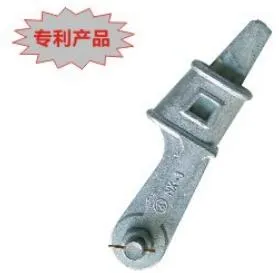
What A Wedge Clamp Does That A Tension Clamp Does Not
The wedge body is tapered. Tension on the conductor drags the wedge into the taper, so the grip rises with the pull instead of relying on a bolt torque staying put. There is no take-up column on this sheet at all — no L1 — which means it is a fixed dead-end, not an adjusting clamp. If the sag has to be trimmed on site, this is the wrong family; use the NUT or UT clamp, which carry 200 to 350 mm of travel.
The body is short for the same reason: L is 150 to 220 mm against 210 to 350 mm on the tension clamps. A wedge does its work in a short cone.
Load Per Kilogram Peaks In The Middle
This is the number worth costing against:
| Model | L (mm) | Failure load | Weight | kN per kg |
|---|---|---|---|---|
| NX-1 | 150 | 45 kN | 1.19 kg | 37.8 |
| NX-2 | 180 | 88 kN | 1.76 kg | 50.0 |
| NX-3 | 195 | 143 kN | 3.20 kg | 44.7 |
| NX-4 | 220 | 164 kN | 4.60 kg | 35.7 |
NX-2 is the efficient one. From NX-3 to NX-4 the rating gains 21 kN — 15 per cent — while the weight gains 1.40 kg, 44 per cent. If a line is over-specified at 164 kN where 143 kN would pass, the fourth size costs the most per kilonewton in the range.
The weight also does not follow L. The steps are +0.57, +1.44, +1.40 kg while L steps +30, +15, +25 mm. Going from NX-1 to NX-2 buys 30 mm of body and 43 kN; NX-2 to NX-3 buys 15 mm and 55 kN for 1.44 kg. That is not one casting scaled three ways — the middle step is a different proportion, and C (18, 20, 25, 30 mm) grows 67 per cent across the four rows while the weight grows nearly four times.
R Stops Tracking The Conductor
R runs 6.0, 7.3, 8.0, 8.0 mm — the only transverse dimension the sheet prints, to one decimal place. Between NX-3 and NX-4 the conductor band moves up a whole millimetre (13.0–14.0 to 15.0–16.0) and R does not move at all.
Whatever R measures on the casting, it is the one column that stops following the conductor. Do not select a size by interpolating R, and do not assume the NX-4 seat is proportioned like the NX-3 seat — the diameters say it is not.
Bolt sizes are M16, M18, M24 and M27. NX-3 and NX-4 are the two that catch people out: the tension clamps of the same conductor band take M22, so a bracket drilled for a UT-3 will not pass an NX-3 wedge.
Three Bands Have No Clamp
The sheet covers 6.67.8, 9.011.0, 13.014.0 and 15.016.0 mm. That leaves three dead bands:
- 7.8 – 9.0 mm (1.2 mm wide)
- 11.0 – 13.0 mm (2.0 mm wide)
- 14.0 – 15.0 mm (1.0 mm wide)
A 12 mm conductor has no clamp on this sheet, and none on the NUT or UT sheets either — the four families all print the same four bands. A 14.5 mm conductor is in the same position. The 14.0–15.0 gap is the newest of the three: it exists because NX-4 starts at 15.0 rather than 14.0.
If the line uses one of those diameters, the answer is a different family, not a bigger wedge. Ask us before assuming NX-2 will close onto 9 mm.
The Same Casting Is Priced Twice On This Site
The energy-saving NX sheet prints C, M, L and R identical to the first three rows here — same 18/16/150/6.0, 20/18/180/7.3, 25/24/195/8.0, same 45, 88 and 143 kN — but weighs 0.45, 0.78 and 1.55 kg against 1.19, 1.76 and 3.20 kg here. Ratios of 2.6, 2.3 and 2.1.
Two sheets, one envelope, a factor of two in mass. No aluminium alloy is twice as dense as another, so the two columns are not weighing the same article. That block below names a reinforced nylon wedge core, which would explain a lighter variant, but this page does not say which of its own parts is nylon. Match the dimensions and the rating — they agree — and ask us which article each weight belongs to before you freight either.
Finish, Tolerance, Documentation
- Body: high-strength cast aluminium alloy; secondary components include a reinforced nylon wedge core
- Galvanising: hot-dip to ISO 1461 / ASTM A153 / IEC 61284, minimum 65 μm coating
- Tolerance: ±0.5 mm on mounting interfaces, coating measured to ISO 2178
- Records: material test certificates issued on request
The process line reads “precision forging, casting, or CNC machining” — three routes to the same body, and this clamp is precision forged, which is what gives the wedge its taper without a machined step. Where the project specifies the process, it goes on the certificate with the delivery.
Technical Parameters
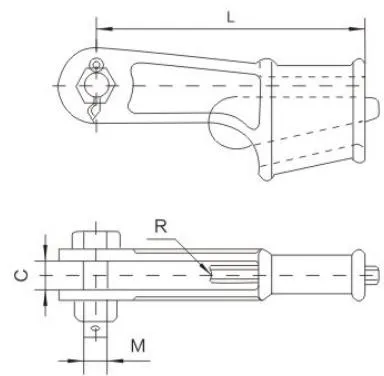
| Model | Applicable Conductor Dia.(mm) | Main Dimensions(mm) | Nominal Failure Load(kN) | Reference Weight(kg) | |||
|---|---|---|---|---|---|---|---|
| C | M | L | R | ||||
| NX-1 | 6.6~7.8 | 18 | 16 | 150 | 6.0 | 45 | 1.19 |
| NX-2 | 9.0~11.0 | 20 | 18 | 180 | 7.3 | 88 | 1.76 |
| NX-3 | 13.0~14.0 | 25 | 24 | 195 | 8.0 | 143 | 3.20 |
| NX-4 | 15.0~16.0 | 30 | 27 | 220 | 8.0 | 164 | 4.60 |
Related Pages
The compact wedge variant with the same three dimensions at less than half the weight: NX energy-saving wedge clamp. Clamps with take-up travel on the same conductor bands: NUT adjustable, UT fixed, NU fixed, UT adjustable.
Note: A fixed dead-end wedge clamp with no take-up column; L is 150 to 220 mm. Load per kilogram peaks at NX-2 (50.0 kN/kg) and falls to 35.7 at NX-4, where the rating gains 15 per cent for 44 per cent more weight. R plateaus at 8.0 mm from NX-3 on. Bolt sizes M16/M18/M24/M27 — M24 and M27 where the tension clamps use M22. Bands 6.6–7.8, 9.0–11.0, 13.0–14.0 and 15.0–16.0 leave 7.8–9.0, 11.0–13.0 and 14.0–15.0 mm unserved across the whole family. The energy-saving NX sheet dimensions all of this identically at 0.45/0.78/1.55 kg.