NXJG Wedge Insulated Strain Clamp for JKLYJ Cable
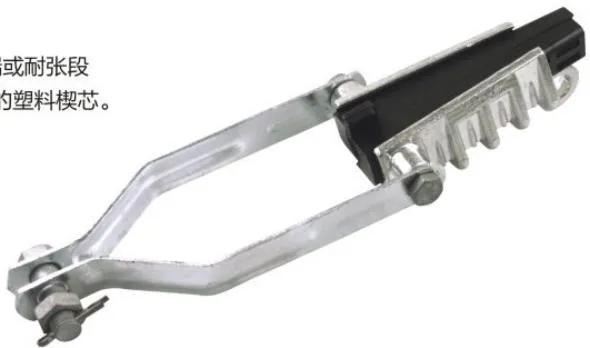
The NXJG terminates JKLYJ aluminum-core overhead insulated cable at 10 kV and below. It hangs from a clevis at the end of the insulator string, takes the cable without stripping a millimetre of insulation, and closes with a reinforced nylon wedge core that both grips and insulates. Four body sizes cover 35 to 240 mm², supplied as two separate model sets — one for 1 kV cable, one for 10 kV — because the insulation thickness changes everything about the fit.
Technical Parameters
1 kV — JKLYJ-1
| Universal Design Model | Applicable Wire (mm2) | Overhead Insulated Aluminum Wire/1kV | Grip Force (kN) | Nominal Failure Load (kN) | |
|---|---|---|---|---|---|
| Wire Outer Diameter (mm) | Selected Wedge Core | ||||
| NXJG-1 (1kV) | 35 | 9.8 | 1kV/35 | 3.4 | 7.5 |
| 50 | 11.2 | 1kV/50 | 4.6 | ||
| NXJG-2 (1kV) | 70 | 12.8 | 1kV/70 | 6.7 | 14.5 |
| 95 | 14.8 | 1kV/95 | 8.9 | ||
| NXJG-3 (1kV) | 120 | 16.2 | 1kV/120 | 11.3 | 22.0 |
| 150 | 18.2 | 1kV/150 | 13.7 | ||
| NXJG-4 (1kV) | 185 | 20.2 | 1kV/185 | 17.3 | 36.4 |
| 240 | 22.6 | 1kV/240 | 22.5 | ||
Note: Body cast in high-strength aluminum alloy with no magnetic hysteresis loss. Wedge core in high-strength reinforced nylon for insulation performance. The cable goes in without stripping and the wedge structure keeps installation simple. Clamp and fitting connect through a ring joint.
10 kV — JKLYJ-10
| Universal Design Model | Applicable Wire (mm2) | Overhead Insulated Aluminum Wire/10kV | Grip Force (kN) | Nominal Failure Load (kN) | |
|---|---|---|---|---|---|
| Wire Outer Diameter (mm) | Selected Wedge Core | ||||
| NXJG-1 (10kV) | 35 | 15.8 | 10kV/35 | 3.4 | 7.5 |
| 50 | 17.1 | 10kV/50 | 4.6 | ||
| NXJG-2 (10kV) | 70 | 18.8 | 10kV/70 | 6.7 | 14.5 |
| 95 | 20.4 | 10kV/95 | 8.9 | ||
| NXJG-3 (10kV) | 120 | 21.8 | 10kV/120 | 11.3 | 22.0 |
| 150 | 23.4 | 10kV/150 | 13.7 | ||
| NXJG-4 (10kV) | 185 | 25.0 | 10kV/185 | 17.3 | 36.4 |
| 240 | 27.2 | 10kV/240 | 22.5 | ||
Note: Dimensions may vary slightly with manufacturing tolerance. Contact our engineering team for custom sizes.
Same Body, Two Voltage Classes
Read the two tables side by side and the diameter gap is the whole story:
| Conductor (mm²) | 1 kV O.D. (mm) | 10 kV O.D. (mm) | Difference (mm) |
|---|---|---|---|
| 35 | 9.8 | 15.8 | +6.0 |
| 50 | 11.2 | 17.1 | +5.9 |
| 70 | 12.8 | 18.8 | +6.0 |
| 95 | 14.8 | 20.4 | +5.6 |
| 120 | 16.2 | 21.8 | +5.6 |
| 150 | 18.2 | 23.4 | +5.2 |
| 185 | 20.2 | 25.0 | +4.8 |
| 240 | 22.6 | 27.2 | +4.6 |
The 10 kV cable is 4.6 to 6.0 mm fatter on the same conductor, and the gap closes as the conductor grows. That is why the ordering code has to carry the voltage class explicitly: NXJG-2 (1 kV) and NXJG-2 (10 kV) are the same casting, but they take different nylon cores — 1kV/70 against 10kV/70 — and only one of them will grip a 70 mm² cable correctly on your line.
The core code names both variables. Every core is stamped voltage class first, conductor section second, so 10kV/95 is unmistakable at the pole. Stocking by core rather than by body is how you keep a two-voltage inventory straight with four castings on the shelf.
Grip strength steps by pair, rated load steps by four. Grip runs 3.4, 4.6, 6.7, 8.9, 11.3, 13.7, 17.3 and 22.5 kN up the eight conductor sizes, but the rated failure load moves only at every second size: 7.5 kN covers 35 and 50 mm², 14.5 kN covers 70 and 95, 22.0 kN covers 120 and 150, 36.4 kN covers 185 and 240. If a line is designed at 22 kN, both 120 and 150 mm² are inside the same clamp class — no need to jump a body.
What Makes It an Insulated Clamp
The nylon core is the part that earns the name. It is a high-strength reinforced nylon moulding, not aluminium, so it does not short the insulation it is pressing against, and it does not need a separate insulation cover after installation the way a bare wedge clamp does.
The clamp-to-fitting joint is a ring connection: the clevis eye takes the insulator pin directly and the load path stays closed through a full circle rather than an open hook. On a dead-end that is the difference between a fitting that walks under vibration and one that does not.
Cable prep, then, is the only thing left to get wrong: square-cut the end, keep it dry, and check the diameter over the insulation against the table before you pick the core. On 10 kV cable a 240 mm² conductor measures 27.2 mm over the insulation — a full 4.6 mm more than the 1 kV version of the same conductor, which is more than enough to seat the wrong core.
Material and Finish
- Body: high-strength cast aluminum alloy, no magnetic hysteresis loss
- Wedge core: high-strength reinforced nylon, insulating
- Hardware: hot-dip galvanized steel
- Galvanizing: ISO 1461 / ASTM A153 / IEC 61284, minimum coating 65 μm
- Tolerance: ±0.5 mm on the wedge seat and clevis
- Inspection: dimensional check, coating thickness to ISO 2178, grip test on samples; mill test certificates on request
The Other Three Wedge Clamps
If one part number covering both voltage classes suits your stores better, the NXJG-C universal design lists 1 kV and 10 kV side by side on a single code. For the tie-rod pattern instead of a clevis, see the NXJL wedge clamp. On steel-cored JKLGYJ rather than aluminum JKLYJ, the NXG clevis clamp is the one cut for that cable.