NLD-J Aluminium Alloy Bolted Strain Clamp
Models: NLD-1J – NLD-4J (4 sizes) · Conductor: 8.0–24.0 mm OD · Rated Failure Load: 40–90 kN · Weight: 0.70–3.00 kg
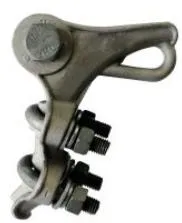
NLD-J is the aluminium alloy bolted dead-end: no press, a keeper over the conductor, U-bolts through the body. Same idea as the iron NLD, same four grip ratings, and roughly half the mass.
The J is the one to remember. NLD-1 and NLD-1J are different clamps with different bodies, different U-bolts and different conductor ranges — not two editions of one part.
Two bolted clamps, side by side
This is the comparison that decides the order, and every row of it comes off the two factory sheets:
| NLD (iron) | NLD-J (alloy) | |
|---|---|---|
| Conductor range | 5.0–23.0 mm | 8.0–24.0 mm |
| Sizes | 4 | 4 |
| Grip rating | 40 / 40 / 70 / 90 kN | 40 / 40 / 70 / 90 kN |
| R | 6.5 / 8 / 11 / 12.5 | 6.5 / 8 / 11 / 12.5 |
| U-bolts | 2, 3, 4, 5 | 2, 2, 3, 3 |
| U-bolt diameter | Ø12, Ø12, Ø16, Ø16 | Ø12, Ø12, Ø14, Ø14 |
| Overall length L1 | 150–410 mm | 122–230 mm |
| Weight | 1.24–6.53 kg | 0.70–3.00 kg |
| Body | malleable cast iron | aluminium alloy |
Identical ratings, identical groove radii, half the weight — and fewer, smaller bolts doing the same work. On the largest size the iron clamp needs five Ø16 U-bolts where the alloy needs three Ø14.
What the alloy gives up
- It starts at 8 mm, not 5. There is no alloy clamp for a 6 mm service drop. If that is the conductor, it is the iron NLD.
- Soft metal under a bolted joint. Aluminium creeps, so the torque has to be re-checked after the string is loaded. Iron does not have that problem, which is why the iron version survives on sites where nobody comes back.
- Galvanic contact at the U-bolts. The bolts are galvanised steel and the body is alloy; the interface is small and the zinc is the sacrificial part, but on a coastal line it is a maintenance item.
What it does not give up is strength. Both families are rated 40 kN at the small end and 90 kN at the large, because the rating is set by the conductor and the groove, not by the body material.
Where the bands sit
| Model | Conductor OD | U-bolts | L1 | Weight |
|---|---|---|---|---|
| NLD-1J | 8.0–12.0 mm | 2 × Ø12 | 122 mm | 0.70 kg |
| NLD-2J | 11.0–16.0 mm | 2 × Ø12 | 135 mm | 0.77 kg |
| NLD-3J | 15.0–20.0 mm | 3 × Ø14 | 200 mm | 1.72 kg |
| NLD-4J | 19.0–24.0 mm | 3 × Ø14 | 230 mm | 3.00 kg |
The bands overlap by a millimetre or two on purpose: a 15.5 mm conductor fits NLD-2J and NLD-3J both, and the choice comes down to whether the extra bolt and the longer body are wanted. Below 12 mm there is one clamp, and above 20 mm there is one.
The factory sheet rates the family for 220 kV and below, on aluminium stranded conductor and ACSR.
Technical parameters
| Model | Applicable Conductor Diameter (Including Wrapping) (mm) | Main Dimensions (mm) | U-Bolt | Nominal Failure Load (kN) | Reference Weight (kg) | |||||
|---|---|---|---|---|---|---|---|---|---|---|
| M | C | L1 | L2 | R | Qty | Dia. | ||||
| NLD-1J | 8.0~12.0 | 16 | 18 | 122 | 100 | 6.5 | 2 | 12 | 40 | 0.70 |
| NLD-2J | 11.0~16.0 | 16 | 19 | 135 | 115 | 8.0 | 2 | 12 | 40 | 0.77 |
| NLD-3J | 15.0~20.0 | 16 | 26 | 200 | 145 | 11.0 | 3 | 14 | 70 | 1.72 |
| NLD-4J | 19.0~24.0 | 18 | 29 | 230 | 155 | 12.5 | 3 | 14 | 90 | 3.00 |
All dimensions in millimetres. M is the body width, C the keeper width, L1 the overall length, L2 the eye-to-first-bolt distance. R is the groove radius and it matches the iron NLD exactly at all four sizes.
Fitting it
- Strip insulation first if there is any. This is a bare-conductor clamp; an insulated conductor goes in with the insulation removed and a cover over the joint.
- Seat the conductor fully in the groove before the keeper. The alloy is softer than iron and a trapped edge will notch the conductor.
- Two passes on the torque, cross pattern, then re-check after tensioning — aluminium relaxes.
- Three bolts on the large sizes is enough. Do not add a fourth to “make it safe”; the body is not drilled for one.
- Do not mix NLD and NLD-J parts. Different keeper, different bolt spacing, different groove.
Related
- NLD — the malleable iron version, 5 mm and up, heavier and stiffer.
- NLL — alloy bolted clamp for smaller conductor and lighter loads.
- NEL — wedge type, one bolt, faster to fit.
- NY — compression dead-end when a press is available.
Note: Quote by conductor outside diameter including wrapping, and say iron or alloy. Same rating, different mass, different bolt count — and the two are not interchangeable on an existing string.