NLD Bolted Strain Clamp
Models: NLD-1 – NLD-4 (4 sizes) · Conductor: 5.0–23.0 mm OD · Rated Failure Load: 40–90 kN · Weight: 1.24–6.53 kg
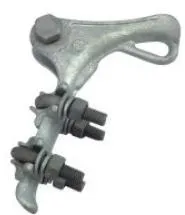
NLD is the dead-end you can fit with a spanner. No press, no dies, no crimp length to get wrong: the conductor sits in a groove, a keeper goes over it, and U-bolts clamp the two together. On rural distribution, on repair work, and anywhere the press cannot go, that is worth more than a lighter fitting.
The body and the keeper are malleable cast iron, the cotter pin is stainless, and everything else is steel, hot-dip galvanised. Iron rather than aluminium because a bolted joint works the metal as the load cycles, and cast iron takes that.
The range starts at 5 mm
NLD-1 takes 5.0 to 10.0 mm conductor, which is smaller than any of the aluminium alloy bolted clamps. On service drops and small ABC work that matters: there is an NLD for a 6 mm conductor, and there is no NLD-J.
The four bands are contiguous and slightly overlapped:
| Model | Conductor OD | U-bolts | L1 | Weight |
|---|---|---|---|---|
| NLD-1 | 5.0–10.0 mm | 2 × Ø12 | 150 mm | 1.24 kg |
| NLD-2 | 10.1–14.0 mm | 3 × Ø12 | 205 mm | 1.90 kg |
| NLD-3 | 14.1–18.0 mm | 4 × Ø16 | 310 mm | 4.24 kg |
| NLD-4 | 18.1–23.0 mm | 5 × Ø16 | 410 mm | 6.53 kg |
Note the jump from NLD-2 to NLD-3: the U-bolt goes from Ø12 to Ø16, the count from 3 to 4, and the mass more than doubles. If your conductor is 14.5 mm, you are buying the big clamp, not the small one with an extra bolt.
Iron, and what it costs
The same four conductor bands are covered by the alloy NLD-J at 43 to 54 percent less weight: 0.70 kg against 1.24 at the small end, 3.00 against 6.53 at the large. Both are rated 40, 40, 70 and 90 kN, and both use the same R.
So the choice is not about strength. It is about three things:
- Galvanic pair. An aluminium body on an aluminium conductor is one metal; a cast iron body is not. On the coast, and on any line where the clamp will sit wet, iron needs the joint compound and the inspection interval that aluminium does not.
- Creep. Iron is stiffer and does not relax under a bolted joint the way aluminium does, so an iron clamp holds its torque longer on a soft aluminium conductor.
- Mass. On a 23 mm conductor the iron clamp is 3.5 kg heavier. Six per tower, and the tower steel notices.
Technical parameters
| Model | Applicable Conductor Diameter (Including Wrapping) (mm) | Main Dimensions (mm) | U-Bolt | Nominal Failure Load (kN) | Reference Weight (kg) | |||||
|---|---|---|---|---|---|---|---|---|---|---|
| M | C | L1 | L2 | R | Qty | Dia. | ||||
| NLD-1 | 5.0~10.0 | 16 | 18 | 150 | 120 | 6.5 | 2 | 12 | 40 | 1.24 |
| NLD-2 | 10.1~14.0 | 16 | 18 | 205 | 130 | 8.0 | 3 | 12 | 40 | 1.90 |
| NLD-3 | 14.1~18.0 | 18 | 22 | 310 | 160 | 11.0 | 4 | 16 | 70 | 4.24 |
| NLD-4 | 18.1~23.0 | 18 | 25 | 410 | 220 | 12.5 | 5 | 16 | 90 | 6.53 |
All dimensions in millimetres. M is the clamp body width, C the keeper width, L1 the overall length and L2 the distance from the eye to the first U-bolt — the number that decides whether the jumper or the next fitting fouls the bolts.
Fitting it
- Seat the conductor in the groove before the keeper goes on. A conductor trapped under the keeper edge is cut through in a season.
- Torque in a cross pattern, and go round twice: the first pass seats the keeper, the second loads the joint.
- Re-torque after the string is tensioned, not before. A bolted dead-end settles under load, and the settlement shows up as a slack U-bolt.
- Do not re-use U-bolts. They are galvanised steel and they take a set.
- No press, no dies, no crimp length. This is the fitting you send when the site has no hydraulic set — and it is why the model range runs so far below the compression clamps.
Related
- NLD-J — the aluminium alloy version, same grip, half the weight, 8 mm and up.
- NLL — the lighter duty bolted clamp for smaller conductor.
- NEL — wedge type, faster to fit, for insulated cable.
- NY — compression dead-end with a jumper tail.
Note: Quote by conductor outside diameter, including any wrapping. Malleable iron body and keeper, stainless cotter, galvanised steel hardware.