JYD Strain Clamp for ACSR, Lap Type
Models: JYD-50/8 – JYD-800/70 (44 sizes) · Conductor: LGJ 50–800 mm² · Grip: 16.1–196.7 kN · Weight: 0.43–3.59 kg
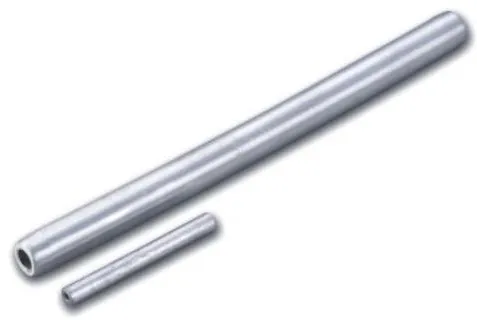
JYD is the short compression dead-end for ACSR. Same conductor range as JY, same grip, same two-tube construction — and 20 to 220 mm less of it.
The overlap in the name is the reason, and the numbers show it plainly once you know where to look.
The steel sleeve is bored to twice the core
Compare the two families on the steel tube, which is the part that holds the line up:
| JY | JYD | |
|---|---|---|
| Steel tube length, L1 | 100–310 mm | 70–130 mm |
| Steel tube bore, d1 | 3.6–13.7 mm | 6.5–18.0 mm |
| Smallest anchor die, D1 | 12 mm | 14 mm |
On JY the bore is the core diameter plus a few tenths of a millimetre — a close sliding fit, crimped once over a long length. On JYD the bore is nearly twice the core diameter and the tube is less than half as long. That is not a shorter version of the same anchor: a bore that size takes the core doubled back on itself, and the load is held over a folded length inside a short sleeve.
Two consequences follow, and both are on the sheet:
- The aluminium tube has to be fatter, because the steel sleeve sits inside its tail rather than behind it. D runs 2 to 6 mm larger than JY at every shared size — 30 mm against 26 at 50 mm², 32 against 26 at 95, closing to nothing by 400 mm².
- JYD stops at 800/70. The three sizes it does not make — 400/95, 630/80 and 800/100 — are exactly the three heaviest steel cores in the JY range, at 95, 80 and 100 mm². Fold one of those back on itself and the sleeve stops being a practical size.
What the short body buys you
- 20 to 220 mm off the string. On a 630 mm² conductor, JY is 880 mm long and JYD is 680; that difference is tower steel.
- A shorter crimp. L1 is 70 to 130 mm against 100 to 310, so the press is on the fitting for less time and the die has less straight run to work in.
- Up to 1.2 kg per fitting. Small in absolute terms, multiplied by six dead-ends per tower and a hundred towers, it is a lorry load.
What it does not buy: grip. Every shared size is rated to the same figure as JY, because the rating belongs to the conductor. The lap type is not the weaker of the two.
Technical parameters
| Model | Applicable Conductor (mm²) | Main Dimensions (mm) | Grip Strength (kN) | Reference Weight (kg) | |||||
|---|---|---|---|---|---|---|---|---|---|
| L | D | d | L1 | D1 | d1 | ||||
| JYD-50/8 | LGJ-50/8 | 280 | 30 | 18.0 | 80 | 14 | 7.0 | 16.1 | 0.43 |
| JYD-50/30 | LGJ-50/30 | 300 | 34 | 22.0 | 100 | 20 | 11.6 | 40.5 | 0.64 |
| JYD-70/10 | LGJ-70/10 | 300 | 30 | 18.0 | 80 | 16 | 8.3 | 22.3 | 0.48 |
| JYD-70/40 | LGJ-70/40 | 330 | 34 | 22.0 | 110 | 20 | 13.6 | 55.4 | 0.67 |
| JYD-95/15 | LGJ-95/15 | 320 | 32 | 21.0 | 80 | 18 | 8.4 | 33.3 | 0.58 |
| JYD-95/20 | LGJ-95/20 | 340 | 32 | 21.0 | 80 | 18 | 9.3 | 35.4 | 0.58 |
| JYD-95/55 | LGJ-95/55 | 420 | 36 | 24.0 | 120 | 22 | 16.0 | 74.2 | 0.89 |
| JYD-120/7 | LGJ-120/7 | 320 | 30 | 16.0 | 80 | 14 | 6.5 | 26.2 | |
| JYD-120/20 | LGJ-120/20 | 380 | 30 | 17.0 | 80 | 16 | 9.3 | 39.0 | 0.57 |
| JYD-120/25 | LGJ-120/25 | 380 | 30 | 17.0 | 100 | 16 | 10.5 | 45.5 | 0.58 |
| JYD-120/70 | LGJ-120/70 | 450 | 40 | 26.0 | 130 | 24 | 18.0 | 93.5 | 1.19 |
| JYD-150/8 | LGJ-150/8 | 360 | 30 | 17.5 | 80 | 14 | 7.0 | 31.3 | |
| JYD-150/20 | LGJ-150/20 | 400 | 30 | 18.0 | 80 | 16 | 9.3 | 44.3 | 0.55 |
| JYD-150/25 | LGJ-150/25 | 400 | 30 | 19.0 | 90 | 18 | 10.5 | 51.4 | 0.58 |
| JYD-150/35 | LGJ-150/35 | 440 | 30 | 19.0 | 120 | 18 | 12.5 | 61.8 | 0.63 |
| JYD-185/10 | LGJ-185/10 | 380 | 32 | 19.5 | 80 | 16 | 7.8 | 38.9 | |
| JYD-185/25 | LGJ-185/25 | 410 | 32 | 20.5 | 90 | 18 | 10.5 | 56.5 | 0.66 |
| JYD-185/30 | LGJ-185/30 | 420 | 32 | 20.5 | 100 | 18 | 11.6 | 61.1 | 0.64 |
| JYD-185/45 | LGJ-185/45 | 480 | 32 | 21.0 | 120 | 20 | 14.0 | 76.2 | 0.77 |
| JYD-210/10 | LGJ-210/10 | 400 | 34 | 20.5 | 80 | 16 | 8.3 | 42.9 | |
| JYD-210/25 | LGJ-210/25 | 420 | 34 | 21.5 | 90 | 20 | 11.2 | 62.7 | |
| JYD-210/35 | LGJ-210/35 | 450 | 34 | 22.0 | 100 | 20 | 12.5 | 70.6 | |
| JYD-210/50 | LGJ-210/50 | 480 | 34 | 23.5 | 120 | 22 | 15.0 | 86.3 | |
| JYD-240/30 | LGJ-240/30 | 450 | 36 | 23.0 | 100 | 20 | 12.0 | 71.9 | 0.90 |
| JYD-240/40 | LGJ-240/40 | 470 | 36 | 23.0 | 100 | 20 | 13.3 | 79.2 | 0.90 |
| JYD-240/55 | LGJ-240/55 | 490 | 36 | 24.0 | 120 | 22 | 16.0 | 97.0 | 0.97 |
| JYD-300/15 | LGJ-300/15 | 440 | 40 | 24.5 | 70 | 18 | 8.4 | 64.7 | |
| JYD-300/20 | LGJ-300/20 | 450 | 40 | 25.0 | 80 | 18 | 9.8 | 71.9 | 1.05 |
| JYD-300/25 | LGJ-300/25 | 480 | 40 | 25.5 | 90 | 20 | 11.2 | 79.3 | 1.12 |
| JYD-300/40 | LGJ-300/40 | 490 | 40 | 25.5 | 100 | 20 | 13.3 | 87.6 | 1.15 |
| JYD-300/50 | LGJ-300/50 | 510 | 40 | 26.0 | 120 | 22 | 15.0 | 98.3 | 1.21 |
| JYD-300/70 | LGJ-300/70 | 560 | 42 | 27.0 | 130 | 24 | 18.0 | 121.6 | |
| JYD-400/20 | LGJ-400/20 | 510 | 45 | 28.5 | 80 | 18 | 9.8 | 84.4 | 1.43 |
| JYD-400/25 | LGJ-400/25 | 520 | 45 | 28.5 | 90 | 20 | 11.2 | 91.2 | 1.48 |
| JYD-400/35 | LGJ-400/35 | 540 | 45 | 28.5 | 100 | 22 | 12.5 | 98.7 | 1.60 |
| JYD-400/50 | LGJ-400/50 | 570 | 45 | 29.5 | 120 | 24 | 15.4 | 117.3 | 1.64 |
| JYD-400/65 | LGJ-400/65 | 580 | 48 | 29.5 | 130 | 26 | 17.2 | 128.5 | |
| JYD-500/35 | LGJ-500/35 | 580 | 52 | 31.5 | 100 | 22 | 12.5 | 113.6 | |
| JYD-500/45 | LGJ-500/45 | 610 | 52 | 31.5 | 110 | 24 | 14.0 | 121.7 | |
| JYD-500/65 | LGJ-500/65 | 640 | 52 | 32.5 | 130 | 26 | 17.2 | 146.3 | 2.61 |
| JYD-630/45 | LGJ-630/45 | 650 | 60 | 35.5 | 110 | 24 | 14.0 | 141.3 | |
| JYD-630/55 | LGJ-630/55 | 680 | 60 | 36.0 | 120 | 26 | 16.0 | 156.2 | 3.59 |
| JYD-800/55 | LGJ-800/55 | 730 | 65 | 40.0 | 120 | 26 | 16.0 | 182.0 | |
| JYD-800/70 | LGJ-800/70 | 760 | 65 | 40.5 | 130 | 26 | 18.0 | 196.7 | |
All dimensions in millimetres, weight per set. Fifteen of the 44 rows carry no weight on the factory sheet — the 210 mm² block, plus 120/7, 150/8, 185/10, 300/15, 300/70, 400/65, 500/35, 500/45, 630/45 and both 800 sizes. We weigh those on request rather than interpolate; a fabricated mass in a loading calculation is worse than a missing one.
Reading the dimensions
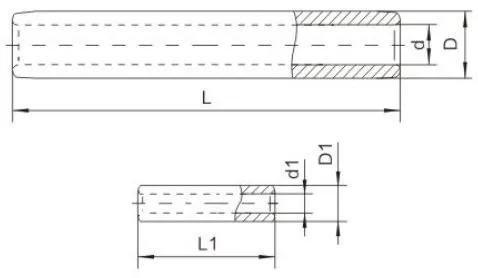
- D — 30 to 65 mm. The aluminium barrel, and the conductor die. Always 2 to 6 mm larger than JY’s at the same size.
- d — 16.0 to 40.5 mm. Barrel bore.
- D1 — 14 to 26 mm. The steel anchor, and the core die. Note the floor is 14, not 12: there is no small-core JYD.
- d1 — 6.5 to 18.0 mm. The anchor bore, and the tell-tale of the lap design.
- L1 — 70 to 130 mm. Anchor length.
- L — 280 to 760 mm. Overall.
Choosing between JY and JYD
| Situation | Take |
|---|---|
| Conductor is 400/95, 630/80 or 800/100 | JY — JYD is not made |
| Tight tower window, no straight run for a long crimp | JYD |
| Minimum string length is the constraint | JYD |
| Existing string hardware is dimensioned to JY | JY |
| Mass matters more than anything else | JYD |
Crimping
- The anchor is a folded core, so feed it, do not force it. If the doubled core will not enter the sleeve by hand, the end is burred, not the sleeve.
- Crimp the anchor first, over its full length. Two indents cover most of the range; at 630 and 800 mm² go to three.
- Then the barrel, three indents, from the pad end toward the mouth.
- Do not re-crimp to take up slack. A second indent on a folded-core anchor cuts strands.
- Check D as well as D1 before the press is set up. A JYD barrel die is not interchangeable with the JY die at the same conductor size — this is the one place the two families deliberately differ.
Related
- JY — the long-body version, 47 sizes, includes the three heavy-core models.
- NY — same conductor range with an integral jumper tail.
- NY-G — steel strand.
- NLL — bolted, no press needed.
Note: Quote by conductor designation. If the model is one of the fifteen without a catalogue weight, say so on the enquiry and we will weigh one.