NY-G Strain Clamp for Steel Strand
Models: NY-35G – NY-150G (9 sizes) · Strand: 7.8–16.0 mm · Grip: 45–187 kN · Weight: 0.47–1.72 kg
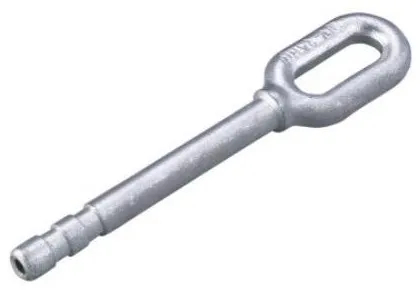
This is the dead-end for galvanised steel strand, not for ACSR. The G is the strand: guy wires, overhead earth wire, and the steel-only spans on distribution work. The conductor column on the sheet is a diameter, 7.8 to 16.0 mm, because steel strand is bought and specified by diameter where ACSR is specified by area.
It is a single-tube clamp. One barrel, one crimp, a palm at the tail. There is no separate steel anchor to crimp, and no jumper tail — the drawing is a plain tube with an eye.
The bore is the whole specification
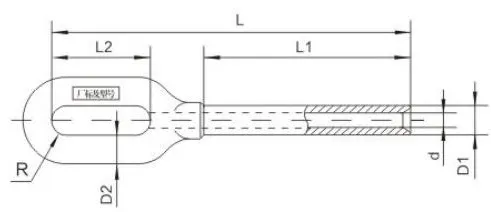
d runs 8.4 to 16.7 mm, and it sits about 0.6 mm over the strand on every row: 7.8 mm strand in an 8.4 mm bore, 11.0 in 11.7, 16.0 in 16.7. That clearance is the crimp allowance. It is also why the model code is only half the story — NY-70G is the clamp for 11.0 mm strand, so if you order “70G” and send 12.5 mm strand, it will not close.
Two numbers to keep apart:
- d — the bore, which takes the strand and sets nothing else.
- D1 and D2 — the outside of the barrel and of the palm end, 16 to 32 mm. D1 is the die.
D1 moves in clean 2 mm steps from 16 to 32, one step per model, so the die size follows the model number directly and there is no ambiguity on the press.
Two sheets, and they do not agree
The factory catalogue carries this clamp twice. The first sheet lists nine models by strand diameter. The second lists four of the same models by standard GJ designation — GJ-35, GJ-50, GJ-80, GJ-100 — and it is not a subset copy:
| Model | L, first sheet | L, GJ sheet | Grip, first sheet | Grip, GJ sheet |
|---|---|---|---|---|
| NY-35G | 200 | 210 | 45 | 45 |
| NY-50G | 215 | 230 | 60 | 60 |
| NY-80G | 260 | 295 | 90 | 100 |
| NY-100G | 285 | 315 | 123 | 110 |
The GJ versions are 10 to 35 mm longer, and on two of the four the grip figure differs. Both sheets are in circulation, so when a customer quotes a length back at us it is worth asking which sheet it came from before we call it a mistake.
There is also one anomaly in the nine-model sheet that looks like a transcription slip: NY-150G is 335 mm long while NY-135G is 338 mm. Every other dimension on the two rows climbs in order, so the 150 should not be shorter than the 135. On an order for either, we confirm L against the drawing.
Technical parameters
By strand diameter
| Model | Applicable Steel Strand Diameter (mm) | Main Dimensions (mm) | Grip Strength (kN) | Reference Weight (kg) | ||||||
|---|---|---|---|---|---|---|---|---|---|---|
| L | L1 | L2 | D1 | D2 | d | R | ||||
| NY-35G | 7.8 | 200 | 115 | 55 | 16 | 16 | 8.4 | 10 | 45 | 0.47 |
| NY-50G | 9.0 | 215 | 130 | 55 | 18 | 16 | 9.7 | 10 | 60 | 0.51 |
| NY-55G | 9.6 | 225 | 140 | 55 | 20 | 16 | 10.2 | 10 | 70 | 0.58 |
| NY-70G | 11.0 | 250 | 155 | 65 | 22 | 18 | 11.7 | 11 | 88 | 0.76 |
| NY-80G | 11.5 | 260 | 175 | 65 | 24 | 18 | 12.2 | 11 | 90 | 0.89 |
| NY-100G | 13.0 | 285 | 185 | 65 | 26 | 20 | 13.5 | 12 | 123 | 1.36 |
| NY-120G | 14.0 | 313 | 195 | 78 | 28 | 22 | 14.7 | 13 | 143 | 1.53 |
| NY-135G | 15.0 | 338 | 215 | 78 | 30 | 22 | 15.7 | 13 | 164 | 1.65 |
| NY-150G | 16.0 | 335 | 230 | 80 | 32 | 24 | 16.7 | 15 | 187 | 1.72 |
By standard GJ designation
| General Design Model | Applicable Steel Strand | Main Dimensions (mm) | Grip Strength (kN) | |||||
|---|---|---|---|---|---|---|---|---|
| L | L2 | D1 | D2 | d | R | |||
| NY-35G | GJ-35 | 210 | 50 | 16 | 16 | 8.4 | 10 | 45 |
| NY-50G | GJ-50 | 230 | 55 | 18 | 16 | 9.7 | 10 | 60 |
| NY-80G | GJ-80 | 295 | 80 | 24 | 18 | 12.2 | 12 | 100 |
| NY-100G | GJ-100 | 315 | 80 | 26 | 20 | 13.7 | 13 | 110 |
All dimensions in millimetres. Weight is per piece and appears only on the diameter sheet; the GJ sheet carries no weight column.
Where it is used
Steel strand dead-ends turn up in three places, and the fitting is the same in all of them:
- Overhead earth wire on towers where the earth wire is galvanised strand rather than OPGW.
- Guy and stay terminations — although a guy usually wants a thimble and a turnbuckle, not a compression tube, so check the string before ordering.
- Steel-only spans on rural distribution, where the whole conductor is strand.
The body is hot-dip galvanised steel, which is what the sheet says and what the application needs: a zinc-plated aluminium body on galvanised strand is a galvanic pair, and the strand is the part that disappears.
Crimping
- One die, at D1. There is no second crimp, and no core to strip to.
- Two indents, from the palm end toward the mouth. Three if the barrel is over 200 mm.
- Do not cut the strand short to fit the bore. The strand must reach the full crimp length, or the clamp holds at the first indent only.
- No jointing paste, no inhibitor. Steel on steel, dry, is correct here.
- Check the zinc after crimping. A die that is worn will crack the coating at the indent; that is a repair, not a touch-up.
Related
- NY — the same family for ACSR, with a jumper tail.
- NY-BG — aluminium-clad steel strand, JLB.
- NYH — welded body for hollow and very large conductors.
- JY-G — the straight joint for steel strand, if you are splicing rather than terminating.
Note: Order by strand diameter in millimetres. State which sheet your length came from if you are matching an existing installation. Grip figures are catalogue values for the strand, not the fitting’s ultimate load.