JY-G and JBD-G Type Splice Sleeve For Steel Strand
Models: JY-25G – JBD-100G · Strand: GJ-25 – GJ-100 · Reference Weight: 0.15–1.27 kg
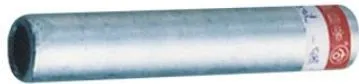
One Sheet, Two Processes
The twelve rows split into two blocks that are the same product made two ways:
- JY-G — hydraulic butt compression. Seven sizes, GJ-25 to GJ-100, L 190 to 340 mm.
- JBD-G — explosive lap compression. Five sizes, GJ-35 to GJ-100, L 110 to 170 mm.
The explosive sleeve is roughly half the length of the hydraulic one for the same strand. That is the process again: a hydraulic joint is compressed in stages along a long barrel, an explosive one is compressed all at once. If the splice length is tight, JBD is the shorter part.
Same Grip, Except On One Size
Line up the strands that appear on both blocks and the ratings match:
| Strand | JY-G | JBD-G |
|---|---|---|
| GJ-35 | 45 kN | 45 kN |
| GJ-50 | 60 kN | 60 kN |
| GJ-55 | 65 kN | 70 kN |
| GJ-70 | 88 kN | 88 kN |
| GJ-100 | 123 kN | 123 kN |
Four of the five are identical, so the two processes are interchangeable strength-wise and the choice is commercial and practical.
GJ-55 is the exception — the explosive sleeve is rated 5 kN higher than the hydraulic one for the same strand. It is a small difference on 65 kN, but it is a real one and it is the only place on the sheet where the two methods disagree. If a design is specified at 68 kN on GJ-55, only the JBD version meets it on the printed data.
JBD-50G Should Weigh About 0.27 kg
Take D and d as the outside and inside of a steel tube of length L, at 7.85 g/cm³:
| Model | D / d / L | Volume | × 7.85 | Printed |
|---|---|---|---|---|
| JBD-35G | 22 / 16.0 / 110 | 19.7 cm³ | 0.15 | 0.15 |
| JBD-55G | 26 / 18.0 / 130 | 35.9 cm³ | 0.28 | 0.28 |
| JBD-70G | 28 / 20.0 / 150 | 45.3 cm³ | 0.36 | 0.35 |
| JBD-100G | 32 / 23.0 / 170 | 66.1 cm³ | 0.52 | 0.52 |
| JBD-50G | 25 / 17.0 / 130 | 34.3 cm³ | 0.27 | 1.27 |
Four of the five explosive sizes reproduce to the printed decimal. The fifth is out by exactly one kilogramme — and 1.27 instead of 0.27 looks precisely like a stray leading digit rather than a measurement.
The surrounding evidence agrees: JBD-50G sits between JBD-35G at 0.15 kg and JBD-55G at 0.28 kg, with dimensions between them. There is no way it is four and a half times its smaller neighbour.
JBD-50G is 0.27 kg. A quotation built on 1.27 overstates the part by a kilogramme a piece — a tonne of phantom freight on a thousand pieces.
The hydraulic block checks out the same way — JY-25G computes at 0.17 kg against a print of 0.17, JY-80G at 0.80 against 0.80 — which also confirms the whole sheet is steel, not aluminium. An aluminium sleeve of these dimensions would weigh about a third as much.
The Explosive Sleeve Is Much Fatter
For the same strand the JBD sleeve is not just shorter, it is much larger in section:
| Strand | JY D / d | JBD D / d |
|---|---|---|
| GJ-35 | 16 / 8.4 | 22 / 16.0 |
| GJ-55 | 22 / 10.3 | 26 / 18.0 |
| GJ-100 | 26 / 13.7 | 32 / 23.0 |
The bore nearly doubles. That is the lap joint: an explosive lap sleeve takes two conductor ends side by side inside it, not end to end, so the bore has to clear both strands. The hydraulic butt joint puts the ends face to face and only needs to clear one.
This is why the two are not interchangeable on site even at the same grip. A JBD needs a much deeper excavation of the strand and a much larger charge; a JY needs the ends cut square and a hydraulic press.
Two Sizes Have No Explosive Version
The hydraulic block runs GJ-25 to GJ-100. The explosive block starts at GJ-35 and stops at GJ-100, with no JBD-25G and no JBD-80G.
So on a 25 mm² or an 80 mm² steel strand there is only one catalogue sleeve, the hydraulic JY. If the site has no press and only explosive tooling, those two sizes are a special.
Technical Parameters
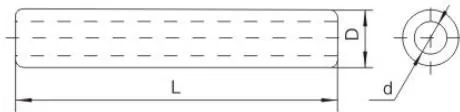
| Model | Applicable Steel Strand (mm²) | Main Dimensions (mm) | Grip Strength (kN) | Reference Weight (kg) | ||
|---|---|---|---|---|---|---|
| L | D | d | ||||
| JY-25G | GJ-25 | 190 | 14 | 7.2 | 33 | 0.17 |
| JY-35G | GJ-35 | 220 | 16 | 8.4 | 45 | 0.30 |
| JY-50G | GJ-50 | 240 | 18 | 9.6 | 60 | 0.40 |
| JY-55G | GJ-55 | 240 | 22 | 10.3 | 65 | 0.56 |
| JY-70G | GJ-70 | 290 | 22 | 11.7 | 88 | 0.65 |
| JY-80G | GJ-80 | 300 | 24 | 12.0 | 100 | 0.80 |
| JY-100G | GJ-100 | 340 | 26 | 13.7 | 123 | 1.00 |
| JBD-35G | GJ-35 | 110 | 22 | 16.0 | 45 | 0.15 |
| JBD-50G | GJ-50 | 130 | 25 | 17.0 | 60 | 1.27 |
| JBD-55G | GJ-55 | 130 | 26 | 18.0 | 70 | 0.28 |
| JBD-70G | GJ-70 | 150 | 28 | 20.0 | 88 | 0.35 |
| JBD-100G | GJ-100 | 170 | 32 | 23.0 | 123 | 0.52 |
Related Pages
Aluminium-clad steel strand: JY-BG. Repair sleeves for steel strand: JX. Conductor sleeves: JT, JTB, JY-L.
Note: JY-G is hydraulic and JBD-G explosive; the explosive sleeve is half the length but nearly twice the bore because it laps two ends side by side. Grip matches on four of five shared strands; GJ-55 is rated 70 kN explosive against 65 hydraulic. JBD-50G prints 1.27 kg where its own tube computes to 0.27 — use 0.27. No explosive version exists for GJ-25 or GJ-80.