JTY 4 to 2 Clamp
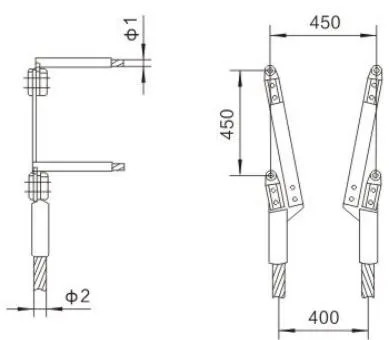
Models: 6 conductor pairs in two builds · Reference Weight: 15.8–17.4 kg or 24.0–25.5 kg · Body: aluminium, pressed
Two Tables, Same Six Models, Eight Kilos Apart
The catalogue prints this fitting twice. Both tables carry identical models, identical conductors and identical Ø1 / Ø2. Only the weight differs:
| Model | Table 1 | Table 2 |
|---|---|---|
| JTY-2/4-300/40-900K | 15.8 kg | 24.0 kg |
| JTY-2/4-300/40-1400 | 17.4 kg | 24.8 kg |
| JTY-2/4-300/40-1440N | 16.8 kg | 25.5 kg |
| JTY-2/4-400/50-900K | 15.8 kg | 24.0 kg |
| JTY-2/4-400/50-1400 | 17.4 kg | 24.8 kg |
| JTY-2/4-400/50-1440N | 16.8 kg | 25.5 kg |
An 8.2 kg difference on the same part number is two processes: a pressed body against a body with a bolted closing plate. The heavier table is the bolted-closing build, and the two are not priced from one another.
We have left both tables on the page and flagged this rather than pick one. Before you quote freight or compare a competitor’s weight, confirm which build you are being offered. The 24–25 kg figures sit close to the JR copper-aluminium version at 25.0–27.0 kg, which suggests table 2 may describe a heavier or bimetal build — but that is an inference, not a catalogue statement, and we will not price on it.
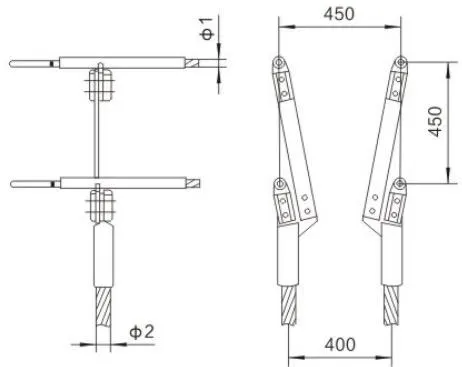
The Geometry Is Identical in Both
Whatever the build, the conductor interface is fixed:
| Quad conductor | Ø1 |
|---|---|
| LGJ-300/40 | 23.94 mm |
| LGJ-400/50 | 27.63 mm |
| Twin conductor | Ø2 |
|---|---|
| LGKK-900 | 49.00 mm |
| LGJQT-1400 | 51.00 mm |
| NAHLGJQ-1440 | 51.36 mm |
Six combinations, two quad conductors, three twin conductors. The same six appear on the JTL bolted version — and there the two quad sizes weigh the same as each other, which is what you would expect on a bolted body where the extra conductor leaves the mass alone.
Pressed Means a Die, and the Die Is Per Size
JTY is a compression fitting: the quad side and the twin side are pressed, so two die sets per size are needed and they are not shared across the six rows. The dies run with Ø1 and Ø2, and the 1440N row is 0.7 mm different from the 1400 row — close enough to look interchangeable and not close enough to press correctly.
Order the die with the clamp, or confirm your existing die matches the Ø on the row.
Where JTY Sits
- Pressed joint required by spec — many transmission specs do not allow a bolted bundle transition on the jumper
- Weight matters — at 15.8 kg the light build is 9 kg below the JR version on the same conductor
- Not for copper — the bimetal job is JR
Technical Parameters
Build 1 (15.8–17.4 kg)
| Model | Applicable Conductor (mm2) | Main Dimensions (mm) | Reference Weight (kg) | ||
|---|---|---|---|---|---|
| 4-Conductor | 2-Conductor | Ø1 | Ø2 | ||
| JTY-2/4-300/40-900K | LGJ-300/40 | LGKK-900 | 23.94 | 49.00 | 15.8 |
| JTY-2/4-300/40-1400 | LGJ-300/40 | LGJQT-1400 | 23.94 | 51.00 | 17.4 |
| JTY-2/4-300/40-1440N | LGJ-300/40 | NAHLGJQ-1440 | 23.94 | 51.36 | 16.8 |
| JTY-2/4-400/50-900K | LGJ-400/50 | LGKK-900 | 27.63 | 49.00 | 15.8 |
| JTY-2/4-400/50-1400 | LGJ-400/50 | LGJQT-1400 | 27.63 | 51.00 | 17.4 |
| JTY-2/4-400/50-1440N | LGJ-400/50 | NAHLGJQ-1440 | 27.63 | 51.36 | 16.8 |
Build 2 (24.0–25.5 kg)
| Model | Applicable Conductor (mm2) | Main Dimensions (mm) | Reference Weight (kg) | ||
|---|---|---|---|---|---|
| 4-Conductor | 2-Conductor | Ø1 | Ø2 | ||
| JTY-2/4-300/40-900K | LGJ-300/40 | LGKK-900 | 23.94 | 49.00 | 24.0 |
| JTY-2/4-300/40-1400 | LGJ-300/40 | LGJQT-1400 | 23.94 | 51.00 | 24.8 |
| JTY-2/4-300/40-1440N | LGJ-300/40 | NAHLGJQ-1440 | 23.94 | 51.36 | 25.5 |
| JTY-2/4-400/50-900K | LGJ-400/50 | LGKK-900 | 27.63 | 49.00 | 24.0 |
| JTY-2/4-400/50-1400 | LGJ-400/50 | LGJQT-1400 | 27.63 | 51.00 | 24.8 |
| JTY-2/4-400/50-1440N | LGJ-400/50 | NAHLGJQ-1440 | 27.63 | 51.36 | 25.5 |
Related Clamps
Bolted aluminium: JTL 4 to 2 clamp. Copper-aluminium: JR 4 to 2 clamp. Six-to-two: JR 6 to 2 clamp.
Note: The two tables are two ways into the same family — one lists the body by model number, the other by the conductor it takes. Order from the conductor table and the build, the die set and the weight come from that row.