JX Repair Sleeve Aluminum Strand Steel Strand
Models: JX-70/10 – JX-150G · Conductor: LGJ-70/10 – GJ-150 · Reference Weight: 0.09–2.06 kg
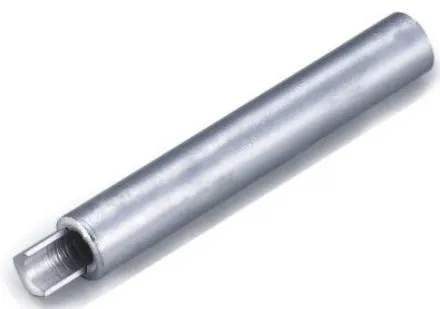
Repair, Not Splice
Every other sleeve in this group carries a Grip Strength column. This one does not — and that is the difference between a splice and a repair.
A splice joins two conductor ends and has to carry the full tension of the span. A repair sleeve goes over a damaged section of a conductor that is still continuous, restores the current path across a few broken strands, and is not the tension member.
So do not read these models as tension fittings. If a conductor has parted and you need to joint it, that is the JT, JTB or JYB sheet. The absence of a grip figure here is the catalogue telling you that no grip is claimed.
If your specification requires a repair sleeve to restore a stated percentage of conductor strength, that figure is not on this page — ask us and we will confirm what is tested.
Two Blocks, Two Materials
The table runs twenty-three ACSR sizes (LGJ-70/10 through LGJ-800/70/100) and then nine steel-strand sizes (JX-25G through JX-150G) marked by the G suffix.
The G block covers GJ strand — bare steel, no aluminium — so those sleeves are steel too, not aluminium. The two blocks look alike in the table and behave very differently on site.
The Weight Column Proves The Material
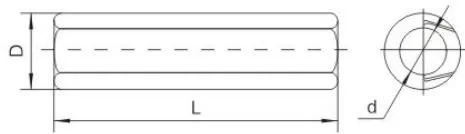
Take D and d as the outside and inside of a tube and compute the volume of L millimetres of it:
| Model | D / d / L | Volume | × 2.7 | Printed |
|---|---|---|---|---|
| JX-150 | 30 / 18 / 170 | 76.9 cm³ | 0.21 | 0.21 |
| JX-630 | 60 / 36 / 370 | 669.5 cm³ | 1.81 | 1.81 |
| JX-800/55 | 65 / 40 / 370 | 762.6 cm³ | 2.06 | 2.06 |
And on the steel block, the same calculation at 7.85 g/cm³:
| Model | D / d / L | Volume | × 7.85 | Printed |
|---|---|---|---|---|
| JX-25G | 14 / 7.2 / 100 | 11.3 cm³ | 0.089 | 0.09 |
| JX-120G | 28 / 15 / 170 | 74.6 cm³ | 0.586 | 0.59 |
| JX-150G | 32 / 16.5 / 200 | 118.4 cm³ | 0.929 | 0.93 |
Thirty of the thirty-three rows resolve to one density or the other, to within a hundredth of a kilogram. That is a strong check and it gives you three things:
- The ACSR rows are aluminium, confirmed at 2.7 g/cm³.
- The nine G rows are steel, confirmed at 7.85 — 2.9 times the mass of the same envelope in aluminium. A JX-120G weighs 0.59 kg against 0.21 kg for the JX-150 that is bigger in every dimension.
- D, d and L really are the outside, the bore and the length of a plain tube. Nothing hidden, no liner, no insert. For a repair sleeve that is what you want: it slides over the conductor and is compressed.
This is the one sheet in the group whose weight column can be fully reproduced. If you are pricing by kilogramme, the numbers here are trustworthy.
JX-70/10 And JX-70/40 Have Their Weights Swapped
Two rows sit next to each other on the same conductor family:
- JX-70/10 — D 22, d 12.5, L 150 — computes 0.104 kg, prints 0.11
- JX-70/40 — D 24, d 15.0, L 150 — computes 0.112 kg, prints 0.10
The larger sleeve is printed lighter than the smaller one. Both figures are a rounding step away from correct, so the error is a swapped pair rather than a bad calculation — and it is 10 g on a 110 g part, which matters only if you are counting to the last gramme on a large order.
Three of the nine steel rows — JX-35G, JX-50G and JX-70G — come out 0.02 to 0.04 kg lighter than the tube volume at 7.85 g/cm³. They are still unmistakably steel (an aluminium part of the same envelope would be around 0.10 kg), so the drift is in the weight column rather than in the material. Every other row on the sheet agrees to the printed decimal.
Two Cells To Read Carefully
GJ-800 on the JX-80G row. There is no such strand. GJ-80 is the size that pairs with an 80 mm² sleeve, and the row’s dimensions (D 24, d 12.0, L 140) are consistent with GJ-80. The extra zero is a typo in the conductor column.
LGJ-240/30/40 210/50 on the JX-240 row. Two designations have run together and lost their separator. The row is meant to cover LGJ-240/30, LGJ-240/40 and LGJ-210/50 — three conductors that this one sleeve serves. Read literally the cell names a conductor that does not exist.
Neither affects the dimensions. Both will confuse a clerk keying the table into an ERP.
The Slash Notation Means “This Sleeve Covers All Of These”
Several rows list more than one conductor after a slash: LGJ-95/15/20 is LGJ-95/15 and LGJ-95/20, and LGJ-300/20/25/40/50 is four conductors on one sleeve.
So a conductor appearing in a slash list does not need its own model — check the whole cell before concluding there is no sleeve for your conductor. The 32 sizes cover considerably more than 32 conductors.
Technical Parameters
| Model | Applicable Conductor(mm2) | Main Dimensions(mm) | Reference Weight(kg) | ||
|---|---|---|---|---|---|
| D | d | L | |||
| JX-70/10 | LGJ-70/10 | 22 | 12.5 | 150 | 0.11 |
| JX-70/40 | LGJ-70/40 | 24 | 15.0 | 150 | 0.10 |
| JX-95 | LGJ-95/15/20 | 24 | 14.5 | 170 | 0.14 |
| JX-95/55 | LGJ-95/55 | 32 | 18.0 | 170 | 0.26 |
| JX-120 | LGJ-120/7/20 | 30 | 16.5 | 170 | 0.23 |
| JX-150 | LGJ-150/20/25 | 30 | 18.0 | 170 | 0.21 |
| JX-150/35 | LGJ-150/35 | 32 | 19.0 | 170 | 0.24 |
| JX-185/10 | LGJ-185/10 | 32 | 20.0 | 170 | 0.23 |
| JX-185 | LGJ-185/25/45 | 32 | 21.0 | 170 | 0.22 |
| JX-210 | LGJ-210/25/35 | 34 | 22.0 | 220 | 0.32 |
| JX-240 | LGJ-240/30/40 210/50 | 36 | 23.0 | 220 | 0.36 |
| JX-240/55 | LGJ-240/55 | 36 | 24.0 | 220 | 0.34 |
| JX-300/15 | LGJ-300/15 | 40 | 25.0 | 270 | 0.56 |
| JX-300 | LGJ-300/20/25/40/50 | 40 | 26.0 | 270 | 0.53 |
| JX-300/70 | LGJ-300/70 | 42 | 27.0 | 270 | 0.60 |
| JX-400 | LGJ-400/20/25/35/50 | 45 | 29.0 | 320 | 0.81 |
| JX-400/65 | LGJ-400/65 | 48 | 30.0 | 320 | 0.96 |
| JX-400/95 | LGJ-400/95 | 48 | 31.0 | 320 | 0.92 |
| JX-500 | LGJ-500/35/45/65 | 52 | 32.0 | 320 | 1.15 |
| JX-560/40 | LGJ-560/40 | 60 | 34.0 | 340 | 1.77 |
| JX-630 | LGJ-630/45/55/80 | 60 | 36.0 | 370 | 1.81 |
| JX-800/55 | LGJ-800/55 | 65 | 40.0 | 370 | 2.06 |
| JX-800 | LGJ-800/70/100 | 65 | 41.0 | 370 | 2.01 |
| JX-25G | GJ-25 | 14 | 7.20 | 100 | 0.09 |
| JX-35G | GJ-35 | 16 | 8.40 | 120 | 0.12 |
| JX-50G | GJ-50 | 18 | 9.60 | 120 | 0.15 |
| JX-55G | GJ-55 | 20 | 10.30 | 120 | 0.23 |
| JX-70G | GJ-70 | 22 | 11.60 | 140 | 0.26 |
| JX-80G | GJ-800 | 24 | 12.00 | 140 | 0.38 |
| JX-100G | GJ-100 | 26 | 14.00 | 160 | 0.48 |
| JX-120G | GJ-120 | 28 | 15.00 | 170 | 0.59 |
| JX-150G | GJ-150 | 32 | 16.50 | 200 | 0.93 |
Related Pages
For a joint that carries tension: JT, JTB, JYB. Steel-strand joints: JY-G and JBD-G.
Note: No grip strength is printed anywhere on this sheet — a repair sleeve restores the conductor, it does not terminate it. Every weight resolves to the tube volume at 2.7 g/cm³ on the twenty-three LGJ rows and 7.85 on the nine GJ rows, which confirms both the material and that D/d/L describe a plain tube. JX-70/10 and JX-70/40 have their weights interchanged. The JX-80G row prints GJ-800 for GJ-80, and the JX-240 row has two designations run together.