JY BG Type Splice Sleeve For Aluminum Clad Steel Strand
Models: JY-35BG – JY-185BG.2 · Conductor: JLB20A-35 – JLB40-150 · Reference Weight: 0.93–4.2 kg
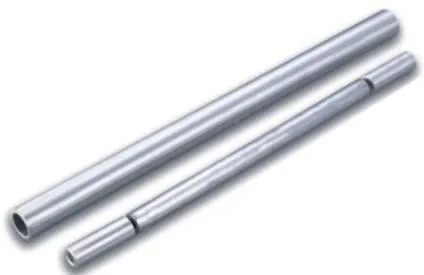
Aluminium-Clad Steel, Not ACSR
The conductor here is JLB — aluminium-clad steel strand, a single homogeneous strand with an aluminium skin bonded to a steel core. It is not ACSR: there is no gap between the two metals, and there is only one strand construction.
That changes the splice. An ACSR splice grips an outer aluminium layer over a separate steel core; a JLB splice grips a single clad strand, and the grade of the cladding matters as much as the area.
Three Numbering Schemes On One Page
Read the model numbers carefully, because this page uses three conventions and they do not mean the same thing:
| Convention | Example | Meaning |
|---|---|---|
| No suffix | JY-35BG, JY-80BG | One grade only for that size |
.1 / .2 |
JY-100BG.1, JY-100BG.2 | .1 is the JLB20A version, .2 the JLB30 |
-20 / -35 / -40 |
JY-80BG-20, JY-80BG-40 | The cladding grade: JLB20A, JLB35, JLB40 |
The .1/.2 block is in the first table, the -20/-35/-40 block in the second. No .1 model appears in the second table and no -20 model appears in the first, so the two blocks are separate catalogues of the same product line rather than two views of one range.
Grip Falls As The Grade Rises
This is the most important thing on the page. Four conductors appear at three grades each, and the grip drops every time the grade number goes up:
| Nominal area | JLB20A | JLB35 | JLB40 |
|---|---|---|---|
| 80 mm² | 85.0 kN | 55.0 | 46.2 |
| 100 mm² | 115.6 | 69.9 | 58.7 |
| 120 mm² | 138.9 | 83.9 | 71.5 |
| 150 mm² | 169.6 | 102.5 | 86.1 |
A JY-150BG built for JLB20A holds 169.6 kN; the same model number at JLB40 holds 86.1 kN — barely half.
The reason is that the grade describes how much aluminium is on the outside. More aluminium cladding means less steel in the same nominal area, and steel is what carries the tension. So a heavier-clad strand of the same size is a weaker strand, and its splice is rated lower.
Ordering consequence: quoting “JY-150BG” alone is not enough. The grade has to be on the purchase order, and a sleeve bought for JLB20A must not be used on JLB40 — the grip figures are not interchangeable and the difference is a factor of two.
The Second Table Swaps L And L1
In the first table the lengths behave normally: L is the overall length and L1 the inner one, with L − L1 running 180 to 270 mm as the size grows. JY-35BG is 400 overall with a 220 mm L1.
In the second table the relationship inverts. JY-80BG-20 prints L 320 and L1 550 — the shorter figure in the L column and the longer in L1, for a sleeve of the same nominal size as the first table’s JY-80BG (560 / 360).
The trap is arithmetic: read L as the overall length off the second table and you will specify a 320 mm sleeve for a joint that needs 550.
On the second table L1 is the overall length. Work from the first table where you can — its convention matches every other sheet in this group — and read L1 on the second as the end-to-end figure, not the body length.
Four Weights Are Missing
JY-65BG, JY-120BG.2, JY-185BG.1 and JY-185BG.2 print no weight at all — the cells are empty, not zero.
The largest of them, JY-185BG.1, is the biggest sleeve on the page. We will not interpolate a figure the catalogue does not carry: ask for a quoted weight on those four if you are costing by kilogramme.
One more oddity while you are in that column: JY-65BG and JY-70BG share every dimension — L 500, D 36, L1 300, D1 22, L2 70 — for conductors 5 mm² apart. They are one sleeve covering both conductors, which is why the second weight cell is blank: order by the conductor and the same sleeve ships.
Technical Parameters
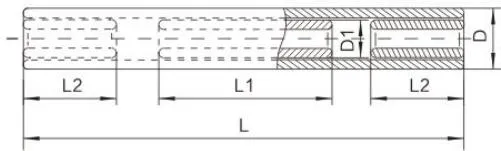
| Model | Applicable Conductor (mm²) | Main Dimensions (mm) | Grip Strength (kN) | Reference Weight (kg) | ||||
|---|---|---|---|---|---|---|---|---|
| L | D | L1 | D1 | L2 | ||||
| JY-35BG | JLB20A-35 | 400 | 32 | 220 | 18 | 70 | 38 | 0.93 |
| JY-50BG | JLB20A-50 | 420 | 32 | 240 | 18 | 70 | 57 | 0.93 |
| JY-65BG | JLB20A-65 | 500 | 36 | 300 | 22 | 70 | 73 | |
| JY-70BG | JLB20A-70 | 500 | 36 | 300 | 22 | 70 | 78 | 1.44 |
| JY-80BG | JLB20A-80 | 560 | 36 | 360 | 24 | 70 | 85 | 1.75 |
| JY-95BG | JLB20A-95 | 600 | 40 | 380 | 26 | 80 | 96 | 2.30 |
| JY-100BG.1 | JLB20A-100 | 620 | 40 | 400 | 28 | 80 | 116 | 2.48 |
| JY-100BG.2 | JLB30-100 | 560 | 36 | 360 | 24 | 70 | 76 | 1.64 |
| JY-120BG.1 | JLB20A-120 | 620 | 42 | 400 | 30 | 80 | 129 | 2.81 |
| JY-120BG.2 | JLB30-120 | 600 | 40 | 380 | 26 | 80 | 92 | |
| JY-150BG.1 | JLB20A-150 | 690 | 45 | 460 | 32 | 80 | 170 | 3.48 |
| JY-150BG.2 | JLB30-150 | 620 | 40 | 400 | 28 | 80 | 112 | 2.25 |
| JY-185BG.1 | JLB20A-185 | 770 | 48 | 500 | 34 | 100 | 199 | |
| JY-185BG.2 | JLB30-185 | 620 | 42 | 400 | 30 | 80 | 138 | |
Second table — the JLB35 and JLB40 grades:
| General Design No. | Applicable Conductor (mm²) | Main Dimensions (mm) | Grip Strength (kN) | Reference Weight (kg) | |||
|---|---|---|---|---|---|---|---|
| L | D | L1 | D1 | ||||
| JY-80BG-20 | JLB20A-80 | 320 | 36 | 550 | 24 | 85.0 | 2.2 |
| JY-80BG-35 | JLB35-80 | 320 | 36 | 530 | 24 | 55.0 | 1.6 |
| JY-80BG-40 | JLB40-80 | 300 | 36 | 500 | 24 | 46.2 | 1.4 |
| JY-100BG-20 | JLB20A-100 | 380 | 38 | 620 | 26 | 115.6 | 2.3 |
| JY-100BG-35 | JLB35-100 | 390 | 38 | 610 | 26 | 69.9 | 2.3 |
| JY-100BG-40 | JLB40-100 | 380 | 38 | 620 | 26 | 58.7 | 1.5 |
| JY-120BG-20 | JLB20A-120 | 400 | 42 | 680 | 30 | 138.9 | 3.1 |
| JY-120BG-35 | JLB35-120 | 400 | 36 | 640 | 24 | 83.9 | 2.6 |
| JY-120BG-40 | JLB40-120 | 380 | 36 | 630 | 24 | 71.5 | 2.2 |
| JY-150BG-20 | JLB20A-150 | 440 | 45 | 740 | 32 | 169.6 | 4.2 |
| JY-150BG-35 | JLB35-150 | 420 | 38 | 700 | 26 | 102.5 | 3.3 |
| JY-150BG-40 | JLB40-150 | 400 | 38 | 660 | 26 | 86.1 | 2.2 |
Related Pages
Steel-strand sleeves, hydraulic and explosive: JY-G and JBD-G. All-aluminium conductor: JY-L. ACSR: JT, JTB.
Note: JLB is clad steel strand, not ACSR, and the cladding grade sets the rating: the same model number holds 169.6 kN at JLB20A and 86.1 kN at JLB40. Three numbering conventions are in use — none, .1/.2 and -20/-35/-40. In the second table L and L1 are the other way round from the first. Four rows print no weight.