JY-L Type Splice Sleeve For Aluminum Stranded Conductor
Models: JY-150L – JY-800L · Conductor: LJ-150 – LJ-800 · Reference Weight: 0.36–4.8 kg
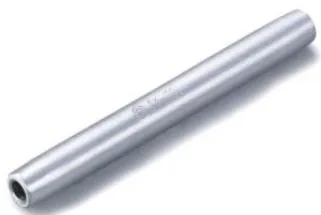
Five Columns, One Of Them Is A Tool
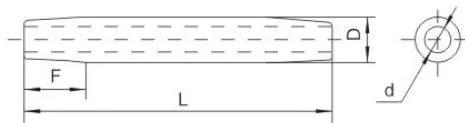
L, D and d are the sleeve: length, outside diameter and bore. Grip is the rating. F is the odd one out — it is not a dimension of the sleeve at all.
Read F against the wall and the pattern shows: F steps exactly where the section gets heavier, 20 mm for the four smallest, 25 for the 300 and 400, 30 for the 500, 35 for the 630, 40 for the 800.
That is the signature of a compression die or hex size — the tooling that closes the sleeve, not a feature of the part. It has no meaning for a buyer specifying a fitting, and no meaning for a draughtsman. Ignore F unless you are selecting the press tooling.
The Bore Is The Conductor Plus About 1.5 mm
Compare d against the outside diameter of the LJ conductor it serves:
| Model | Conductor OD | d | Clearance |
|---|---|---|---|
| JY-150L | 15.8 | 17.0 | 1.2 |
| JY-240L | 20.4 | 21.5 | 1.1 |
| JY-500L | 29.2 | 30.5 | 1.3 |
| JY-800L | 36.9 | 38.5 | 1.6 |
A consistent 1.1 to 1.6 mm of diametral clearance across a conductor range from 16 to 37 mm. That is a designed slip fit: enough to slide the sleeve over a cut conductor end, tight enough that the compression closes it onto the strands rather than folding it.
This is the check to make when a sleeve arrives. A bore measuring the conductor diameter exactly will not go on; one measuring 3 mm over will not compress properly. If you are inspecting a delivery, a caliper on the bore against the conductor is worth more than a look at the stamp.
Same Conductor, Same Grip, Twice The Weight
Two families serve the all-aluminium LJ conductor — this one and the JT-L mechanical sheet. Where they overlap they disagree sharply:
| Conductor | JT-L | JY-L |
|---|---|---|
| LJ-150 | L 320, 0.16 kg, 22 kN | L 280, 0.36 kg, 22 kN |
| LJ-240 | L 380, 0.28 kg, 34.5 kN | L 350, 0.75 kg, 34 kN |
Identical grip, slightly shorter, and two and a half times the mass. The JY-L is 70 mm shorter than the JT-L on LJ-150 and weighs 200 g more.
The two sheets also do not use the same notation. JY-L prints D and d — the outside and the bore — while JT-L prints H and C, where C is exactly half of H, so C there is not a bore at all and the two envelopes cannot be compared column by column. What can be compared is the result: same conductor, same grip, and 2.2 to 2.7 times the mass on the JY-L.
Same rating does not mean same part. On an all-aluminium conductor the JY-L is the heavier sleeve, and the weight difference is what the extra wall buys: a longer compression length and a thicker end for the die. Where the line is weight-limited, say so at enquiry and we quote the JT-L for the same conductor.
Why The Weight Does Not Compute From D, d And L
On a constant-wall tube the weight is π/4 × (D² − d²) × L × 2.7 g/cm³. On this sheet that calculation matches the printed figure on the smallest size and misses increasingly as the sleeve grows:
| Model | Computed | Printed | Difference |
|---|---|---|---|
| JY-150L | 0.36 | 0.36 | 0 % |
| JY-210L | 0.53 | 0.60 | +13 % |
| JY-400L | 1.21 | 1.50 | +24 % |
| JY-500L | 1.92 | 2.00 | +4 % |
| JY-630L | 2.95 | 2.80 | −5 % |
| JY-800L | 3.78 | 4.80 | +27 % |
The scatter runs both ways and does not track size, which is what you expect once you know the part: the sleeve is not a plain constant-wall tube. The wall is thickened at both ends to take the die and the centre stop, and the amount of extra metal that adds depends on the size. On the small sizes it is a few per cent; on an 800 mm² sleeve the two ends are a quarter of the mass.
The printed figure is a weighed figure — use it. Do not rebuild these from D, d and L. For a size outside the nine listed, we weigh the sample and send the number with the offer.
The Range
Nine sizes from LJ-150 to LJ-800, grip 22 to 110 kN, length 280 to 650 mm, weight 0.36 to 4.8 kg. The D/d wall grows steadily — 13 mm on the 150, 26.5 on the 800 — so the largest sleeve is not a scaled copy of the smallest.
There is no size below LJ-150 on this sheet. For LJ-16 through LJ-120 the JT-L sheet is the only catalogue option.
Technical Parameters
| Model | Applicable Conductor (mm²) | Main Dimensions (mm) | Grip Strength (kN) | Reference Weight (kg) | |||
|---|---|---|---|---|---|---|---|
| L | D | d | F | ||||
| JY-150L | LJ-150 | 280 | 30 | 17.0 | 20 | 22 | 0.36 |
| JY-185L | LJ-185 | 310 | 32 | 19.0 | 20 | 27 | 0.44 |
| JY-210L | LJ-210 | 330 | 34 | 20.0 | 20 | 31 | 0.60 |
| JY-240L | LJ-240 | 350 | 36 | 21.5 | 20 | 34 | 0.75 |
| JY-300L | LJ-300 | 390 | 40 | 24.0 | 25 | 45 | 0.95 |
| JY-400L | LJ-400 | 450 | 45 | 27.5 | 25 | 58 | 1.50 |
| JY-500L | LJ-500 | 510 | 52 | 30.5 | 30 | 73 | 2.00 |
| JY-630L | LJ-630 | 570 | 60 | 34.0 | 35 | 87 | 2.80 |
| JY-800L | LJ-800 | 650 | 65 | 38.5 | 40 | 110 | 4.80 |
Related Pages
The lighter twin for the same conductor: JT-L. ACSR sleeves: JT, JTB. Steel strand: JY-G and JBD-G.
Note: F is the compression die size, not a sleeve dimension. The bore d is the conductor diameter plus 1.1 to 1.6 mm throughout, which is the fit to check on delivery. JY-L carries the same grip as JT-L on LJ-150 and LJ-240 at two and a half times the weight. The printed weights scatter plus or minus 27 % around a plain tube, so they cannot be computed from D, d and L.