JTL 4 to 2 Clamp
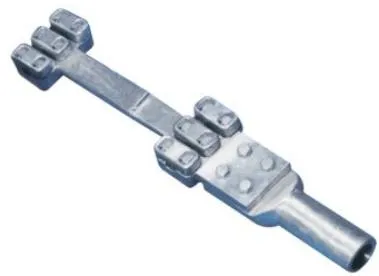
Models: 6 sizes · Reference Weight: 23.0–24.0 kg · Body: all aluminium
What a 4-to-2 Does
A quad bundle has to become a twin bundle somewhere: at the jumper loop, at the transition between a four-conductor span and a two-conductor span, or at a substation gantry. Four conductors in, two out. This clamp does it in one casting rather than with four separate fittings and a plate.
The model reads straight across: JTL-2/4-<quad conductor>-<twin conductor>.
- 2/4 — twin side first, quad side second
- LGJ-300/40 or LGJ-400/50 — the quad conductors, one per leg
- LGKK-900, LGJQT-1400, NAHLGJQ-1440 — the twin conductors
Six Rows, Two Quad Conductors
Only two quad conductors are catalogued: LGJ-300/40 and LGJ-400/50. Those are the two standard 220 kV and 500 kV quad configurations, and the range stops there.
If your quad is LGJ-400/35 or LGJ-630/45, there is no row for it. That is not a stock gap to work around with a nearby size — the quad side takes four conductors in one body and the bore is cut to the conductor. Tell us the pair and we will quote as a special.
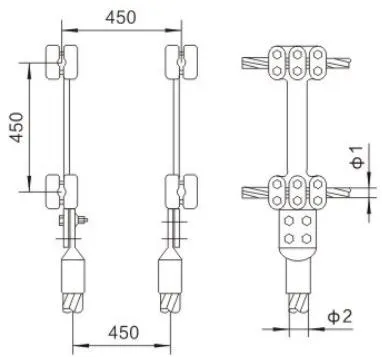
Three twin conductors on each quad side gives six rows, and Ø2 tracks the twin conductor exactly:
| Twin conductor | Ø2 |
|---|---|
| LGKK-900 | 49.00 mm |
| LGJQT-1400 | 51.00 mm |
| NAHLGJQ-1440 | 51.36 mm |
Note LGKK-900 at 49 mm against 50 mm on our TL equal diameter clamp and SJ twin spacer. The 1 mm difference is groove depth rather than bore — this is a keeper-groove fitting, not a bored body, so the figure is measured to the groove floor.
Ø1 Does Not Move With the Twin Side
The quad bore is 23.94 mm on every LGJ-300/40 row and 27.63 mm on every LGJ-400/50 row, whatever the twin conductor. Weight follows the same rule:
- LGJ-300/40 rows — 23.0, 23.5, 24.0 kg
- LGJ-400/50 rows — 23.0, 23.5, 24.0 kg
The two quad sizes produce identical weights. A 400/50 quad fitting is not heavier than a 300/40 one, because the extra mass is all in the twin-side hardware, which is the same on both.
JTL vs JTY vs JR — Three Builds, One Shape
The same six rows appear on three pages of this catalogue under three prefixes, and the difference is material and process, not geometry:
| Family | Build | Weight band |
|---|---|---|
| JTL (this page) | All aluminium, bolted | 23.0 – 24.0 kg |
| JTY | Aluminium, pressed | 15.8 – 25.5 kg |
| JR | Copper-aluminium bimetal | 25.0 – 27.0 kg |
All three use identical Ø1 and Ø2 for a given conductor pair. A line item that reads “4-to-2 clamp” without a prefix does not identify the build — the JTY range alone spans 15.8 to 25.5 kg on the same six models.
Use JR where the twin side is copper, JTY where the joint has to be pressed, JTL where a bolted aluminium joint is acceptable.
Technical Parameters
| Model | Applicable Conductor (mm2) | Main Dimensions (mm) | Reference Weight (kg) | ||
|---|---|---|---|---|---|
| 4-Conductor | 2-Conductor | Ø1 | Ø2 | ||
| JTL-2/4-300/40-900K | LGJ-300/40 | LGKK-900 | 23.94 | 49.00 | 23.0 |
| JTL-2/4-300/40-1400 | LGJ-300/40 | LGJQT-1400 | 23.94 | 51.00 | 23.5 |
| JTL-2/4-300/40-1440N | LGJ-300/40 | NAHLGJQ-1440 | 23.94 | 51.36 | 24.0 |
| JTL-2/4-400/50-900K | LGJ-400/50 | LGKK-900 | 27.63 | 49.00 | 23.0 |
| JTL-2/4-400/50-1400 | LGJ-400/50 | LGJQT-1400 | 27.63 | 51.00 | 23.5 |
| JTL-2/4-400/50-1440N | LGJ-400/50 | NAJLGJQ-1440 | 27.63 | 51.36 | 24.0 |
Related Clamps
Pressed version: JTY 4 to 2 clamp. Copper-aluminium version: JR 4 to 2 clamp. Six-to-two bundle: JR 6 to 2 clamp. Quad bundle spacers and dampers: MRJ triple spacer damper.
Note: State both conductors by full designation. The quad side is cut to the conductor and cannot be reamed to a neighbouring size.