NY-BG Strain Clamp for Aluminium-Clad Steel Strand
Models: NY-35BG – NY-185BG.2 (14 sizes) · Strand: JLB20A / JLB30A, 35–185 mm² · Grip: 38–199 kN · Weight: 1.92–7.92 kg
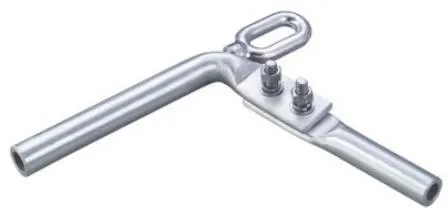
Aluminium-clad steel strand (JLB) is the conductor that does not corrode. The aluminium is metallurgically bonded onto each steel wire, so the strand is steel-strong and aluminium-bright, and it is what goes on overhead earth wire and on the long spans where galvanised strand would rust out. NY-BG is its dead-end: a compression body with a steel anchor for the strand and an aluminium palm for the string.
Mechanically it is the NY body — two crimps, one die at the barrel and one at the anchor. The difference is all in the strand, and the strand comes in grades.
The dot suffix is the grade, not a revision
Two families sit on the same sheet:
- JLB20A — the heavier clad, more steel, higher grip. Clamps NY-xxBG.1.
- JLB30A — more aluminium in the same nominal area, lighter, lower grip. Clamps NY-xxBG.2.
They are not interchangeable and they are not two editions of one part. Same nominal area, same 100 mm²:
| Clamp | Strand | Grip | Weight | D |
|---|---|---|---|---|
| NY-100BG.1 | JLB20A-100 | 116 kN | 4.34 kg | 40 mm |
| NY-100BG.2 | JLB30A-100 | 76 kN | 3.25 kg | 36 mm |
A 40 kN difference on a 100 mm² strand, from a suffix. Quote the suffix. An enquiry that says “NY-100BG” without it will be answered with a question, and an order that omits it will ship the wrong grade.
The same pattern shows on the third-party general-design sheet further down, where three cladding grades are priced against one nominal area — JLB20A-80, JLB35-80 and JLB40-80 at 85.0, 53.4 and 46.6 kN. Grip falls as the cladding rises, because the cladding is aluminium and the aluminium is the soft part. So the grade is a strength decision first and a corrosion decision second.
Sizes, and where the table stops
Fourteen models from 35 to 185 mm², in the .1/.2 pairs from 100 mm² up. Below 100 the family is single-grade — NY-35BG, 50BG, 65BG, 70BG, 80BG, 95BG exist only in the 20A grade, because at those sizes the 30A grade is not made.
Two rows are worth knowing by heart:
- NY-65BG and NY-70BG are the same clamp — 390, 285, 65, 210, 36, 22, 18, 11, identical in every dimension. Only the grip and the weight differ, 73/78 kN and 2.71/2.76 kg, because JLB20A-65 and JLB20A-70 are different strands in one body.
- NY-185BG.2 is NY-150BG.2 stepped up 2 mm — the same 465 × 340 × 78 × 250 envelope and the same R, but D 42 against 40 and D1 30 against 28, so it is a different pair of dies for 26 kN more grip.
That is normal for this family: the clamp is sized to the strand diameter, and several grades share a diameter.
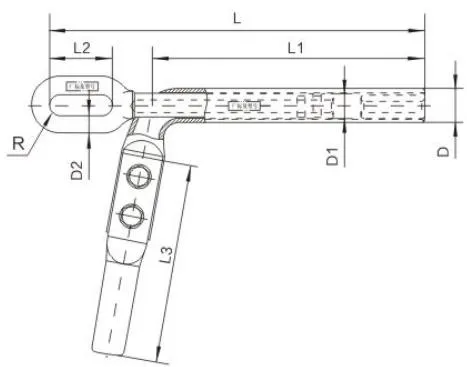
Technical parameters
| Model | Applicable Conductor (mm²) | Main Dimensions (mm) | Grip Strength (kN) | Reference Weight (kg) | |||||||
|---|---|---|---|---|---|---|---|---|---|---|---|
| L | L1 | L2 | L3 | D | D1 | D2 | R | ||||
| NY-35BG | JLB20A-35 | 325 | 230 | 55 | 200 | 32 | 18 | 16 | 10 | 38 | 1.92 |
| NY-50BG | JLB20A-50 | 345 | 250 | 55 | 200 | 32 | 18 | 16 | 10 | 57 | 1.96 |
| NY-65BG | JLB20A-65 | 390 | 285 | 65 | 210 | 36 | 22 | 18 | 11 | 73 | 2.71 |
| NY-70BG | JLB20A-70 | 390 | 285 | 65 | 210 | 36 | 22 | 18 | 11 | 78 | 2.76 |
| NY-80BG | JLB20A-80 | 435 | 325 | 65 | 210 | 36 | 24 | 18 | 11 | 85 | 3.15 |
| NY-95BG | JLB20A-95 | 450 | 340 | 65 | 250 | 40 | 26 | 18 | 11 | 96 | 3.75 |
| NY-100BG.1 | JLB20A-100 | 465 | 340 | 78 | 250 | 40 | 28 | 20 | 13 | 116 | 4.34 |
| NY-100BG.2 | JLB30A-100 | 435 | 325 | 65 | 210 | 36 | 24 | 18 | 11 | 76 | 3.25 |
| NY-120BG.1 | JLB20A-120 | 465 | 340 | 78 | 250 | 42 | 30 | 22 | 13 | 129 | 5.0 |
| NY-120BG.2 | JLB30A-120 | 450 | 340 | 65 | 250 | 40 | 26 | 20 | 12 | 92 | 3.75 |
| NY-150BG.1 | JLB20A-150 | 535 | 390 | 85 | 260 | 45 | 32 | 24 | 15 | 170 | 6.62 |
| NY-150BG.2 | JLB30A-150 | 465 | 340 | 78 | 250 | 40 | 28 | 20 | 13 | 112 | 4.34 |
| NY-185BG.1 | JLB20A-185 | 575 | 435 | 85 | 260 | 48 | 34 | 24 | 15 | 199 | 7.92 |
| NY-185BG.2 | JLB30A-185 | 465 | 340 | 78 | 250 | 42 | 30 | 22 | 13 | 138 | 5.1 |
Four rows were missing from the earlier version of this page — NY-150BG.1, NY-150BG.2, NY-185BG.1 and NY-185BG.2 — and they are back in the table above. If you have a quotation from us for a 150 or 185 mm² NY-BG, it was priced from the drawing rather than from this sheet.
General design, 80 to 150 mm²
The second sheet is the general-design version of the same clamps, drawn against three cladding grades. It runs to 150 mm² only, it has no weight column, and it does not always agree with the sheet above — NY-120BG-20 is 490 mm long and rated 139 kN where NY-120BG.1 is 465 mm and 129 kN. Two editions, both in circulation.
| General Design Model | Applicable Conductor (mm²) | Main Dimensions (mm) | Grip Strength (kN) | Reference Weight (kg) | |||||
|---|---|---|---|---|---|---|---|---|---|
| L | L2 | D | D1 | D2 | R | ||||
| NY-80BG-20 | JLB20A-80 | 435 | 70 | 36 | 24 | 18 | 12 | 85.0 | 2.5 |
| NY-80BG-35 | JLB35-80 | 435 | 65 | 36 | 24 | 18 | 12 | 53.4 | 2.5 |
| NY-80BG-40 | JLB40-80 | 435 | 65 | 36 | 24 | 18 | 12 | 46.6 | 2.5 |
| NY-100BG-20 | JLB20A-100 | 455 | 80 | 38 | 26 | 20 | 12 | 116.0 | 3.7 |
| NY-100BG-35 | JLB35-100 | 435 | 70 | 38 | 26 | 20 | 12 | 68.1 | 3.2 |
| NY-100BG-40 | JLB40-100 | 435 | 70 | 38 | 26 | 20 | 12 | 59.6 | 2.9 |
| NY-120BG-20 | JLB20A-120 | 490 | 80 | 42 | 30 | 22 | 13 | 139.0 | 3.8 |
| NY-120BG-35 | JLB35-120 | 450 | 70 | 36 | 24 | 18 | 12 | 81.9 | 2.5 |
| NY-120BG-40 | JLB40-120 | 450 | 70 | 36 | 24 | 18 | 12 | 71.5 | 2.7 |
| NY-150BG-20 | JLB20A-150 | 460 | 80 | 45 | 32 | 26 | 16 | 170.0 | 7.3 |
| NY-150BG-35 | JLB35-150 | 445 | 80 | 38 | 26 | 18 | 12 | 100.0 | 3.2 |
| NY-150BG-40 | JLB40-150 | 445 | 70 | 38 | 26 | 18 | 12 | 87.4 | 3.2 |
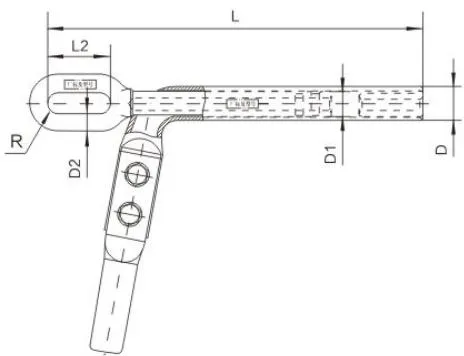
Reading the dimensions
- D — aluminium barrel OD, 32 to 48 mm. The conductor die.
- D1 — anchor OD, 18 to 34 mm. The second die.
- L — overall length, 325 to 575 mm.
- L1 — barrel length, 230 to 435 mm. Strip to this minus 1–2 mm.
- L2 — palm length, 55 to 85 mm.
- L3 — 200 to 260 mm; the distance from the bend to the palm centre line.
- R — eye radius, 10 to 15 mm.
D1 runs from 18 to 34 mm in 2 mm steps, and it is the number that tells you which of your two dies is which: on this clamp the anchor die is always the smaller of the two, and the barrel die is always D. Getting them the wrong way round bursts the anchor sleeve, which is the one failure on a dead-end you cannot see from the ground.
Where it is used
- Overhead earth wire in polluted or coastal areas, where galvanised strand has a service life measured in years rather than decades.
- Long river and valley crossings, where the strand is asked to carry its own weight over 800 m or more.
- Anywhere the earthing conductor is also the structural one — the clad strand does both jobs.
The body casts in aluminium and the anchor is hot-dip galvanised steel, so the two metals are separated at the crimp, not at the strand. That is deliberate: the aluminium palm is what bolts to the string, and the steel is where the load is.
Crimping
- Crimp the anchor first on this one. The clad strand work-hardens at the anchor, and crimping the barrel first pulls the strand through.
- Strip the barrel length, not the strand. JLB is a finished strand; there is nothing to strip beyond the end cut.
- Two indents on the anchor, three on the barrel at 150 mm² and above.
- No jointing compound. The clad surface is the contact surface; paste between the strand and the barrel does nothing useful and traps water.
- Do not anneal. A torch on a clad strand destroys the bond between aluminium and steel, and the strand then fails inside the clamp.
Related
- NY — the ACSR version, with a jumper tail.
- NY-G — plain galvanised strand, GJ.
- NYH — welded body for hollow and very large conductors.
- JY-BG — the straight joint for the same strand.
- NLL — bolted alternative when there is no press on site.
Note: Order by grade and area — NY-100BG.1 for JLB20A-100, NY-100BG.2 for JLB30A-100. Where the two factory sheets disagree on length or grip, tell us which one your drawing follows.