FYH Preformed Armor Rods
Models: FYH-35/6 – FYH-800/100 (66 sets) · Rods: 3.6–7.8 mm · Set length: 1000–3000 mm · Weight: 0.20–6.20 kg

Three Tables, Two Of Them The Same Product
The sheet is split by conductor family:
- Table 1 — 12 rows under the current GB designation JL/G1A (95/20 through 630/55)
- Table 2 — 6 rows under LBGJ / JLB1A, aluminium-clad steel conductors
- Table 3 — 48 rows under LGJ, the older designation, from 35/6 to 800/100
Tables 1 and 3 are the same products listed twice. All twelve JL/G1A models also appear as LGJ models, and the geometry is identical row for row — same D, same d, same L, same Qty:
| Model | D | d | L | Qty | Weight in table 1 | Weight in table 3 |
|---|---|---|---|---|---|---|
| FYH-95/20 | 11.4 | 3.6 | 1400 | 13 | 0.55 | 0.54 |
| FYH-150/25 | 14.2 | 3.6 | 1500 | 16 | 0.70 | 0.64 |
| FYH-185/30 | 15.7 | 4.6 | 1800 | 14 | 1.30 | 1.26 |
| FYH-240/30 | 17.9 | 4.6 | 1900 | 16 | 1.50 | 1.44 |
| FYH-240/40 | 17.9 | 4.6 | 1900 | 16 | 1.50 | 1.44 |
| FYH-300/25 | 19.7 | 6.3 | 2000 | 13 | 2.40 | 2.33 |
| FYH-300/40 | 19.9 | 6.3 | 2000 | 13 | 2.40 | 2.34 |
| FYH-400/35 | 22.3 | 6.3 | 2200 | 14 | 2.80 | 2.80 |
| FYH-400/50 | 23.0 | 6.3 | 2200 | 14 | 2.80 | 2.80 |
| FYH-500/45 | 24.9 | 6.3 | 2500 | 16 | 3.50 | 3.48 |
| FYH-630/45 | 27.9 | 7.8 | 2500 | 15 | 5.40 | 5.32 |
| FYH-630/55 | 28.5 | 7.8 | 2500 | 15 | 5.40 | 5.40 |
Table 1 is never lighter than table 3 and is up to 0.08 kg heavier — 1.5 per cent on the 630. One article, two numbers. Quote the table-3 figure and the table-1 figure will not be beaten, and do not read the difference as a heavier variant.
The Aluminium Rods Check Out Against Their Own Geometry
Take each row’s own figures — Qty rods of diameter d, each L long, at 2.7 g/cm³ for aluminium — and compare:
| Model | Qty × d × L | Calculated | Printed | Ratio |
|---|---|---|---|---|
| FYH-95/20 | 13 × 3.6 × 1400 | 0.500 kg | 0.55 | 1.10 |
| FYH-150/25 | 16 × 3.6 × 1500 | 0.660 kg | 0.70 | 1.06 |
| FYH-240/30 | 16 × 4.6 × 1900 | 1.364 kg | 1.50 | 1.10 |
| FYH-400/35 | 14 × 6.3 × 2200 | 2.592 kg | 2.80 | 1.08 |
| FYH-630/45 | 15 × 7.8 × 2500 | 4.838 kg | 5.40 | 1.12 |
Most rows land between 0.94 and 1.16 of the straight-rod figure. A preformed rod is laid in a helix, so it is 5 to 15 per cent longer than its finished set — that accounts for the whole difference.
So d is the diameter of one rod, Qty is how many rods are in the set, and the weight is bare aluminium. You can size a set from the table without weighing anything.
The Steel-Cored Table Is Three To Four Times Heavier
Table 2 covers aluminium-clad steel conductors, and its weight column behaves nothing like the other two:
| Model | Conductor | Qty × d × L | Aluminium calc | Steel calc | Printed |
|---|---|---|---|---|---|
| FYH-50BG | LBGJ-50-23AC | 9 × 3.6 × 1000 | 0.25 kg | 0.72 kg | 0.95 kg |
| FYH-80BG | JLB1A-80 | 12 × 3.6 × 1400 | 0.46 kg | 1.34 kg | 1.61 kg |
| FYH-100BG | LBGJ-100-20AC | 12 × 3.6 × 1400 | 0.46 kg | 1.34 kg | 1.92 kg |
| FYH-120BG | JLB1A-120 | 14 × 3.6 × 1400 | 0.54 kg | 1.57 kg | 1.72 kg |
| FYH-150BG | LBGJ-150-40AC | 15 × 3.6 × 1500 | 0.62 kg | 1.80 kg | 1.98 kg |
| FYH-185BG | LBGJ-185-20AC | 16 × 3.6 × 1500 | 0.66 kg | 1.92 kg | 2.10 kg |
Against aluminium the printed weights are 3.2 to 4.2 times the calculation. Against steel at 7.85 g/cm³ they are 1.09 to 1.43 times — much closer. That is the right answer physically: an aluminium-clad steel rod is mostly steel, so its mass belongs near the steel line, not the aluminium one.
But the three smallest sets do not sit on that line. FYH-120BG, 150BG and 185BG come within 9 to 10 per cent of the steel calculation; FYH-50BG, 80BG and 100BG sit 20 to 43 per cent above it. And the ordering breaks:
FYH-100BG prints 1.92 kg. FYH-120BG prints 1.72 kg — with the 100 having two fewer rods of the same diameter and the same length. A smaller set cannot be the heavier one.
Cost FYH-50BG, 80BG and 100BG against a set we have weighed, and keep the steel-cored and aluminium blocks in separate columns when you compare — a steel set at the same rod count carries about three times the mass per metre, so the two blocks are different articles rather than one series in two materials.
Three Rows That Fit Neither Table
Three rows on the LGJ table sit outside the 0.94–1.16 band, and each of them is a set built on a different rod:
- FYH-120/70 prints 0.75 kg. Its own geometry — 14 rods of 4.6 mm at 1800 mm — gives 1.13 kg. The rows with exactly that geometry (FYH-185/10 through 185/45) print 1.24 to 1.26 kg. So 0.75 is roughly a third light, and it is the only row in the 4.6 mm class that is not about 1.25 kg. Treat FYH-120/70’s weight as unconfirmed.
- FYH-240/55 prints 1.50 kg with only 13 rods, while FYH-240/30 and FYH-240/40 print 1.44 kg with 16 rods. Thirteen rods against sixteen, and a sixth more mass: the 240/55 set is made on the heavier rod, and 1.50 kg is that set.
- FYH-35/6 prints 0.20 kg where its geometry gives 0.25, and FYH-50/30 prints 0.30 kg where its geometry gives 0.39. Both are light by a fifth to a quarter — the smallest sets, where a 0.05 kg rounding is 20 per cent, so these two are more likely rounding than error.
Length Runs Backwards At The Top
Set length climbs with conductor — 1000, 1400, 1800, 2000, 2200, 2500 mm — and then breaks:
- FYH-720/50 is 3000 mm.
- FYH-800/55, 800/70 and 800/100 are all 2500 mm.
The largest conductor on the sheet gets a shorter set than the one below it. If the 720 row is the outlier, the 800 family is consistent with the 630 family; if the 800 is, the 720 is a special. The page does not say, so do not assume the 800 set covers more span than the 720 set — it is 500 mm shorter.
Two smaller anomalies in the same table: FYH-400/25 prints D 22.1 mm against 22.3 for FYH-400/20, so the dimension drops going up a size; and FYH-720/50’s conductor is written ACSR-720/50 where every other row uses LGJ or JL/G1A.
How This Differs From FYB
Same group, same material, different duty. The FYH sets run 1000 to 3000 mm, which is a full armour span; the FYB sets run 420 to 480 mm, about a fifth as long, for the same conductors.
So when the job is protecting a conductor through a clamp or a damper jaw, this is the sheet. A 420 mm set is not a shorter version of a 2500 mm one — it covers a fraction of the length and a different amount of wear.
Technical Parameters
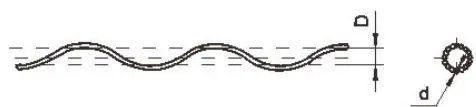
| Model | Applicable Conductor(mm2) | Main Dimensions(mm) | Qty | Reference Weight(kg) | ||
|---|---|---|---|---|---|---|
| D | d | L | ||||
| FYH-95/20 | JL/G1A-95/20 | 11.4 | 3.6 | 1400 | 13 | 0.55 |
| FYH-150/25 | JL/G1A-150/25 | 14.2 | 3.6 | 1500 | 16 | 0.70 |
| FYH-185/30 | JL/G1A-185/30 | 15.7 | 4.6 | 1800 | 14 | 1.30 |
| FYH-240/30 | JL/G1A-240/30 | 17.9 | 4.6 | 1900 | 16 | 1.50 |
| FYH-240/40 | JL/G1A-240/40 | 17.9 | 4.6 | 1900 | 16 | 1.50 |
| FYH-300/25 | JL/G1A-300/25 | 19.7 | 6.3 | 2000 | 13 | 2.40 |
| FYH-300/40 | JL/G1A-300/40 | 19.9 | 6.3 | 2000 | 13 | 2.40 |
| FYH-400/35 | JL/G1A-400/35 | 22.3 | 6.3 | 2200 | 14 | 2.80 |
| FYH-400/50 | JL/G1A-400/50 | 23.0 | 6.3 | 2200 | 14 | 2.80 |
| FYH-500/45 | JL/G1A-500/45 | 24.9 | 6.3 | 2500 | 16 | 3.50 |
| FYH-630/45 | JL/G1A-630/45 | 27.9 | 7.8 | 2500 | 15 | 5.40 |
| FYH-630/55 | JL/G1A-630/55 | 28.5 | 7.8 | 2500 | 15 | 5.40 |
| Model | Applicable Conductor(mm2) | Main Dimensions(mm) | Qty | Reference Weight(kg) | ||
|---|---|---|---|---|---|---|
| D | d | L | ||||
| FYH-50BG | LBGJ-50-23AC | 7.7 | 3.6 | 1000 | 9 | 0.95 |
| FYH-80BG | JLB1A-80 | 9.6 | 3.6 | 1400 | 12 | 1.61 |
| FYH-100BG | LBGJ-100-20AC | 11.0 | 3.6 | 1400 | 12 | 1.92 |
| FYH-120BG | JLB1A-120 | 12.0 | 3.6 | 1400 | 14 | 1.72 |
| FYH-150BG | LBGJ-150-40AC | 13.2 | 3.6 | 1500 | 15 | 1.98 |
| FYH-185BG | LBGJ-185-20AC | 14.5 | 3.6 | 1500 | 16 | 2.10 |
| Model | Applicable Conductor(mm2) | Main Dimensions(mm) | Qty | Reference Weight(kg) | ||
|---|---|---|---|---|---|---|
| D | d | L | ||||
| FYH-35/6 | LGJ-35/6 | 7.1 | 3.6 | 1000 | 9 | 0.20 |
| FYH-50/8 | LGJ-50/8 | 8.0 | 3.6 | 1100 | 9 | 0.25 |
| FYH-50/30 | LGJ-50/30 | 9.8 | 3.6 | 1300 | 11 | 0.30 |
| FYH-70/10 | LGJ-70/10 | 9.7 | 3.6 | 1300 | 11 | 0.33 |
| FYH-95/15 | LGJ-95/15 | 11.4 | 3.6 | 1400 | 13 | 0.53 |
| FYH-95/20 | LGJ-95/20 | 11.4 | 3.6 | 1400 | 13 | 0.54 |
| FYH-95/55 | LGJ-95/55 | 13.3 | 3.6 | 1500 | 16 | 0.62 |
| FYH-120/7 | LGJ-120/7 | 12.0 | 3.6 | 1400 | 14 | 0.55 |
| FYH-120/20 | LGJ-120/20 | 12.5 | 3.6 | 1400 | 14 | 0.57 |
| FYH-120/25 | LGJ-120/25 | 13.0 | 3.6 | 1400 | 14 | 0.58 |
| FYH-120/70 | LGJ-120/70 | 14.9 | 4.6 | 1800 | 14 | 0.75 |
| FYH-150/8 | LGJ-150/8 | 13.3 | 3.6 | 1500 | 16 | 0.62 |
| FYH-150/20 | LGJ-150/20 | 14.7 | 3.6 | 1500 | 16 | 0.65 |
| FYH-150/25 | LGJ-150/25 | 14.2 | 3.6 | 1500 | 16 | 0.64 |
| FYH-150/35 | LGJ-150/35 | 14.5 | 3.6 | 1500 | 16 | 0.66 |
| FYH-185/10 | LGJ-185/10 | 14.9 | 4.6 | 1800 | 14 | 1.24 |
| FYH-185/25 | LGJ-185/25 | 15.7 | 4.6 | 1800 | 14 | 1.25 |
| FYH-185/30 | LGJ-185/30 | 15.7 | 4.6 | 1800 | 14 | 1.26 |
| FYH-185/45 | LGJ-185/45 | 16.3 | 4.6 | 1800 | 14 | 1.26 |
| FYH-210/10 | LGJ-210/10 | 15.9 | 4.6 | 1800 | 14 | 1.27 |
| FYH-210/25 | LGJ-210/25 | 16.6 | 4.6 | 1800 | 14 | 1.28 |
| FYH-210/35 | LGJ-210/35 | 16.9 | 4.6 | 1800 | 14 | 1.28 |
| FYH-210/50 | LGJ-210/50 | 17.3 | 4.6 | 1800 | 14 | 1.30 |
| FYH-240/30 | LGJ-240/30 | 17.9 | 4.6 | 1900 | 16 | 1.44 |
| FYH-240/40 | LGJ-240/40 | 17.9 | 4.6 | 1900 | 16 | 1.44 |
| FYH-240/55 | LGJ-240/55 | 18.6 | 4.6 | 1900 | 13 | 1.50 |
| FYH-300/15 | LGJ-300/15 | 19.1 | 6.3 | 2000 | 13 | 2.30 |
| FYH-300/20 | LGJ-300/20 | 19.4 | 6.3 | 2000 | 13 | 2.30 |
| FYH-300/25 | LGJ-300/25 | 19.7 | 6.3 | 2000 | 13 | 2.33 |
| FYH-300/40 | LGJ-300/40 | 19.9 | 6.3 | 2000 | 13 | 2.34 |
| FYH-300/50 | LGJ-300/50 | 20.1 | 6.3 | 2000 | 13 | 2.34 |
| FYH-300/70 | LGJ-300/70 | 20.9 | 6.3 | 2000 | 13 | 2.54 |
| FYH-400/20 | LGJ-400/20 | 22.3 | 6.3 | 2200 | 14 | 2.80 |
| FYH-400/25 | LGJ-400/25 | 22.1 | 6.3 | 2200 | 14 | 2.80 |
| FYH-400/35 | LGJ-400/35 | 22.3 | 6.3 | 2200 | 14 | 2.80 |
| FYH-400/50 | LGJ-400/50 | 23.0 | 6.3 | 2200 | 14 | 2.80 |
| FYH-400/65 | LGJ-400/65 | 23.2 | 6.3 | 2200 | 14 | 2.83 |
| FYH-400/95 | LGJ-400/95 | 24.8 | 6.3 | 2200 | 14 | 2.85 |
| FYH-500/35 | LGJ-500/35 | 24.9 | 6.3 | 2500 | 16 | 3.48 |
| FYH-500/45 | LGJ-500/45 | 24.9 | 6.3 | 2500 | 16 | 3.48 |
| FYH-500/65 | LGJ-500/65 | 25.7 | 6.3 | 2500 | 16 | 3.50 |
| FYH-630/45 | LGJ-630/45 | 27.9 | 7.8 | 2500 | 15 | 5.32 |
| FYH-630/55 | LGJ-630/55 | 28.5 | 7.8 | 2500 | 15 | 5.40 |
| FYH-630/80 | LGJ-630/80 | 28.9 | 7.8 | 2500 | 15 | 5.40 |
| FYH-720/50 | ACSR-720/50 | 31.0 | 7.8 | 3000 | 15 | 6.20 |
| FYH-800/55 | LGJ-800/55 | 31.8 | 7.8 | 2500 | 17 | 6.02 |
| FYH-800/70 | LGJ-800/70 | 32.1 | 7.8 | 2500 | 17 | 6.10 |
| FYH-800/100 | LGJ-800/100 | 32.3 | 7.8 | 2500 | 17 | 6.20 |
Related Pages
The short sets for the same conductors: FYB preformed armor rods, YJB preformed armor rods. Dampers that specify which preformed set goes with them: FRYJ. Wrap-around protection tape: aluminum armor tape.
Note: Sixty-six sets in three tables. Tables 1 and 3 list the same twelve products twice — JL/G1A and LGJ — with identical D, d, L and Qty and a weight up to 0.08 kg apart. Aluminium rows verify at 0.94–1.16 of a 2.7 g/cm³ calculation, which confirms d, Qty and the weight column. Table 2 (aluminium-clad steel) sits 1.09–1.43 of a steel calculation, which is right, but the three smallest sets run 20–43 per cent above even that, and FYH-100BG at 1.92 kg exceeds FYH-120BG at 1.72 kg with fewer, equally long rods. FYH-120/70 at 0.75 kg is a third below the 1.13 kg its own geometry gives; FYH-240/55 is heavier than its 16-rod neighbours with 13 rods. The 720 set is 3000 mm and the 800 sets 2500 mm.