JBT Grounding Rod
Diameter: 14 or 16 mm · Length: 1000, 2000 or 3000 mm · Material: copper-clad steel
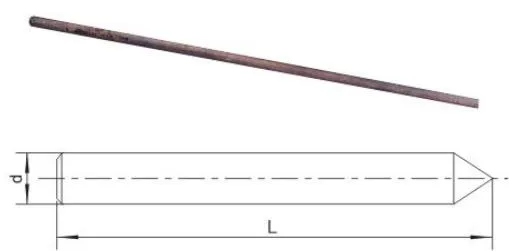
JBT is a driven earth rod. The factory note is one line and it says the whole thing: “‘JBT’ adopts copper-clad steel.” Not solid copper, not galvanised steel — a steel core with a copper skin.
That combination is the point of the product. The steel core is what survives being driven through made ground with a hammer; the copper skin is what carries the current into the soil and what resists corrosion for the twenty or thirty years the rod is expected to last. A solid copper rod would deform under the driving; a galvanised steel rod would lose its zinc in aggressive soil within a few years.
The model number is the diameter and the length
JBT-1630 is not an arbitrary code. Read it as 16 mm × 30, where the 30 is the length in hundreds of millimetres:
| Model | Diameter d (mm) | Length L (mm) | Length in metres | Reference weight (kg) |
|---|---|---|---|---|
| JBT-1410 | 14 | 1000 | 1 m | 1.25 |
| JBT-1420 | 14 | 2000 | 2 m | 2.50 |
| JBT-1610 | 16 | 1000 | 1 m | 1.68 |
| JBT-1620 | 16 | 2000 | 2 m | 3.36 |
| JBT-1630 | 16 | 3000 | 3 m | 4.95 |
The weights confirm the reading: doubling the length doubles the weight exactly (1.25 → 2.50, 1.68 → 3.36). So the code is consistent with the mass, and there is no hidden second meaning in it.
Five sizes, and one that is missing
Only five combinations are catalogued out of the six the two diameters and three lengths would allow:
- 14 mm comes in 1 m and 2 m. There is no JBT-1430.
- 16 mm comes in all three: 1 m, 2 m and 3 m.
So if a specification calls for a 3 m rod at 14 mm, it is not a stock item — either step up to 16 mm, or plan on coupling two 14 mm rods, which the sheet does not list a coupling for.
Reading the drawing
The drawing labels only two dimensions:
- d — the rod diameter, 14 or 16 mm.
- L — the overall length, 1000 to 3000 mm.
One end is chamfered and the other is pointed. The chamfer is the driving end — it takes the hammer blows without mushrooming the head past the diameter of the hole, which is what lets a rod be driven to depth and still be clampable. The point is the entering end.
Fitting it
- Drive, do not drill and drop. The copper skin is thin; a rod dropped into an oversized hole has poor soil contact and the earth resistance will not come down.
- Leave the chamfered end proud. You need enough rod above ground to land the earth clamp — see JDL — and to inspect the connection at every visit.
- Do not weld to the rod. A welded connection burns the copper off the steel at exactly the point that has to stay corrosion-resistant. Use a clamp, or an exothermic weld with the correct mould.
- The sheet lists no coupling and no driving stud. If you need to joint two rods or protect the head during driving, ask — do not assume they are in the box.
The rest of the family
- JDL grounding clamp — the clamp that lands the conductor on the rod.
- JBCD piercing grounding clamp — for bonding without stripping the conductor.
- DG ground wire terminals — the terminal end of the same run.
- Copper-aluminium accessories — the wider group this rod is photographed with.
Note: Quote the model as it is written — JBT-1620 — and say whether a driving stud or a coupling is needed, because neither is on the sheet.