JDG Ground Wire Terminal
Models: JDG-35 – JDG-100 (GB 2008) · Conductor: 35–100 mm² steel strand · Bores: 9.5–15.0 mm · Reference Weight: 0.20–0.39 kg
The Short Bolted Terminal
JDG is the bolted, short-bodied terminal for bare galvanised steel strand, numbered to GB 2008. Four sizes, 35 to 100 mm², and the smallest of the ground wire terminals on the site at 0.20 to 0.39 kg.
Where the DG-G is a long cast body that reaches past whatever is in the way, JDG is a short bolted clamp: L1 60 to 80 mm, a flat palm and a single bolt. Use it where the ground wire lands directly on a plate or a bracket and there is nothing to reach around; use DG-G where the terminal has to be a bracket itself.
One Bolt Size Across the Range
Φ is 18 mm on all four sizes. Nothing else on this page changes with the rating: D goes 16, 18, 22, 26 and the bore 9.5, 11.0, 13.0, 15.0, but the palm bolt stays one size.
That is worth knowing when you specify a run: an earthing system built from JDG terminals needs one bolt and one hole at every attachment point, from 35 mm² to 100 mm². The cast DG series does not offer that — its Φ runs 18, 20 and 22 with the size. On a tower where the ground wire steps up in section, JDG means the hardware does not step with it.
The Weight Column Behaves Here
Read the weights in order: 0.20, 0.24, 0.32, 0.39 kg — monotonic, and the steps are proportional to the size step.
That is not a small thing on this family. The cast DG-BG sheet has four weight steps that go backwards or flat while the bore grows, which is why those figures carry a ±0.1 kg warning. The JDG column does not have that problem and can be used for a freight estimate as printed.
The column is computed the same way as on the cast sheet, and on these sizes it rises with the size.
Bores: Compare, Do Not Assume
The 2008 numbering does not simply rename the older sizes, and the bores prove it:
| Size | JDG | JDBG | DG-BG series | DG-G series |
|---|---|---|---|---|
| 80 | 13.0 | 13.0 | 13.0 | 12.1 |
| 100 | 15.0 | 15.0 | 14.5 | 13.7 |
| 35 | 9.5 | — | 9.0 | — |
On the two sizes it shares with JDBG the bore is identical, and on both it is 0.8 to 1.3 mm wider than the old DG-G terminal. So the 2008 part is not the old part with a new label: the bore moved, and a DG-80G will not take a strand that a JDG-80 takes.
At 35 mm² there is one more thing to see. JDG-35 grips 9.5 mm where the aluminium DG-35BG grips 9.0 — the opposite of the pattern everywhere else, where the steel-side terminal is the narrower one. The DG-G series starts at 70, so JDG-35 has no steel-side counterpart to compare against, which makes it the one size on these four sheets where the number cannot be trusted to tell you which terminal is wider.
Measure the strand. On a fixed-bore terminal that is not caution, it is the only way to order.
Technical Parameters
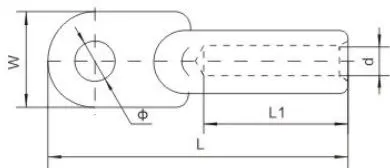
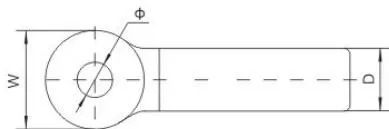
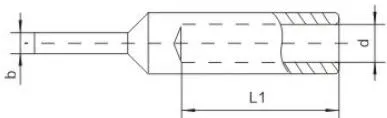
| Model (GB 2008) | Main Dimensions (mm) | Reference Weight (kg) | |||||
|---|---|---|---|---|---|---|---|
| D | d | b | Φ | W | L1 | ||
| JDG-35 | 16 | 9.5 | 8 | 18 | 30 | 60 | 0.20 |
| JDG-50 | 18 | 11.0 | 8 | 18 | 30 | 60 | 0.24 |
| JDG-80 | 22 | 13.0 | 8 | 18 | 40 | 70 | 0.32 |
| JDG-100 | 26 | 15.0 | 8 | 18 | 40 | 80 | 0.39 |
Related Pages
The cast terminal in aluminium and galvanised steel: DG ground wire terminal. The pressed terminal for aluminium-clad strand: JDBG ground wire terminal. Steel strand splices: JY-G and JBD-G. Grounding clamps: JDL grounding clamp.
Note: Φ is 18 mm on all four sizes, so one bolt serves the whole range — the cast DG needs three. The bores match JDBG exactly on 80 and 100 and run 0.8 to 1.3 mm wider than the old DG-G, so a 2008 part is not a renamed old one. At 35 mm² the JDG bore of 9.5 is wider than the aluminium DG-35BG at 9.0, which is the one place the pattern inverts; measure the strand. The weight column is monotonic here, unlike the cast DG-BG sheet.