BD Overhead Ground Wire Suspension Hanger
Models: BD-1839 – BD-2762 (4 sizes) · Pole: φ190–φ400 tapered RC · Reference Weight: 4.26–7.1 kg
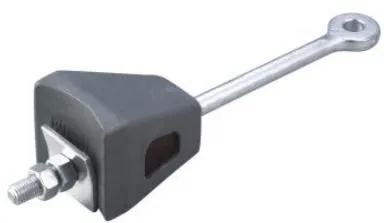
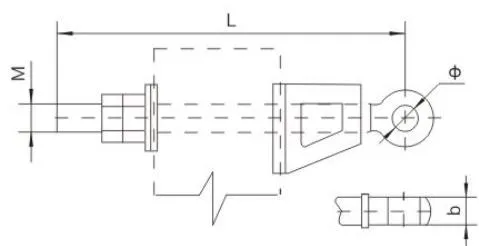
The BD brackets the overhead ground wire off the side of a tapered reinforced-concrete pole. It is not a clamp: it is the steel hanger that puts the wire out where it belongs and holds the fitting that grips it, banded to the pole through the bolt marked M.
Four sizes, one per standard pole taper.
Technical Parameters
| Model | Applicable Range | Main Dimensions (mm) | Reference Weight (kg) | |||
|---|---|---|---|---|---|---|
| Φ | b | M | L | |||
| BD-1839 | φ190 Tapered RC Pole | 20 | 18 | 18 | 390 | 4.26 |
| BD-2244 | φ230 Tapered RC Pole | 20 | 18 | 22 | 440 | 4.77 |
| BD-2451 | φ300 Tapered RC Pole | 20 | 18 | 24 | 510 | 5.25 |
| BD-2762 | φ400 Tapered RC Pole | 20 | 18 | 27 | 620 | 7.10 |
The Model Number Is Two Dimensions
Every one of the four models can be read without the table. The first pair of digits is the bolt size M, the second pair is the length L divided by ten.
| Model | First pair | M in table | Second pair | L in table |
|---|---|---|---|---|
| BD-1839 | 18 | 18 | 39 | 390 |
| BD-2244 | 22 | 22 | 44 | 440 |
| BD-2451 | 24 | 24 | 51 | 510 |
| BD-2762 | 27 | 27 | 62 | 620 |
All four check, exactly, with no rounding. So BD-2762 is an M 27 hanger 620 mm long. That is a useful property in the field, because the only two things that matter when you are picking one off a truck are which bolt fits the pole band and whether the bracket is long enough.
L Follows the Pole
The bracket length is not a free choice — it is set by the pole it has to reach around:
| Pole | φ190 | φ230 | φ300 | φ400 |
|---|---|---|---|---|
| L | 390 | 440 | 510 | 620 |
| L minus pole diameter | 200 | 210 | 210 | 220 |
The offset from the pole surface runs 200 to 220 mm across the whole range. That is the number that actually matters: it is where the ground wire lands relative to the pole face, and it is held nearly constant on purpose so that the same cross-arm geometry, the same clearance calculation and the same fitting stack all work on a 190 pole and a 400 pole.
If you are designing for a pole size that is not in this table, the offset is the thing to specify. A φ350 pole needs an L of about 560 to 570 mm, which is not a catalogue item — ask, and we will quote it against the drawing rather than have you shim a 510.
What Φ and b Are
- Φ 20 mm — constant on all four. It is the through-bolt or pin at the wire end, so one size of fitting hangs off every model in the family.
- b 18 mm — constant on all four. It is the plate thickness at the banding point, and it is what the pole band has to clamp against.
The only dimension that changes with pole size is M (the banding bolt) and L. Everything at the wire end is identical, which means the fittings you hang on the BD do not have to be re-selected when the pole size changes.
Weight
4.26 kg on the smallest, 7.10 kg on the φ400. Two thirds more steel on the largest, in a bracket whose only job is to hold a wire. If you are pricing a concrete-pole line by the tonne of hardware, the BD is not a rounding error — it is the heaviest single item in the ground-wire assembly.
Material & Finish
- Material: hot-dip galvanized steel
- Finish: hot-dip galvanized to ISO 1461, minimum coating 65 μm
- Tolerance: ±0.5 mm on the bolt holes and the banding face
- Certification: mill test certificates on request
The bracket sits against a concrete pole, which is an alkaline environment and a wet one at the base. Galvanizing is the specified protection, not paint: the zinc sacrifices itself at the pole interface where the coating is scratched during installation, and paint would simply fail there.
Related Fittings
UB clevis for suspension — the shackle that hangs off the ground wire end.
ZBS clevis for suspension — the flat clevis used in the same position on smaller assemblies.