YH Type Composite Busbar Ring
Models: YH(2+8) – YH-2x800+24x240 (7 sizes) · D: 120–360 mm · Weight: 2.3–8.5 kg
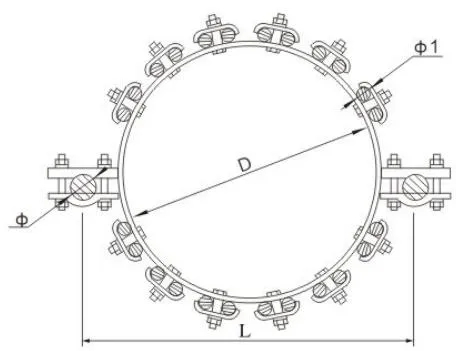
What The Bracket Means, And Which Row Explains It
The five smaller models are written YH(2+8), (2+12), (2+16), (2+20), (2+24). The two largest are written out in full: YH-2x630+24x240 and YH-2x800+24x240.
The full form decodes the bracket. It is a count of conductors on each of two levels — 2 of one size and 24 of another. So the bracket rows should read 2 + 8, 2 + 12, 2 + 16, 2 + 20, 2 + 24 sub-conductors against 2 mains.
That reading is confirmed by Ø1, which is 21.66 mm on both large rows — they both carry 24 sub-conductors of 240 mm², so Ø1 is the sub-conductor diameter and the two models differ only in the main pair: Ø 35 mm for the 630 and 39 mm for the 800.
But the five bracket rows print no Ø and no Ø1 at all. So the five smaller rings are described by a conductor count with no diameter to check the fit against.
D And L: Five Rows Share One Offset, Two Do Not
D is the ring diameter, L the overall length, and for five rows the difference is constant:
| Model | D | L | L − D |
|---|---|---|---|
| YH(2+8) | 120 | 210 | 90 |
| YH(2+12) | 160 | 250 | 90 |
| YH(2+16) | 200 | 290 | 90 |
| YH(2+20) | 240 | 330 | 90 |
| YH(2+24) | 280 | 370 | 90 |
| YH-2x630+24x240 | 320 | 420 | 100 |
| YH-2x800+24x240 | 360 | 500 | 140 |
The first five are one family scaled by 40 mm steps — the body grows, the proportions do not. The last two break the pattern, and the break widens: 100 mm on the 630, 140 mm on the 800.
So the two largest are not the small ring made bigger. They carry a longer body relative to their diameter, which is what you would expect from a ring that has to hold 24 sub-conductors around a 39 mm main rather than a handful around a 24 mm one.
The Two Largest Weigh Three Times More Per Millimetre
D steps by exactly 40 mm on every row, which makes the weight column easy to read:
| Step | D | Weight | Added per 40 mm |
|---|---|---|---|
| (2+8) → (2+12) | 120 → 160 | 2.3 → 2.8 | +0.5 kg |
| (2+12) → (2+16) | 160 → 200 | 2.8 → 3.6 | +0.8 kg |
| (2+16) → (2+20) | 200 → 240 | 3.6 → 4.1 | +0.5 kg |
| (2+20) → (2+24) | 240 → 280 | 4.1 → 4.7 | +0.6 kg |
| (2+24) → 630 | 280 → 320 | 4.7 → 6.5 | +1.8 kg |
| 630 → 800 | 320 → 360 | 6.5 → 8.5 | +2.0 kg |
Inside the bracket family each 40 mm costs 0.5 to 0.8 kg. Past it, the same 40 mm costs 1.8 and 2.0 kg — three times as much.
Two things could do that: a heavier construction, or more sub-conductors (24 instead of the 8 to 24 of the bracket rows). Both are consistent with the sheet and neither is stated. If you are choosing between YH(2+24) at 4.7 kg and the 630 at 6.5 kg for the same job, the difference is not the diameter — ask what changes at that step.
The Conductor Column Does Not Line Up One To One
The column is headed Conductor Cross-Section (mm²), and it does not hold an area. It holds strings like “185 x 8 / 240 x 12” — a count times an area, twice.
Worse, the strings do not sit one per row:
- YH(2+8) reads 185 x 8 / 240 x 12 — two combinations, and the “12” belongs to the next model up.
- YH(2+12) reads 240 x 12 / 300 x 16 — the same 240 x 12 again, plus the “16” of the row below.
- YH(2+16) and both large rows are empty.
- YH(2+24) reads just “24” — truncated, missing its conductor area.
So consecutive rows share a combination, one row carries a fragment, and three are blank. The conductor-to-model mapping cannot be read off this table. Only the two full models are unambiguous, because their names state the constitution.
For the five bracket rows, tell us the actual conductor layout and let us confirm the ring — do not pick by the bracket number alone.
What Is Not On The Page
- No material — no alloy, no finish, no galvanising specification, though the weights and the “composite” name imply more than one material.
- No bolt size, no torque.
- No weight tolerance — with a 0.5 kg step between sizes, a few per cent of tolerance moves a ring into the next class.
- No rated short-circuit current, which is the duty of a busbar spacer.
Technical Parameters
| Model | Conductor Cross-Section (mm²) | Main Dimensions (mm) | Reference Weight (kg) | |||
|---|---|---|---|---|---|---|
| Ø | Ø1 | D | L | |||
| YH(2+8) | 185 x 8 / 240 x 12 | 120 | 210 | 2.3 | ||
| YH(2+12) | 240 x 12 / 300 x 16 | 160 | 250 | 2.8 | ||
| YH(2+16) | 200 | 290 | 3.6 | |||
| YH(2+20) | 400 x 20 | 240 | 330 | 4.1 | ||
| YH(2+24) | 24 | 280 | 370 | 4.7 | ||
| YH-2x630+24x240 | 35 | 21.66 | 320 | 420 | 6.5 | |
| YH-2x800+24x240 | 39 | 21.66 | 360 | 500 | 8.5 | |
Related Pages
Tubes these rings go onto: aluminum tubular busbar. Spacers for two parallel tubes: JS double busbar spacer. Fittings between tube and channel sections: KLMG cross-road transition.
Note: Seven rings at 40 mm diameter steps. The bracket models (2+8) to (2+24) count conductors on two levels, decoded by the two rows written out in full — YH-2x630+24x240 and YH-2x800+24x240 — where Ø1 is 21.66 mm, the 240 mm² sub-conductor, and Ø is 35 and 39 mm for the main pair. L − D is 90 mm on the five bracket rows and 100 and 140 mm on the two largest. Each 40 mm costs 0.5–0.8 kg inside the family and 1.8–2.0 kg beyond it. The conductor column holds count-times-area strings, consecutive rows share one, one row is truncated to “24” and three are blank, so the mapping cannot be read off the table. No material, bolt, torque or short-circuit rating printed.