ZCJ Type Support Bracket
Models: ZCJ-45 – ZCJ-450 (5 rows) · Height: 300–445 mm · Weight: 6.0–14.2 kg
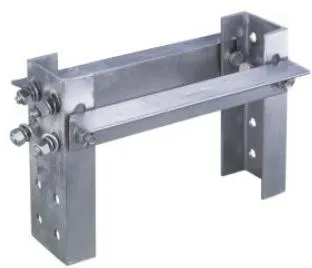
Two Tables That Do Not Share A Header
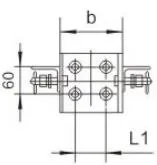
The first table has four rows and four dimensions — Φ, b, H, L. The second has one row and three — b, L1, L, under a header that reads General Design No. instead of Model.
So there is no column that appears in both beyond b and L, and the single row of the second table cannot be compared with the four in the first on anything but length and weight. Treat them as two products that happen to share a page.
Four Sizes, Two Variables Only
Φ is 18 mm and b is 120 mm on all four rows of the first table. Only H and L move:
| Model | H | L | Weight |
|---|---|---|---|
| ZCJ-45 | 300 | 370 | 10.5 kg |
| ZCJ-45H | 445 | 358 | 14.2 kg |
| ZCJ-50 | 300 | 416 | 13.1 kg |
| ZCJ-50S | 300 | 420 | 13.5 kg |
That is a single post section with four bodies. There is no larger-diameter version on the sheet — if the load needs a thicker post than 18 mm, nothing here covers it.
The H Variant Buys 145 mm For 3.7 kg
ZCJ-45H is the same bracket raised: H goes from 300 to 445 mm, and the weight goes from 10.5 to 14.2 kg — plus 35 per cent.
Note what happens to L: it falls, from 370 to 358 mm. So L is not the overall height and does not grow with H — the two are independent dimensions, and the taller bracket is also 12 mm shorter in L.
Per millimetre of L the four rows run 0.028, 0.040, 0.032 and 0.032 kg. The H variant is the heaviest per unit length, which is what an extra 145 mm of post should cost. If the design only needs 350 mm of height, the H variant is 3.7 kg of metal for nothing.
S Adds Four Millimetres And Point Four Kilos
ZCJ-50 to ZCJ-50S is the smallest step on the page: 4 mm more L, 0.4 kg more weight, everything else identical.
Four millimetres is inside what a site tolerance would absorb, so the two are close to the same part with a different drawing. If both are quoted, ask which one the factory actually builds — the 0.4 kg and the 4 mm suggest a revision rather than a size.
The step from ZCJ-45 to ZCJ-50 is the real one: 46 mm more L and 2.6 kg more weight, 25 per cent.
ZCJ-450 Is The Odd Row, And The Cheapest
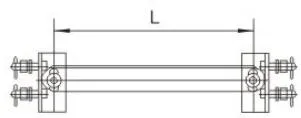
The second table’s single row is ZCJ-450 — b 120, L1 60, L 450, 6.0 kg.
Compare: it is 80 mm longer than ZCJ-45 and 4.5 kg lighter. On the first table’s pattern, 370 mm of bracket costs 10.5 kg; 450 mm costs 6.0. That cannot be the same construction.
The second table is a different feature set: its dimensions belong to the General Design No. bracket, a standardised light-duty part rather than the fabricated brackets above — which is why L1 has no counterpart in the first table. The two are different shapes and are drawn separately.
ZCJ-450 is costed from its own row, not from the first table’s kilograms per millimetre — that ratio comes out at nearly double the sheet figure, because the 450 is a deeper bracket carrying more plate.
Two Codes One Character Apart
ZCJ-45 and ZCJ-450 are both on this page, and they are different products at different weights. A purchase order that loses or gains a zero buys the wrong bracket, and the price difference is a factor of nearly two.
Write the code in full, with the H or S suffix where it applies, and check the weight on the acknowledgement against the table above. It is the fastest way to catch the error before it ships.
What Is Missing
- No material and no galvanising specification, though this is an outdoor support carrying a busbar.
- No load rating of any kind — no vertical load, no cantilever moment, no wind figure. A bracket is bought for its strength and the sheet gives its geometry only.
- No bolt or foundation detail — no base plate size, no hole pattern, no anchor centres.
- No tube or insulator interface — Φ 18 mm is printed but not named, so it is not stated what mounts on it.
Technical Parameters
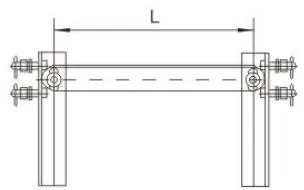
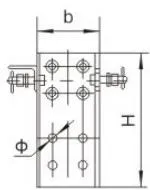
| Model | Main Dimensions (mm) | Reference Weight (kg) | |||
|---|---|---|---|---|---|
| Φ | b | H | L | ||
| ZCJ-45 | 18 | 120 | 300 | 370 | 10.5 |
| ZCJ-45H | 18 | 120 | 445 | 358 | 14.2 |
| ZCJ-50 | 18 | 120 | 300 | 416 | 13.1 |
| ZCJ-50S | 18 | 120 | 300 | 420 | 13.5 |
| General Design No. | Main Dimensions (mm) | Reference Weight (kg) | ||
|---|---|---|---|---|
| b | L1 | L | ||
| ZCJ-450 | 120 | 60 | 450 | 6.0 |
Related Pages
Tubes and fittings the bracket carries: aluminum tubular busbar, KLMG cross-road transition. Attachment hardware above it: GD attachment point fitting, YL / YLP extension rod.
Note: Two tables with different headers — Φ/b/H/L for the four ZCJ-45 to 50S rows, and b/L1/L for the single ZCJ-450 row under a General Design No. header. Φ 18 and b 120 are constant, so only H and L vary; there is no heavier post section. ZCJ-45H adds 145 mm of H for 3.7 kg while L falls 12 mm. ZCJ-50 to 50S is 4 mm and 0.4 kg, more like a revision than a size. ZCJ-450 prints 6.0 kg at 450 mm against 10.5 kg at 370 mm for ZCJ-45, which cannot be the same construction — do not cost it from the first table. The two codes differ by one character. No material, no load rating, no base plate or hole pattern.