GGJ Type Tubular Busbar Transition Joint
Models: GGJ-70 – GGJ-150 · Tubular Busbar OD: 70–150 mm · Sizes: 8
Two Columns, One Number
Read the table straight down and both data columns carry the same figure: GGJ-70 is 70 mm, GGJ-150 is 150 mm, and every row in between repeats itself.
The sheet is a size list, not a dimension sheet. It confirms that a joint exists for a given tube outside diameter and it tells you nothing else — no length, no wall thickness, no weight, no bore, no flange or bolt pattern.
That is worth saying plainly: a GGJ is specified by its drawing, not by a size table. What the list does is confirm that the range covers your tube before you enquire.
The Series Steps By Ten, Until It Doesn’t
The eight sizes run 70, 80, 90, 100, 110, 120, 130, 150.
Between 70 and 130 the step is 10 mm and the spacing is even. Then the last size jumps 20 mm — there is no GGJ-140.
So a 140 mm tube has no catalogue joint. It sits between the 130 and the 150, and neither will fit: one is 10 mm under and one is 10 mm over. If your design uses 140 mm tube, that is a special from the start, not a stock item.
The series is otherwise dense enough that most standard tubular busbar sizes are covered — 6063 aluminium tube is commonly stocked in the 70 to 150 range at 10 mm increments, and this list tracks that.
What A GGJ Is Specified By
Everything that makes it installable comes with the drawing, and the drawing comes with the quotation:
- Length — how long the transition is.
- Wall thickness and bore — whether it slips over the tube, butts to it, or is bored to match.
- The transition itself — GGJ is a transition joint, so it changes section or material; the drawing states to what. A tube-to-flat-plate transition and a tube-to-tube reducer are different parts and both carry this name.
- Bolt holes or flange — the pattern and the bolt size.
- Weight — per piece, against the drawing.
Send the four items in the next section and the drawing goes out with the price.
What To Send Us Before Ordering
To quote a GGJ accurately we need four things that the sheet does not contain:
- The tube outside diameter and wall thickness at each end — the OD is in the table, the wall is not.
- What the joint connects to — tube to tube, tube to flat terminal plate, or tube to a different tube size.
- The overall length required, or the gap it has to bridge.
- The material at each end — aluminium tube to copper equipment needs a bimetallic transition, and that is a different part from an aluminium-to-aluminium one.
Send those and we will come back with a drawing. Ordering from the model number alone risks a part that fits the diameter and matches nothing else.
Technical Parameters
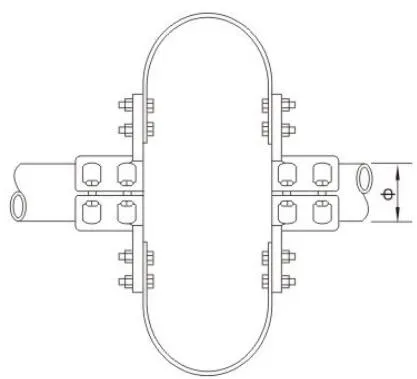
| Model | Tubular Busbar O.D. (mm) | Main Dimension Ø (mm) |
|---|---|---|
| GGJ-70 | 70 | 70 |
| GGJ-80 | 80 | 80 |
| GGJ-90 | 90 | 90 |
| GGJ-100 | 100 | 100 |
| GGJ-110 | 110 | 110 |
| GGJ-120 | 120 | 120 |
| GGJ-130 | 130 | 130 |
| GGJ-150 | 150 | 150 |
Related Pages
Tubular busbar fittings of all kinds start at tubular busbar fittings installation schematic. Tubular expansion joints: MGS. Flat busbar transition plates: MG, MGB.
Note: Eight sizes, and both columns print the same number, so this is a size list rather than a dimension sheet. There is no length, wall thickness, bore, bolt pattern or weight. The series steps by 10 mm from 70 to 130 and then jumps to 150 — there is no 140 mm joint.