GLM Aluminium Oil-Blocking Connection Tube
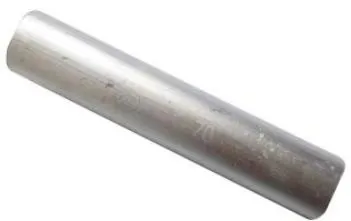
Models: GLM-10 – GLM-630 (15 sizes)
GLM is an aluminium tube with a solid block in the middle. The two barrels are not connected to each other. One conductor enters from the left, one from the right, and nothing passes between them — not the conductor, and not the oil.
The M means oil-blocking. It is the current designation; if you are holding an older drawing or a tender document that says GL, it is the same part; the former GL designation has been superseded by GLM.
What the block is for
On an oil-filled or oil-impregnated paper cable the insulation is not solid. It is paper wound around the conductor, saturated with oil, and that oil is under pressure and free to travel along the conductor strands. A joint is a hole in that oil system.
Without a block, two things happen, and both are slow:
- The oil migrates toward the low-pressure end. The high side drains, the paper dries, and dry paper is a partial-discharge site. The failure surfaces years later, inside the joint, and reads as a manufacturing defect.
- The low side over-pressurises. Oil arriving faster than it can be held finds the weakest accessory — a sealing end, a stress cone — and weeps.
A solid block stops the migration at the joint. That is the entire function of the middle of this tube, and it is the only reason the part exists.
If the cable is XLPE or PVC, you do not need it. Solid insulation has no oil to move. The GL-G through-hole tube does the same electrical job without the block, and it is shorter where the block was contributing length — GL-G-16 is 65 mm against 70 mm here. Fitting an oil-blocking tube to an XLPE cable is paying for a feature that has nothing to do.
Reading the drawing
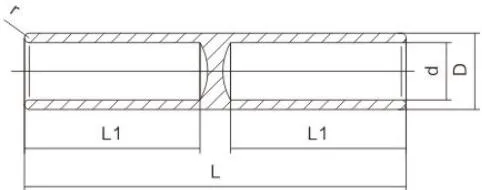
The section shows the block as solid hatching in the middle, with an identical barrel either side.
- L1 is the depth of one barrel. Both barrels are equal, so the sheet states it once. L is not 2 × L1 — the difference is the block itself: 9 mm at GLM-10 (65 − 2×28), 10 mm at GLM-630 (170 − 2×80). Do not crimp on it.
- r is the radius on the outside edge of the mouth. It runs from 0.8 mm on the small sizes to 4.0 mm at GLM-630 and scales with wall thickness, because that is what it rolls over. Its job is not cosmetic: a square-cut mouth shaves strands on the way in and leaves a sharp edge under the tape. The radius is what makes the mouth safe to push a conductor through.
L1 is the strip length. Strip to L1, insert until the conductor bottoms on the block, crimp. On an oil-blocking tube the block is a physical stop, which is the one real advantage this design has over a through tube: the jointer cannot get the insertion depth wrong, because there is something to hit.
Aluminium is not a smaller copper
The bore d is the same as the copper equivalent at every size — a 240 mm² conductor is a 240 mm² conductor in either metal. What changes is the wall. Aluminium conducts at roughly 60 % of copper, so the tube needs more metal around the same bore to carry the current and to hold a crimp without splitting.
| Size | GLM (aluminium) D × d | GTM (copper) D × d |
|---|---|---|
| 25 | 12 × 7.0 | 11 × 7.0 |
| 95 | 21 × 13.0 | 18 × 13.0 |
| 240 | 30 × 20.0 | 27 × 20.0 |
| 630 | 54 × 34.0 | 45 × 34.0 |
Two things follow, and both are practical:
- They do not share a die. A die sized on
Dwill not close the other metal correctly, even at the same nominal size. The 630 aluminium tube needs a die 9 mm larger than the copper one. - A GLM will not fit where a GTM fits. On a tight cable box at 630 mm², the aluminium tube needs 9 mm more clearance.
Installation notes that matter for aluminium
Aluminium oxide forms in minutes on a stripped surface and is an insulator. Three points, in order:
- Wire-brush the conductor and the bore immediately before insertion, and apply contact grease to both. This is not optional on aluminium the way it is often skipped on copper.
- Use the die matched to
D, not to the nominal size. Under-crimping aluminium leaves a high-resistance joint that heats; over-crimping splits the tube wall. Aluminium has no elastic recovery to compensate for a loose crimp. - Do not mix metals in one tube. A GLM takes aluminium conductor only. For an aluminium-to-copper joint use the bimetallic GTL, which has a welded copper-aluminium barrier — a plain aluminium tube with copper in one end will corrode at the interface and fail.
Technical parameters — GLM, aluminium
| Model | Main dimensions (mm) | ||||
|---|---|---|---|---|---|
| D | d | L | L1 | r | |
| GLM-10 | 9 | 4.5 | 65 | 28 | 0.8 |
| GLM-16 | 10 | 5.5 | 70 | 31 | 0.8 |
| GLM-25 | 12 | 7.0 | 75 | 32 | 1.0 |
| GLM-35 | 14 | 8.5 | 85 | 37 | 1.0 |
| GLM-50 | 16 | 9.5 | 95 | 42 | 1.2 |
| GLM-70 | 18 | 12.0 | 105 | 46 | 1.2 |
| GLM-95 | 21 | 13.0 | 110 | 50 | 1.5 |
| GLM-120 | 23 | 15.0 | 115 | 52 | 1.5 |
| GLM-150 | 25 | 16.0 | 120 | 55 | 1.8 |
| GLM-185 | 27 | 18.0 | 125 | 57 | 1.8 |
| GLM-240 | 30 | 20.0 | 130 | 61 | 1.8 |
| GLM-300 | 34 | 23.0 | 140 | 65 | 1.8 |
| GLM-400 | 38 | 26.0 | 150 | 70 | 2.0 |
| GLM-500 | 42 | 29.0 | 160 | 75 | 2.2 |
| GLM-630 | 54 | 34.0 | 170 | 80 | 4.0 |
Reading the columns
- D (mm) — outside diameter. This selects the die.
- d (mm) — bore. Match the measured outside diameter of the stranded conductor.
- L (mm) — overall length, both mouths.
- L1 (mm) — depth of one barrel; both are equal. This is the strip length, and the block is the insertion stop.
- r (mm) — radius on the outside edge of the mouth, 0.8 to 4.0 mm.
Which tube in this family
| Tube | Metal | Inside | Depth column | Sizes | For |
|---|---|---|---|---|---|
| GLM | aluminium | oil block | L1 | 10 – 630 | aluminium conductor, oil-filled cable |
| GTM | copper | oil block | L1 | 10 – 630 | copper conductor, oil-filled cable |
| GL-G | aluminium | through | — | 16 – 800 | aluminium conductor, solid insulation |
| GT-G | copper | through | — | 10 – 630 | copper conductor, solid insulation |
| GTY | copper | through | — | 1.5 – 1000 | copper, thin wall, small to very large |
| GTL | copper + aluminium | bimetallic | L1, L2 | 16 – 630 | copper conductor to aluminium conductor |
Ordering
State the conductor metal, the cable type, and the conductor size. The cable type is not an optional detail here — it decides between an oil block and a through hole, and the two are not interchangeable on an oil-filled cable.
FAQ
What does oil-blocking mean? The tube is solid in the middle, so the two barrels are separate. On an oil-filled cable that stops the insulating oil migrating from one side of the joint to the other.
Is GLM the same as GL?
Yes. GL was the earlier designation for the aluminium oil-blocking tube; GLM is the current one. The dimensions are unchanged. If a tender document specifies GL, quote GLM.
Do I need it for XLPE cable? No. Solid insulation has no oil to migrate. Use the GL-G through-hole tube instead — same body without the block, and cheaper wherever the block was only adding length.
What is L1? The depth of one barrel. Both barrels are the same, so the sheet gives it once. L1 is also the strip length, and the block is a hard stop, so the conductor cannot be inserted too far.
How long is the block in the middle? L − 2 × L1. It is 9 mm at GLM-10 and 10 mm at GLM-630. Do not crimp on it.
Can I use GLM on copper conductor? No. Use GTM. The bore matches at every size, but the wall does not, and an aluminium tube crimped onto copper will corrode at the joint.
Is a smaller size available than GLM-10? 10 mm² is the smallest in the range. Below that the wall becomes too thin to crimp reliably, and a sealed splice is used instead.