GTY Copper Connection Tube
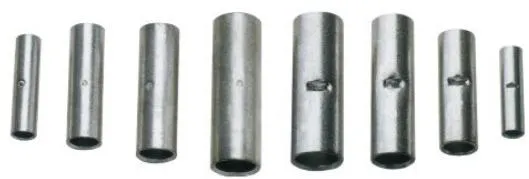
Models: GTY-1.5 – GTY-1000 (21 sizes)
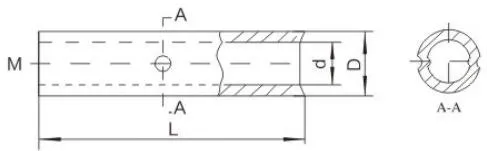
GTY is a straight copper tube, open at both ends, with nothing inside it. Push one conductor in each end, crimp both ends, and the two are joined. The sheet carries three columns and no more — D, d, L — which makes it the simplest part in the range and also the one most often ordered wrong, because three numbers look like enough and one of them is not.
What the three columns actually decide
| Column | What it is | What it decides |
|---|---|---|
| d | bore | whether the conductor goes in |
| D | outside diameter | which die you use |
| L | overall length | how much barrel you have to crimp |
There is no L1 on this sheet, unlike the oil-blocking tubes, which print the depth of each half. Here the tube is symmetrical and open end to end, so half of L is the depth you have on each side: GTY-240 is 80 mm long, 40 mm per conductor.
d is the one that fails. It is the bore, and it has to match the measured outside diameter of the stranded conductor — not the nominal square millimetres. On a butt connector both conductors share one bore, so a joint between a Class 2 and a Class 5 conductor of the same nominal size is a joint where one side is loose. If the two cables differ, say so; the answer is usually to pick the bore for the fatter one and accept a slacker fit on the other, or to use a reducer.
D selects the die, and the die carries the same size code as the tube. Running a 240 tube in a 185 die puts a flat on the joint that looks like a crimp and is not one.
Where a butt connector is the right part
- A joint in a run, not a termination. GTY joins conductor to conductor. For conductor to equipment, the part is a lug.
- Overhead and cable work where the joint has to be as slim as the conductor. A bolted clamp is bulkier and has edges; a crimped tube does not.
- Copper to copper only. GTY is copper. Copper to aluminium is GTL or a transition plate — a copper tube crimped onto an aluminium conductor is a galvanic joint in the one place you will never see it again.
The 1.5 to 1000 span is two different products
This one sheet covers control wire and 1000 mm² feeder, and the two are not the same job:
- GTY-1.5 to GTY-16 — D is 3.7 to 7.5 mm. These are hand-tool joints in panels and instrument circuits. L is 20 to 35 mm, which is one crimp per side.
- GTY-25 to GTY-95 — D 9.0 to 17.5 mm. Line work and cable boxes, two crimps per side, hydraulic or mechanical head.
- GTY-120 to GTY-1000 — D 19.5 to 56 mm. Substation and cable-head work. GTY-800 and GTY-1000 step to L 150 and 170 mm because the joint needs the length, not because the tube is stronger.
Note the L column: it is 20 mm for the first three sizes, then steps steadily. Between 1.5 and 4 mm² the tube does not get longer, only wider — there is a minimum length a crimp tool can work in, and 20 mm is it.
Technical parameters
| Model | Main dimensions (mm) | ||
|---|---|---|---|
| D | d | L | |
| GTY-1.5 | 3.7 | 1.8 | 20 |
| GTY-2.5 | 4.0 | 2.5 | 20 |
| GTY-4 | 4.8 | 3.1 | 20 |
| GTY-6 | 5.5 | 3.8 | 25 |
| GTY-10 | 6.8 | 4.8 | 30 |
| GTY-16 | 7.5 | 5.5 | 35 |
| GTY-25 | 9.0 | 7.0 | 40 |
| GTY-35 | 10.5 | 8.2 | 45 |
| GTY-50 | 12.5 | 9.8 | 50 |
| GTY-70 | 14.5 | 11.5 | 55 |
| GTY-95 | 17.5 | 13.5 | 60 |
| GTY-120 | 19.5 | 15.0 | 65 |
| GTY-150 | 21.0 | 16.5 | 70 |
| GTY-185 | 23.5 | 18.5 | 75 |
| GTY-240 | 26.5 | 21.0 | 80 |
| GTY-300 | 30.0 | 24.0 | 85 |
| GTY-400 | 34.0 | 27.0 | 90 |
| GTY-500 | 38.0 | 30.0 | 100 |
| GTY-630 | 45.0 | 35.0 | 110 |
| GTY-800 | 50.0 | 39.0 | 150 |
| GTY-1000 | 56.0 | 44.0 | 170 |
Which connection tube you want
There are six tubes on this site and they are not interchangeable. The difference is what happens inside the tube.
| Code | Metal | Inside | Depth column | Sizes | For |
|---|---|---|---|---|---|
| GTY | copper | plain through, thin wall | — | 1.5 – 1000 | joining two copper conductors |
| GTM | copper | oil block | L1 | 10 – 630 | oil-filled cable, where oil must not pass |
| GLM | aluminium | oil block | L1 | 10 – 630 | the same, aluminium conductor |
| GT-G | copper | plain through, standard wall | — | 10 – 630 | a standard-wall through joint |
| GL-G | aluminium | plain through | — | 16 – 800 | the same, aluminium |
| GTL | copper + aluminium | bimetallic | L1, L2 | 16 – 630 | copper conductor to aluminium conductor |
GTY is the only one that starts at 1.5 mm² and the only one that reaches 1000 mm². If you need a joint in the small sizes or above 800, it is GTY or nothing in this family.
Ordering
Send the conductor size or its measured outside diameter, the quantity, and whether both sides are the same conductor. If the conductors differ in class or size, say both — one bore has to take both.
FAQ
Is GTY a terminal or a joint? A joint. Both ends take a conductor; there is no palm and no bolt hole. For conductor to equipment use a lug — DTM for copper, DLM for aluminium, DTL for the bimetal case.
Can I join copper to aluminium with GTY? No. It is a copper tube. Use GTL, which is welded bimetal with an aluminium end and a copper end.
How many crimps per side? It follows L and the die. As a working figure, one crimp per 10 mm of barrel with at least two per side from GTY-25 upward, and one per side on the small sizes. Confirm against your tool — the tube does not dictate it, the die and the head do.
Why is there no L1 on this sheet? The tube is symmetrical and open end to end, so each side has half of L. On GLM and GTM there is an oil block in the middle, so the sheet has to state each side separately.
Can I cut a GTY in half and use it as two short joints? No. Cutting removes the radiused mouth, and an unradiused edge shaves strands on the way in. Order the size you need.
Do you make a GTY in aluminium? The through-hole aluminium tube is GL-G, 16 to 800 mm². There is no small-size aluminium equivalent below 16.