GTM Copper Oil-Blocking Connection Tube
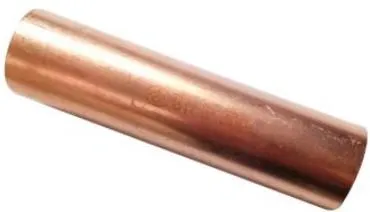
Models: GTM-10 – GTM-630 (15 sizes), plain or tinned
GTM is a copper tube with a solid block in the middle. The two barrels are separate — the conductor cannot pass through, and neither can the oil. It is the copper counterpart of GLM.
The M means oil-blocking. It is the current designation; drawings and tender schedules issued before the change say GT, and it is the same part with the dimensions unchanged.
What the block is for
On an oil-filled or oil-impregnated paper cable the insulation is paper wound around the conductor and saturated with oil under pressure. The oil is free to travel along the strands. A joint is a hole in that oil system.
Without a block:
- Oil migrates to the low-pressure end. The high side drains and the paper dries. Dry paper is a partial-discharge site, and the failure appears years later inside the joint.
- The low side over-pressurises and weeps at the weakest accessory — a sealing end, a stress cone.
The block stops the migration at the joint. That is its whole function.
On XLPE or PVC cable you do not need it. There is no oil to move. The GT-G through-hole tube does the same electrical job without the block and is shorter on most sizes — GT-G-10 is 50 mm against 62 mm here.
Reading the drawing
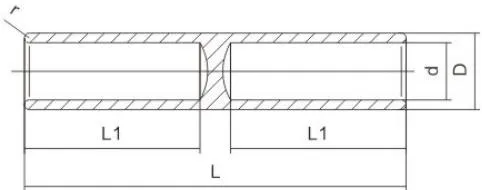
The section shows the block as solid hatching, with an identical barrel either side.
- L1 is the depth of one barrel. Both barrels are equal, so it is stated once. L is not 2 × L1: the difference is the block, 6 mm at GTM-10 (62 − 2×28) rising to 10 mm at GTM-630 (170 − 2×80). Do not crimp on it.
- r is the radius on the outside edge of the mouth, 0.7 mm at the small sizes to 2.0 mm at 630. It removes the sharp edge so the conductor goes in without shaving strands and the tape is not cut from inside.
L1 is the strip length. Strip to L1, insert until the conductor bottoms on the block, crimp. The block is a physical stop, so the insertion depth cannot be got wrong — the one real advantage an oil-blocking tube has over a through tube.
Plain or tinned
GTM is supplied in two finishes, and the choice is not cosmetic:
- Plain copper — the default. Lowest resistance at the crimp, and nothing to damage during handling.
- Tinned — a thin tin layer over the whole tube. It is specified where the joint will be exposed to sulphur compounds, where the cable is in a damp or ammoniacal environment, or where the finished joint sits against aluminium hardware. Tin blocks the copper-aluminium galvanic couple at the contact point. Tinning costs a few percent more and only pays where one of those conditions is real.
The dimensions are identical between the two finishes. Only the surface differs.
Copper versus aluminium at the same number
The bore d is the same in both metals — a 240 mm² conductor is a 240 mm² conductor. The wall is not. Copper carries roughly 1.6× the current of aluminium for the same section, so the copper tube needs less metal around the same bore:
| Size | GTM (copper) D × d | GLM (aluminium) D × d |
|---|---|---|
| 25 | 11 × 7.0 | 12 × 7.0 |
| 95 | 18 × 13.0 | 21 × 13.0 |
| 240 | 27 × 20.0 | 30 × 20.0 |
| 630 | 45 × 34.0 | 54 × 34.0 |
Two consequences:
- No shared die. A die sized on
Dwill not close the other metal correctly at the same nominal size. - Clearance differs. At 630 mm² the copper tube needs 9 mm less room than the aluminium one, which matters in a cramped cable box.
Installation
- Strip to L1, not to a guessed length. The block is the stop, and the strip has to be short enough that bare conductor does not sit under the insulation when the tube bottoms out.
- Use the die matched to
D. Copper recovers elastically after crimping, so an undersized crimp loosens over time rather than failing visibly. - Crimp from the block outward, one indent per barrel minimum, two above 185 mm². Crimping toward the block traps air and can bow the tube.
- Copper to aluminium is not this part. For a transition joint use the bimetallic GTL. A copper tube with aluminium conductor in one end corrodes at the interface and fails at the boundary, not in the middle.
Technical parameters — GTM, copper
| Model | Main dimensions (mm) | ||||
|---|---|---|---|---|---|
| D | d | L | L1 | r | |
| GTM-10 | 9 | 5.0 | 62 | 28 | 0.7 |
| GTM-16 | 10 | 6.0 | 65 | 30 | 0.7 |
| GTM-25 | 11 | 7.0 | 70 | 32 | 0.7 |
| GTM-35 | 12 | 8.5 | 75 | 34 | 0.7 |
| GTM-50 | 14 | 9.6 | 80 | 35 | 1.0 |
| GTM-70 | 16 | 12.0 | 90 | 41 | 1.0 |
| GTM-95 | 18 | 13.0 | 95 | 43 | 1.0 |
| GTM-120 | 20 | 15.0 | 100 | 46 | 1.0 |
| GTM-150 | 22 | 16.0 | 105 | 48 | 1.2 |
| GTM-185 | 25 | 18.0 | 110 | 50 | 1.2 |
| GTM-240 | 27 | 20.0 | 120 | 55 | 1.5 |
| GTM-300 | 30 | 23.0 | 130 | 60 | 1.5 |
| GTM-400 | 34 | 26.0 | 140 | 64 | 1.8 |
| GTM-500 | 38 | 29.0 | 155 | 70 | 1.8 |
| GTM-630 | 45 | 34.0 | 170 | 80 | 2.0 |
Reading the columns
- D (mm) — outside diameter. This selects the die.
- d (mm) — bore. Match the measured outside diameter of the stranded conductor.
- L (mm) — overall length, both mouths.
- L1 (mm) — depth of one barrel; both are equal. This is the strip length, and the block is the insertion stop.
- r (mm) — radius on the outside edge of the mouth, 0.7 to 2.0 mm.
Which tube in this family
| Tube | Metal | Inside | Depth column | Sizes | For |
|---|---|---|---|---|---|
| GTM | copper | oil block | L1 | 10 – 630 | copper conductor, oil-filled cable |
| GLM | aluminium | oil block | L1 | 10 – 630 | aluminium conductor, oil-filled cable |
| GT-G | copper | through | — | 10 – 630 | copper conductor, solid insulation |
| GL-G | aluminium | through | — | 16 – 800 | aluminium conductor, solid insulation |
| GTY | copper | through | — | 1.5 – 1000 | copper, thin wall, small to very large |
| GTL | copper + aluminium | bimetallic | L1, L2 | 16 – 630 | copper conductor to aluminium conductor |
Ordering
State the conductor size, the cable type, and the finish — plain or tinned. Cable type decides between an oil block and a through hole; on an oil-filled cable the two are not interchangeable.
FAQ
Is GTM the same as GT?
Yes. GT was the earlier designation for the copper oil-blocking tube; GTM is the current one. Dimensions are unchanged. Quote GTM against an old GT schedule.
What does oil-blocking mean? The tube is solid in the middle, so the barrels are separate. On an oil-filled cable that stops the insulating oil travelling from one side of the joint to the other.
Can I use it on XLPE cable? Physically yes, electrically pointless. There is no oil to block. The GT-G through-hole tube is the same body without the block and shorter on most sizes.
Should I order plain or tinned? Plain unless the joint is in a sulphur-bearing, damp or ammoniacal atmosphere, or the finished joint is in contact with aluminium hardware. Then tin. The dimensions are the same either way.
How long is the block? L − 2 × L1. 6 mm at GTM-10, 10 mm at GTM-630. Do not crimp on it.
Can GTM take an aluminium conductor? No. Use GTL. The bore may accept the conductor, but the copper-aluminium interface will corrode and the joint fails there.