GTL Copper-Aluminium Connection Tube
Models: GTL-16 – GTL-630 (14 sizes)
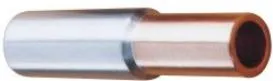
GTL joins a copper conductor to an aluminium one. It is a tube in two metals, welded through the middle: the aluminium half takes the aluminium conductor, the copper half takes the copper conductor, and the weld is the transition. The photograph shows it plainly — one end is copper-coloured, the other is bright aluminium, with a dark weld band between them.
Which end is which
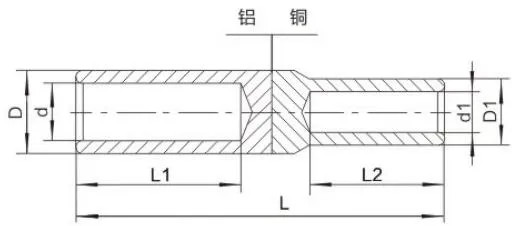
The drawing labels the two halves above the section: 铝 (aluminium) on the left, 铜 (copper) on the right. That maps onto the columns exactly:
| Half | Columns | Metal |
|---|---|---|
| Left | D, d, L1 | aluminium |
| Right | D1, d1, L2 | copper |
So when you read GTL-240 — D 30, d 21.0, L1 61, D1 25, d1 18.0, L2 50 — the aluminium end has a 30 mm outside diameter and a 21 mm bore, and the copper end is 25 mm outside with an 18 mm bore. Getting this backwards is the standard way to order the wrong part, and the numbers alone will not tell you: both halves are tubes.
The aluminium half is longer, and that is not an accident
Take GTL-630: aluminium L1 = 80 mm, copper L2 = 70 mm. The pattern holds right across the range — the aluminium side is 2 to 10 mm longer on every size.
The reason is conductivity. Aluminium carries about 61 % of what copper carries for the same section, so the same nominal square millimetre needs more compressed length on the aluminium side to reach the same joint resistance. The same logic is why the aluminium end is fatter: at equal nominal section an aluminium conductor is roughly a quarter larger across, and the bore has to take it.
That has a practical consequence for the installer: the two strip lengths are not the same. Strip L1 for the aluminium conductor and L2 for the copper one. If the jointer strips both to the same length, one side is either short of the barrel depth or has bare conductor sticking out of it.
The middle is a weld, not a barrel
L is the overall length, and L1 + L2 is always shorter than L — 59 against 75 on GTL-16, 150 against 170 on GTL-630. That 16 to 20 mm is the welded transition zone: solid bimetal, no bore, nothing to crimp.
Do not put a die on it. A die closed on the weld loads the joint in the one place it cannot yield, and the failure mode is a crack through the weld that will not show until the joint is under load and warm.
What the weld buys you. A bolted copper-to-aluminium joint relies on a bimetallic plate and two bolted interfaces, and every interface is a place to corrode. GTL removes both interfaces: the transition is metallurgical, inside the tube, and there is nothing to re-torque or inspect. That is why it is used where the joint will be buried, in a cable box, or in a manhole.
Technical parameters
| Model | Aluminium end (mm) | Copper end (mm) | L | ||||
|---|---|---|---|---|---|---|---|
| D | d | L1 | D1 | d1 | L2 | ||
| GTL-16 | 9 | 5.5 | 31 | 9 | 5.0 | 28 | 75 |
| GTL-25 | 12 | 7.0 | 32 | 10 | 5.5 | 30 | 80 |
| GTL-35 | 14 | 8.5 | 37 | 11 | 7.0 | 32 | 90 |
| GTL-50 | 16 | 9.5 | 42 | 13 | 8.5 | 34 | 95 |
| GTL-70 | 18 | 12.0 | 46 | 15 | 9.6 | 35 | 100 |
| GTL-95 | 21 | 13.0 | 50 | 17 | 12.0 | 41 | 110 |
| GTL-120 | 23 | 15.0 | 52 | 19 | 13.0 | 43 | 112 |
| GTL-150 | 25 | 16.0 | 55 | 21 | 15.0 | 46 | 118 |
| GTL-185 | 27 | 18.0 | 57 | 23 | 16.0 | 48 | 125 |
| GTL-240 | 30 | 21.0 | 61 | 25 | 18.0 | 50 | 130 |
| GTL-300 | 34 | 23.0 | 65 | 29 | 20.0 | 55 | 140 |
| GTL-400 | 38 | 26.0 | 70 | 30 | 23.0 | 60 | 150 |
| GTL-500 | 42 | 29.0 | 75 | 34 | 26.0 | 64 | 160 |
| GTL-630 | 54 | 34.0 | 80 | 38 | 29.0 | 70 | 170 |
Reading the columns
- D, d (mm) — aluminium end: outside diameter, bore. The aluminium conductor goes in here.
- L1 (mm) — aluminium end depth, and the strip length for the aluminium conductor.
- D1, d1 (mm) — copper end: outside diameter, bore. The copper conductor goes in here.
- L2 (mm) — copper end depth, and the strip length for the copper conductor.
- L (mm) — overall length. L − L1 − L2 is the weld zone: 16 to 20 mm, and it must stay clear of the die.
Do not confuse GTL with DTL
Both are copper-aluminium, and they do different jobs:
- DTL is a terminal. One end is an aluminium barrel for an aluminium cable, the other is a copper palm with a bolt hole for an aluminium-to-copper equipment pad. It terminates.
- GTL is a joint. Both ends are barrels, one aluminium and one copper, for joining two conductors in a run.
If the question is “how do I land this aluminium cable on that copper busbar”, it is DTL. If it is “how do I join this aluminium run to that copper run”, it is GTL.
Ordering
Send both conductor sizes — copper on one side, aluminium on the other — the quantity, and the conductor class for flexible cable. The two sides are not the same size in practice, and quoting from one number produces a tube that fits one end.
FAQ
Which end takes the copper conductor? The D1 / d1 / L2 end, on the right in the drawing. The aluminium conductor goes into the D / d / L1 end.
Why is the aluminium end longer? Aluminium conducts about 61 % as well as copper for the same section, so the aluminium side needs more compressed length to reach the same joint resistance. It is also fatter, because an aluminium conductor of the same nominal size is larger across.
Can I crimp the middle? No. L − L1 − L2 is solid welded bimetal with no bore. A die there cracks the weld.
Can I use GTL for two aluminium conductors? Yes electrically, but it wastes the copper end and costs more than GL-G. For aluminium to aluminium use an aluminium tube.
How deep do I strip each side? L1 into the aluminium end, L2 into the copper end. They differ by 2 to 10 mm and stripping both to the same length leaves one side wrong.
Is GTL the same as a copper tube crimped onto an aluminium cable? No. A copper tube on an aluminium conductor is a galvanic joint with no transition — it corrodes from the inside. GTL’s transition is welded, which is the entire point of the part.