GT-G Copper Through-Hole Connection Tube
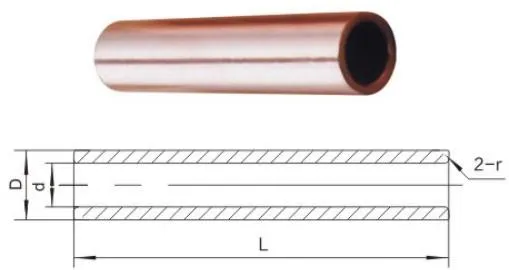
Models: GT-G-10 – GT-G-630 (15 sizes)
GT-G is a straight copper tube, open at both ends, with nothing inside it. Push one conductor into each end, crimp both ends, and the two are joined. It is the standard-wall copper butt connector, and the coil of the range — everything that is not thin-wall and not oil-blocking.
GT-G, GTM and GTY — three copper tubes that get confused
All three are copper, all three join two conductors, and all three are bought for the same job. They are not interchangeable:
| GT-G | GTM | GTY | |
|---|---|---|---|
| Wall | standard | standard | thin |
| Inside | open | solid block | open |
| Sizes | 10 – 630 | 10 – 630 | 1.5 – 1000 |
| Depth column | — | L1 | — |
| For | general butt joints | oil-filled cable | tight boxes, small and very large sizes |
The block is the only thing that matters for oil. If the cable is oil-filled or oil-impregnated paper, GT-G is wrong and GTM is right, whatever the sizes say.
Wall thickness is the thing that matters for a tight box. GTY carries the same current in a smaller outside diameter because the wall is thinner, which is worth the extra care in crimping when the joint has to fit inside a confined enclosure — or when the size is outside the GT-G range at either end, below 10 mm² or above 630 mm².
Through hole versus oil block, size by size
Same body, with and without the block. The bore is identical at every size where both exist, so the die is comparable — but the outside diameter and length are not always:
| Size | GT-G D × d × L | GTM D × d × L |
|---|---|---|
| 16 | 9 × 6.0 × 56 | 10 × 6.0 × 65 |
| 95 | 18 × 13.0 × 85 | 18 × 13.0 × 95 |
| 240 | 27 × 20.0 × 110 | 27 × 20.0 × 120 |
| 630 | 45 × 35.0 × 170 | 45 × 34.0 × 170 |
The length saving is 5–12 mm across the range, except at 630 mm² where the two are both 170 mm. Do not quote a shorter joint on 630 without checking.
At the small end the through tube is also one millimetre smaller on D — 8 mm against 9 mm at 10 mm² — because there is no block to be walled around.
Copper versus aluminium through tubes
The aluminium partner is GL-G, 16–800 mm². The bore matches size for size; the wall does not. Aluminium conducts at roughly 60 % of copper, so the aluminium tube is larger on D at every size and they do not share a die.
GT-G runs from 10 mm², GL-G starts at 16 mm². Below 16 mm² there is no aluminium through tube — the wall would be too thin to crimp. For copper below 10 mm², use GTY.
Installation
- Select the die on
D, not on the nominal size. Running a 240 tube in a 185 die leaves a flat that looks like a crimp and is not one. - Two indents per end above 185 mm², one per end below. Crimp from the mouth inward.
- Both conductors go into one bore. A joint between a Class 2 and a Class 5 conductor of the same nominal size will be loose on one side. If the two cables differ, say so before ordering.
- Copper conductor only. For copper to aluminium use the bimetallic GTL. A copper tube with aluminium in one end corrodes at the interface and fails there.
- In damp or ammoniacal conditions, or where the finished joint touches aluminium hardware, specify tinned. Plain copper is the default.
Technical parameters — GT-G, copper
| Model | Main dimensions (mm) | |||
|---|---|---|---|---|
| D | d | L | r | |
| GT-G-10 | 8 | 5 | 50 | 0.5 |
| GT-G-16 | 9 | 6 | 56 | 0.5 |
| GT-G-25 | 10 | 7 | 60 | 0.5 |
| GT-G-35 | 12 | 8.5 | 64 | 0.7 |
| GT-G-50 | 14 | 10 | 72 | 0.7 |
| GT-G-70 | 16 | 12 | 78 | 0.7 |
| GT-G-95 | 18 | 13 | 85 | 0.8 |
| GT-G-120 | 20 | 15 | 90 | 0.8 |
| GT-G-150 | 22 | 16 | 94 | 1.2 |
| GT-G-185 | 25 | 18 | 100 | 1.2 |
| GT-G-240 | 27 | 20 | 110 | 1.5 |
| GT-G-300 | 31 | 24 | 120 | 1.5 |
| GT-G-400 | 34 | 26 | 135 | 1.8 |
| GT-G-500 | 38 | 30 | 150 | 1.8 |
| GT-G-630 | 45 | 35 | 170 | 2.0 |
Reading the columns
- D (mm) — outside diameter. This selects the die.
- d (mm) — bore. Match the measured outside diameter of the stranded conductor, not the nominal square millimetres.
- L (mm) — overall length, both mouths open. Half of L is the depth available per conductor.
- r (mm) — radius on the outside edge of both mouths, 0.5 to 2.0 mm. Both ends are radiused because either end can take the first conductor.
There is no L1 here. With nothing inside, there is no insertion stop and no fixed strip length — the rule is that bare conductor must not extend past the tube body when both ends are crimped.
Sizes above 630 mm²
The standard-wall GT-G stops at 630 mm². Above that the tube wall would make the part heavier than the joint justifies, and the range is covered by thin-wall GTY up to 1000 mm². For 800 mm² in the standard wall, ask — dimensions are confirmed against the approval drawing, since the published GT-G sheet ends at 630.
Which tube in this family
| Tube | Metal | Inside | Depth column | Sizes | For |
|---|---|---|---|---|---|
| GT-G | copper | through | — | 10 – 630 | copper conductor, solid insulation |
| GTM | copper | oil block | L1 | 10 – 630 | copper conductor, oil-filled cable |
| GL-G | aluminium | through | — | 16 – 800 | aluminium conductor, solid insulation |
| GLM | aluminium | oil block | L1 | 10 – 630 | aluminium conductor, oil-filled cable |
| GTY | copper | through | — | 1.5 – 1000 | copper, thin wall, small to very large |
| GTL | copper + aluminium | bimetallic | L1, L2 | 16 – 630 | copper conductor to aluminium conductor |
Ordering
State the conductor size, the finish (plain or tinned), and — if the cable is not XLPE or PVC — the cable type. On an oil-filled cable this part is the wrong one.
FAQ
What is the difference between GT-G and GTY? Wall thickness. GT-G is standard wall, 10–630 mm². GTY is thin wall, 1.5–1000 mm², giving the same current in a smaller outside diameter — useful in a tight box, and the only option below 10 mm² or above 630 mm².
Is GT-G the same as GTM? No. GTM has a solid block in the middle and is for oil-filled cable. GT-G is open end to end. The bore is the same at every size where both exist.
Can I use GT-G on an oil-filled cable? No. Nothing stops the oil, which migrates along the strands, dries the paper on the low-pressure side and over-pressurises the other. Use GTM.
Why is there no L1 column? L1 is the barrel depth on an oil-blocking tube, fixed by the block. With nothing inside there is no stop, so L is simply halved.
Can I cut a long one in half? No. Cutting removes the radiused mouth on the cut end, and a square edge shaves strands and cuts the tape from inside. Order the size you need.
Is there an 800 mm² GT-G? The published standard-wall range ends at 630. Above that, use thin-wall GTY to 1000 mm², or ask for 800 and confirm against the approval drawing.