GL-G Aluminium Through-Hole Connection Tube
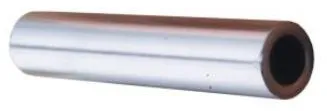
Models: GL-G-16 – GL-G-800 (15 sizes)
GL-G is the plain aluminium tube: open from end to end, nothing in the middle. One conductor in one side, the second in the other, and if they meet in the centre that is fine — there is nothing to stop them.
It is the largest aluminium tube in the range, up to 800 mm², and it is the part to specify whenever the cable is XLPE or PVC rather than oil-filled.
Through hole versus oil block
The two aluminium tubes are the same body. GLM has a solid block in the middle; GL-G does not. Apart from the block and the overall length, every dimension is identical:
| Size | GL-G D / d / r | GLM D / d / r | L: GL-G vs GLM |
|---|---|---|---|
| 16 | 10 / 5.5 / 0.8 | 10 / 5.5 / 0.8 | 65 vs 70 |
| 95 | 21 / 13.0 / 1.5 | 21 / 13.0 / 1.5 | 95 vs 110 |
| 240 | 30 / 20.0 / 1.8 | 30 / 20.0 / 1.8 | 120 vs 130 |
| 630 | 54 / 34.0 / 4.0 | 54 / 34.0 / 4.0 | 170 vs 170 |
Two points worth carrying into a quotation:
- L is shorter on the through-hole part by 5–15 mm, but not at 630. At 630 mm² both are 170 mm. The saving is real from 16 to 500 mm² and disappears at the top of the range, so do not promise a shorter joint on 630 without checking the cable box.
- The die is the same. Same
D, same die. A contractor already tooled for GLM-240 needs nothing new for GL-G-240.
Why the aluminium tube goes to 800 and the copper one stops at 630
This is a cost point, not a technical limit. Aluminium is the cheaper metal, so a 800 mm² aluminium tube still competes on price with the alternative of two smaller conductors; a copper tube at that size would cost more than the joint is worth and the market uses a different arrangement. GL-G-800 is 60 mm outside diameter, 38 mm bore, 200 mm long.
For copper above 630 mm², the thin-wall GTY runs to 1000 mm².
When to use GL-G rather than GLM
- Cable is XLPE, PVC or EPR. Solid insulation, no oil to migrate. Using an oil-blocking tube here buys a feature with nothing to do, and costs more.
- You want a shorter joint. 5–15 mm shorter from 16 to 500 mm².
- The jointer needs to slide the tube on one conductor first. A through tube can be threaded onto one conductor before the second is brought up; an oil-blocking tube cannot, because the block stops it.
Do not use it on an oil-filled cable. With no block, insulating oil migrates along the strands from the high-pressure side to the low, dries the paper on one side and over-pressurises the other. The failure appears years later inside the joint.
Installation notes for aluminium
- Wire-brush conductor and bore immediately before insertion, then apply contact grease to both. Aluminium oxide re-forms in minutes and is an insulator.
- Crimp at both ends, from the mouth inward. Two indents per end above 185 mm². Aluminium has no elastic recovery to hold a loose crimp — an under-crimped joint heats and anneals.
- Do not crimp in the middle on a short cut-down tube; keep the indents on the conductor, not on air.
- Aluminium conductor only. For an aluminium-to-copper joint use the bimetallic GTL.
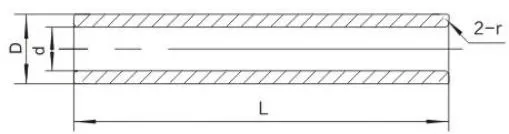
Technical parameters — GL-G, aluminium
| Model | Main dimensions (mm) | |||
|---|---|---|---|---|
| D | d | L | r | |
| GL-G-16 | 10 | 5.5 | 65 | 0.8 |
| GL-G-25 | 12 | 7.0 | 70 | 1.0 |
| GL-G-35 | 14 | 8.5 | 75 | 1.0 |
| GL-G-50 | 16 | 9.5 | 80 | 1.2 |
| GL-G-70 | 18 | 12.0 | 90 | 1.2 |
| GL-G-95 | 21 | 13.0 | 95 | 1.5 |
| GL-G-120 | 23 | 15.0 | 100 | 1.5 |
| GL-G-150 | 25 | 16.0 | 105 | 1.8 |
| GL-G-185 | 27 | 18.0 | 110 | 1.8 |
| GL-G-240 | 30 | 20.0 | 120 | 1.8 |
| GL-G-300 | 34 | 23.0 | 130 | 1.8 |
| GL-G-400 | 38 | 26.0 | 140 | 2.0 |
| GL-G-500 | 42 | 29.0 | 150 | 2.2 |
| GL-G-630 | 54 | 34.0 | 170 | 4.0 |
| GL-G-800 | 60 | 38.0 | 200 | 4.0 |
Reading the columns
- D (mm) — outside diameter. This selects the die, and it is the same die as the matching GLM size.
- d (mm) — bore. Match the measured outside diameter of the stranded conductor.
- L (mm) — overall length, both mouths open.
- r (mm) — radius on the outside edge of both mouths, 0.8 to 4.0 mm. Both ends are radiused because either end can take the first conductor.
There is no L1 on this part. With nothing inside, there is no insertion stop and no fixed strip length — the only rule is that bare conductor must not extend past the tube body when both ends are crimped.
Which tube in this family
| Tube | Metal | Inside | Depth column | Sizes | For |
|---|---|---|---|---|---|
| GL-G | aluminium | through | — | 16 – 800 | aluminium conductor, solid insulation |
| GLM | aluminium | oil block | L1 | 10 – 630 | aluminium conductor, oil-filled cable |
| GT-G | copper | through | — | 10 – 630 | copper conductor, solid insulation |
| GTM | copper | oil block | L1 | 10 – 630 | copper conductor, oil-filled cable |
| GTY | copper | through | — | 1.5 – 1000 | copper, thin wall, small to very large |
| GTL | copper + aluminium | bimetallic | L1, L2 | 16 – 630 | copper conductor to aluminium conductor |
Ordering
State the conductor size and confirm it is aluminium. The cable type only decides whether you need the oil-blocking version — if the cable is XLPE or PVC, this is the right part and the cheaper one.
FAQ
What is the difference between GL-G and GLM? GLM has a solid block in the middle and is for oil-filled cable. GL-G is open end to end, 5–15 mm shorter from 16 to 500 mm², and for solid-insulation cable. Every other dimension is identical.
Is GL-G the same as GL?
No. GL was the earlier designation for the oil-blocking tube, now GLM. GL-G has always been the through-hole part and keeps its name.
Why no L1 column? L1 is the barrel depth on an oil-blocking tube, where the block fixes it. With nothing inside there is no stop and no fixed strip length.
Can I use GL-G on an oil-filled cable? No. Without the block, oil migrates along the strands, the paper dries on one side and the other side over-pressurises. Use GLM.
Can I cut a long one to make two short ones? No. Cutting removes the radiused mouth on the cut end, and a square edge shaves strands on the way in and cuts the tape from inside. It also leaves an unradiused edge that can split under the die. Order the size you need.
Do GL-G and GLM share a die?
Yes, at every size where both exist. Same D.