DTK Quick-Connect Energy-Saving Electrical Connector
Models: DTK-25 – DTK-240 (9 sizes), in four variants
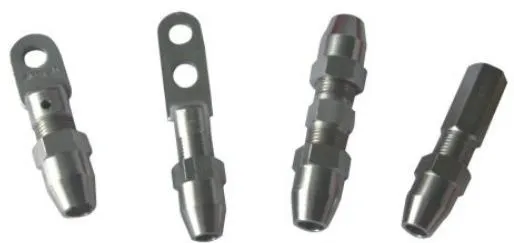
DTK is not a crimp lug. Inside the body there is a thread and an inner cone: you push the conductor into the tapered nose, then tighten the nut, and the cone closes onto the conductor. A wrench is the whole tool kit. Nothing is compressed by a press, nothing is cut off to remove it, and the same body can be undone and reused on a second conductor.
That one property is why the part exists. Every crimped joint on a site needs a hydraulic press, a die set, and someone trained to use them — and if the cable is already terminated inside a cabinet with 60 mm of clearance, the press does not fit. A DTK goes on with an open-end wrench in the space of a hand.
The catalogue calls it energy-saving. What the claim rests on is contact resistance: a threaded cone compresses the strands evenly over the full length of the cone, and the body is tin-plated copper, so the joint runs cooler than a crimp of the same section in the field. Treat that as the marketing line and judge the part on the two things you can verify — it installs without a press, and it can be taken off without destroying the cable.
Four parts, one table
The range is one table with four columns of model numbers, and they are four different products:
| Variant | Code | What it is | Where it goes |
|---|---|---|---|
| Single hole | DTK-25 … DTK-240 | palm with one hole | busbar and equipment pad |
| Two hole | DTK-25S … DTK-240S | palm with two holes | switchgear and breaker pads |
| Transformer joint | SBK-M12/25 … SBK-M20/240 | threaded stud instead of a palm | directly onto a transformer or CT/PT terminal |
| Connection tube | SJK-25 … SJK-240 | two cones, no palm | conductor to conductor |
Read the SBK code carefully, because it carries one number the others do not: the thread. SBK-M12/50 is a 50 mm² joint with an M12 stud. Order SBK-M20/50 and it will not fit an M12 transformer terminal, no matter how right the cable size is.
The diameter that decides it
The last column of the catalogue table is bore — 7.0 mm at 25 mm², 20.6 mm at 240 mm². This is the number to check against the actual conductor, not the nominal square millimetres.
The reason is that the table is written for LGJ (ACSR). A 240 mm² ACSR conductor is not a 240 mm² solid cylinder — it is a steel core wound with aluminium strands, and its outside diameter is larger than the equivalent copper conductor. A mechanical cone has to accept the real outside diameter, so if you are using this connector on a compacted or sector-shaped conductor, or on copper rather than ACSR, measure the conductor and compare it to the bore column before ordering.
| Model | LGJ (mm²) | Bore (mm) | SBK thread |
|---|---|---|---|
| DTK-25 | 25 | 7.0 | M12 |
| DTK-35 | 35 | 8.0 | M12 |
| DTK-50 | 50 | 9.5 | M12 |
| DTK-70 | 70 | 11.3 | M12 |
| DTK-95 | 95 | 13.0 | M16 |
| DTK-120 | 120 | 14.8 | M16 |
| DTK-150 | 150 | 16.4 | M20 |
| DTK-185 | 185 | 18.0 | M20 |
| DTK-240 | 240 | 20.6 | M20 |
Technical parameters
| Quick-connect terminal | Quick-connect two-hole terminal | Quick-connect transformer joint | Quick-connect tube | Conductor LGJ (mm²) | Bore (mm) |
|---|---|---|---|---|---|
| DTK-25 | DTK-25S | SBK-M12/25 | SJK-25 | 25 | 7.0 |
| DTK-35 | DTK-35S | SBK-M12/35 | SJK-35 | 35 | 8.0 |
| DTK-50 | DTK-50S | SBK-M12/50 | SJK-50 | 50 | 9.5 |
| DTK-70 | DTK-70S | SBK-M12/70 | SJK-70 | 70 | 11.3 |
| DTK-95 | DTK-95S | SBK-M16/95 | SJK-95 | 95 | 13.0 |
| DTK-120 | DTK-120S | SBK-M16/120 | SJK-120 | 120 | 14.8 |
| DTK-150 | DTK-150S | SBK-M20/150 | SJK-150 | 150 | 16.4 |
| DTK-185 | DTK-185S | SBK-M20/185 | SJK-185 | 185 | 18.0 |
| DTK-240 | DTK-240S | SBK-M20/240 | SJK-240 | 240 | 20.6 |
Note: conductor sizes are the ACSR figures from the catalogue. Confirm the bore against the conductor you will actually use.
What it replaces, and when not to
The catalogue positions DTK against the DT/DL/DTL terminals and the STL copper-aluminium equipment clamp. In practice it wins in three situations and loses in one.
It wins where there is no room for a press. Inside a kiosk, on a pole, on a transformer lid — anywhere the tool will not fit, the bolted connector is the only option that does not involve dismantling something.
It wins where the joint may have to come apart. A crimp is permanent: to change a cable you cut the lug off and lose the length. A DTK unscrews.
It wins on mixed metals in the field. The body is copper, tin-plated, so it will land on a copper pad or an aluminium one without the joint you would get from bare copper on bare aluminium. This is not a licence to skip a bimetallic plate on a big current path, but for a small downlead it is ordinary practice.
It loses on vibration and on the buried joint. A threaded joint holds by preload. Thermal cycling and vibration relax that preload, and a joint nobody re-torques will eventually loosen — which is exactly why crimped joints exist. Do not use a DTK where the connection will be sealed up and never inspected, and do not use one as a substitute for a compression joint on a tension member.
Fitting
- Strip the conductor to the depth of the cone, not to the depth of the body. Too short and the cone grips insulation; too long and the strands bottom out before the cone closes.
- Push the conductor fully home into the nose.
- Tighten the nut with a wrench, holding the body so it does not turn. Bring it down firmly and evenly — this is a preload joint, and a nut left snug is a joint that will heat.
- Re-torque at the first inspection after energisation, and again after the first load cycle in a new installation. Then on the normal maintenance interval.
- Grease the palm face and the stud thread on outdoor installations, and tape the finished joint.
Related fittings
- DTM in copper and DLM in aluminium — the crimped equivalents, 10–1000 mm².
- DTL — crimped copper-aluminium transition terminals.
- DT-F / DTL-F — sealed crimp lugs for wet locations, which a threaded joint is not.
- SYG — the compression equipment clamp this connector is often ordered alongside.
FAQ
Does it need a special tool? An open-end wrench. That is the entire point of the design, and it is why this part is used where a hydraulic press cannot reach.
Can I reuse it? Yes — undo the nut, withdraw the conductor, and it goes back together on another cable of the same bore. Do not reuse the conductor end that was already clamped; cut it back and start with fresh strands.
Is it really a copper-aluminium transition? The body is copper, tin-plated. That is a surface treatment, not a transition weld. For a large aluminium conductor onto a copper pad, use a proper bimetal part — a DTL or a transition plate.
What is the difference between DTK-120 and DTK-120S? One palm hole versus two. They are otherwise the same connector.