JBG Parallel Groove Clamp
Conductor: 4.5 to 22 mm diameter · Sizes: JBG-1 to JBG-4 · Bolts: 1 or 2
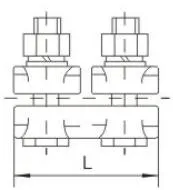
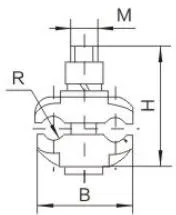
JBG is the general-purpose parallel groove clamp: a body with two grooves, a cover plate, and one or two bolts that pull the two together. Two conductors sit side by side in the grooves and the bolts do the work. No press, no die, nothing to crimp.
Four sizes cover 4.5 mm to 22 mm conductor diameter, which is the range from a small insulated service drop up to a 95 mm² ACSR.
Materials
The factory note is precise and worth keeping: “the clamp body and cover plate are aluminium alloy, other parts are hot-dip galvanised steel.”
So the two pieces that touch the conductor are aluminium alloy, and the bolts, washers and spring washers are galvanised steel. Practically:
- The bolts are the part that corrodes first. On a coastal or industrial site, expect to replace them at first maintenance, or specify a finish upgrade.
- The aluminium body is the conductive path, so the conductor-to-groove contact carries the current and the steel only supplies clamping force.
Technical parameters
| Model | Applicable conductor diameter (mm) | Main dimensions (mm) | Bolts | ||||
|---|---|---|---|---|---|---|---|
| L | B | H | R | M | |||
| JBG-1 | 4.5~11.5 | 36 | 43 | 60 | 6.0 | 1 | |
| JBG-2 | 11.5~14.0 | 68 | 48 | 58 | 7.0 | 2 | |
| JBG-3 | 14.0~17.0 | 72 | 58 | 75 | 8.5 | 2 | |
| JBG-4 | 17.0~22.0 | 80 | 72 | 75 | 11.0 | 2 | |
All dimensions in millimetres. The sheet prints no weight for JBG, and the M column is blank on all four rows — the bolt thread is not stated.
The groove radius R is half the biggest conductor
This is the one thing in the table that is not obvious, and it is exact in all four rows: R is half the top of the conductor range.
| Model | Range tops out at | Half of it | R on the sheet |
|---|---|---|---|
| JBG-1 | 11.5 mm | 5.75 | 6.0 |
| JBG-2 | 14.0 mm | 7.00 | 7.0 |
| JBG-3 | 17.0 mm | 8.50 | 8.5 |
| JBG-4 | 22.0 mm | 11.00 | 11.0 |
So the groove is cut to the largest conductor the clamp will take, not the smallest. That is deliberate — it is what lets one clamp cover a range — but it has a consequence worth knowing before you order: at the bottom of a range the clamp has to close a real gap, and closing that gap is done by bolt torque, not by the groove shape.
Two practical results:
- Do not buy at the very bottom of a range if you can avoid it. A 17 mm conductor in JBG-4 (range 17–22) means the bolts are pulling the cover most of the way down.
- Torque matters more than on a compression joint. A parallel groove clamp that is under-torqued has contact only where the groove happens to touch.
The small one is different
JBG-1 is a single-bolt clamp and it is half the length of the others — L is 36 mm against 68, 72 and 80 mm. It covers 4.5 to 11.5 mm, which is service-drop and small insulated conductor territory, and it is built to be fitted by hand off a ladder rather than from a bucket.
Also worth noticing: H dips from 60 mm on JBG-1 to 58 mm on JBG-2 before climbing to 75 mm on the larger two. JBG-2 is the narrowest of the four in that dimension despite being the second size.
Fitting it
- Clean and grease both conductors. Aluminium oxide is the contact resistance; jointing compound under the grooves is what keeps the joint cool at load.
- Same conductor both sides is the easy case. Mixing sizes in one clamp works, but both must be inside the stated range — a clamp whose range is 11.5–14.0 means each conductor, not the average.
- Re-torque after the first load cycle. A bolted aluminium joint relaxes as it warms; that is why the aluminium-body clamps get re-checked and the compression ones do not.
- Not a tension fitting. JBG carries current across a joint, not the tension of the span.
The rest of the family
- JBB — the same idea for steel strand, GJ-25 to GJ-240.
- JB — the aluminium-strand and ACSR version.
- JBTL — the shaped-body parallel groove clamp.
- JXD — the wedge type, for when a bolted clamp cannot be re-torqued.
Note: Quote the model and both conductor diameters — JBG-3, 16 mm on 16 mm. And ask for the bolt thread, because the sheet leaves M blank.