JBLY Shaped Parallel Groove Clamp
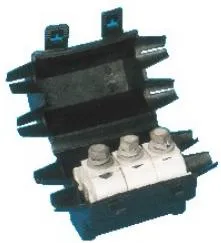
An aluminium parallel groove clamp with a shaped body — the casting is divided along its length into two or three sections, each carrying its own bolt. That is what the “Y” in JBLY stands for and it is the difference from the plain JBL, which is a single undivided block.
The sections matter because each one grips independently. On a long span where the conductor moves in the clamp, two sections hold better than one, and three hold better than two. It is also why the same conductor size appears three times in the table below with different lengths.
There are two JBLY standards, and they are not the same clamp
The factory builds this clamp to two bodies, and a sample book normally prints one of them:
- Hangzhou type — 10 rows, up to 400 mm²
- Beijing type — 7 rows, up to 240 mm²
They share model codes. So JBLY-35~120 (3-section) exists in both standards, is called the same thing in both, and measures differently. Nothing in the code tells you which one you are being quoted.
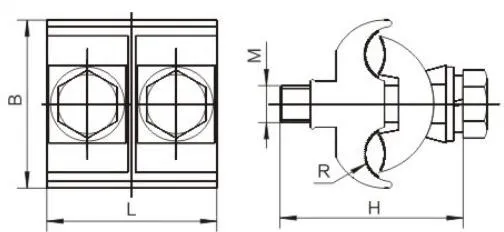
Hangzhou type
| Universal code | Model | Conductor (mm²) | L | B | H | R | M | Bolts |
|---|---|---|---|---|---|---|---|---|
| — | JBLY-10~70 (2-section) | 10~70 | 43 | 36 | 45 | 5 | 8 | 2 |
| — | JBLY-10~70 (3-section) | 10~70 | 63 | 36 | 45 | 5 | 8 | 3 |
| — | JBLY-35~120 (2-section) | 35~120 | 46 | 45 | 50 | 7 | 10 | 2 |
| — | JBLY-35~120 (2-section, extended) | 35~120 | 67 | 45 | 50 | 7 | 10 | 2 |
| JBLY-1 | JBLY-35~120 (3-section) | 35~120 | 67 | 45 | 50 | 7 | 10 | 3 |
| — | JBLY-50~240 (2-section) | 50~240 | 47 | 63 | 65 | 10 | 10 | 2 |
| — | JBLY-50~240 (2-section, extended) | 50~240 | 70 | 63 | 65 | 10 | 10 | 2 |
| JBLY-2 | JBLY-50~240 (3-section) | 50~240 | 70 | 63 | 65 | 10 | 10 | 3 |
| — | JBLY-120~400 (2-section) | 120~400 | 70 | 74 | 70 | 12.5 | 12 | 2 |
| — | JBLY-120~400 (3-section) | 120~400 | 90 | 74 | 70 | 12.5 | 12 | 3 |
The first column is the universal code — the short designation used in Chinese type tests and in some tender schedules. Only two rows carry one: JBLY-1 is the 35120 three-section clamp and 240 three-section. Every other row has no universal equivalent. If a schedule asks for JBLY-1 you get the 35~120 three-section, not a 2-section and not the extended version.JBLY-2 is the 50
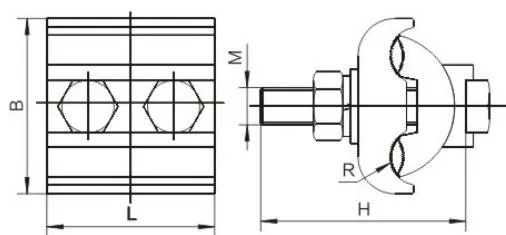
Beijing type
| Model | Conductor (mm²) | L | A | H | R | M | Bolts |
|---|---|---|---|---|---|---|---|
| JBLY-16~70 (2-section) | 10~70 | 42 | 36 | 45 | 5 | 8 | 2 |
| JBLY-35~120 (2-section) | 35~120 | 45 | 47 | 55 | 7 | 10 | 2 |
| JBLY-35~120 (2-section, extended) | 35~120 | 67 | 47 | 55 | 7 | 10 | 2 |
| JBLY-35~120 (3-section) | 35~120 | 67 | 47 | 55 | 7 | 10 | 3 |
| JBLY-50~240 (2-section) | 50~240 | 45 | 63 | 70 | 10 | 10 | 2 |
| JBLY-50~240 (2-section, extended) | 50~240 | 67 | 63 | 70 | 10 | 10 | 2 |
| JBLY-50~240 (3-section) | 50~240 | 67 | 63 | 70 | 10 | 10 | 3 |
Note the column heading: the Beijing sheet letters the width A where the Hangzhou sheet letters it B. It is the same dimension. Nothing in the two bodies is named differently in a way that matters — it is the numbers that differ.
Where the two standards differ
Put the same model from each side by side:
| Model | Hangzhou L/B/H | Beijing L/A/H | Difference |
|---|---|---|---|
| 10~70, 2-section | 43 / 36 / 45 | 42 / 36 / 45 | L 1 mm shorter |
| 35~120, 2-section | 46 / 45 / 50 | 45 / 47 / 55 | 2 mm wider, 5 mm taller |
| 35~120, 2-section extended | 67 / 45 / 50 | 67 / 47 / 55 | 2 mm wider, 5 mm taller |
| 35~120, 3-section | 67 / 45 / 50 | 67 / 47 / 55 | 2 mm wider, 5 mm taller |
| 50~240, 2-section | 47 / 63 / 65 | 45 / 63 / 70 | 2 mm shorter, 5 mm taller |
| 50~240, 2-section extended | 70 / 63 / 65 | 67 / 63 / 70 | 3 mm shorter, 5 mm taller |
| 50~240, 3-section | 70 / 63 / 65 | 67 / 63 / 70 | 3 mm shorter, 5 mm taller |
The height is always 5 mm more in the Beijing type, on every size above 70 mm². That is the one consistent difference and it is the one that decides whether the clamp clears what is above it. Width moves only on the 35~120, and length moves only by 1 to 3 mm.
Ask which standard before you quote. We will supply either, but we will not swap one for the other on a repeat order without telling you.
The Beijing type does not reach 400
Three rows exist only in the Hangzhou standard:
JBLY-10~70 (3-section)— the small conductor gets a three-section body only from HangzhouJBLY-120~400 (2-section)JBLY-120~400 (3-section)
So above 240 mm² there is only one JBLY, and it is Hangzhou. If a tender asks for a Beijing-type clamp on 300 mm², nothing in this range matches.
Extended and three-section have the same length
On both standards, the “2-section extended” row is exactly as long as the 3-section row:
| Model | 2-section | 2-section extended | 3-section |
|---|---|---|---|
| 35~120 | 46 | 67 | 67 |
| 50~240 | 47 | 70 | 70 |
The extended version is therefore the three-section body with only two bolts in it. It buys you contact length without a third bolt — useful where the conductor is stiff or the clamp is long, and cheaper than the three-bolt part. The two rows cost different amounts and do different jobs, so do not treat them as the same item with an extra hole.
A section is worth 21 to 23 mm: 46 to 67 on the 35120, 47 to 70 on the 50240.
R and M
- R is the groove radius — twice R is the conductor outside diameter. It runs 5 to 12.5 mm across the range, so the largest clamp takes a 25 mm conductor.
- M is the bolt thread — M8 from 10 mm² up to 120 mm², M10 from 35
120 upward on the larger rows, M12 only on the 120400.
Both standards use the same R and M on every shared row, so the groove and the bolt are not where the difference lies.
Aluminium only
The body is aluminium. On copper conductor it corrodes at the contact. For a copper-to-aluminium joint use the CAPG bimetallic clamp or the JBTL flash-welded clamp; for an all-copper joint the JBT range.