SLG Bolted Copper Aluminum Equipment Clamp (New Brazing)
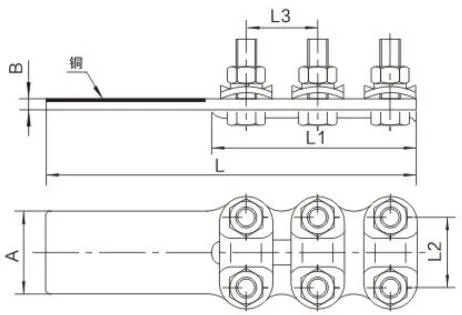
Models: SLG-1A/1B/1C – SLG-4A/4B/4C (4 sizes, three palm types) · Conductor: 35–240 mm² · Bolts: 4 or 6
This is the newest brazing process applied to the copper-aluminium equipment clamp, and it changes three things about the part: the palm comes in three angles, the plate is a uniform 6.0 mm across the range, and the sheet carries an extra length dimension.
It is also the sheet most likely to be ordered wrong, because it uses the same model codes as the standard SLG and means something different by them. That is covered in full below.
What changed against the standard sheet
| Standard SLG | New brazing | |
|---|---|---|
| Plate B | 5 / 5 / 6 / 6 mm | 6.0 mm on every size |
| L2 | 65 / 80 / 85 / 85 | 34 / 36 / 42 / 42 |
| L3 | not printed | 35 / 42 / 40 / 40 |
| L1 | 65 / 80 / 125 / 125 | 65 / 80 / 125 / 125 (same) |
| L | 145 / 175 / 225 / 225 | 145 / 175 / 225 / 225 (same) |
| Palm types | A, B | A, B, C |
Two of these are cosmetic and two are not. The clamped length L1 and the overall length L are unchanged, so the part still lands on the same pad and grips the same conductor. But the plate grows on the small sizes and the L2 dimension shrinks by roughly half — which means the palm is shorter and the transition sits closer to the terminal than on the standard part.
If you are replacing a standard SLG-1A in an existing assembly, the new-brazing SLG-1A will bolt up and will be 1 mm thicker and 31 mm shorter in the palm. That is a real fit question, not a cosmetic one.
The code collision
This is the part worth reading twice.
SLG-1A on the standard sheet: plate 5 mm, L2 = 65.
SLG-1A on this sheet: plate 6.0 mm, L2 = 34.
The codes are identical. The parts are not. Neither the model number nor the conductor range distinguishes them — only the sheet does. So:
- State the process when ordering. “New brazing” or “standard”, not just
SLG-1A. - When quoting from a customer drawing, ask which sheet the drawing was made against before you price it.
- When matching an existing installation, measure the plate and the palm. The code will not tell you.
The Q series sits between the two: SLG-xAQ / BQ / CQ is brazed with 6 and 7 mm plate and its own suffix, which is the one sheet here that cannot be confused by code alone.
Technical parameters
| Model | Conductor (mm²) | Bolts | A (mm) | B (mm) | L3 (mm) | L2 (mm) | L1 (mm) | L (mm) |
|---|---|---|---|---|---|---|---|---|
| SLG-1A/1B/1C | 35–50 | 4 | 40 | 6.0 | 35 | 34 | 65 | 145 |
| SLG-2A/2B/2C | 70–95 | 4 | 40 | 6.0 | 42 | 36 | 80 | 175 |
| SLG-3A/3B/3C | 120–150 | 6 | 50 | 6.0 | 40 | 42 | 125 | 225 |
| SLG-4A/4B/4C | 185–240 | 6 | 50 | 6.0 | 40 | 42 | 125 | 225 |
Three palm angles
The A / B / C letter is the palm angle, and it works the same way as on the Q series: A is flat (0°), B is 30°, C is a right angle (90°). All three share the dimensions in the table above, so the angle costs nothing in length — it costs everything in fit, because a brazed palm cannot be bent on site to suit a terminal you did not measure.
Reading the columns
- A (mm) — clamp width across the conductor.
- B (mm) — plate thickness, 6.0 on every size. This is the one figure the process change made uniform.
- L1 (mm) — clamped length over the conductor, unchanged from the standard sheet.
- L2 (mm) — the short transition length. Much shorter than the standard sheet’s L2, so do not carry a number across from one sheet to the other.
- L3 (mm) — a third length this sheet carries and the standard one does not. Use it as printed; do not derive it from L and L1.
- L (mm) — overall length, identical to the standard sheet size for size.
- Bolts — 4 on sizes 1 and 2, 6 on sizes 3 and 4.
Ordering
Send the code with the palm letter, the conductor size, the stud size, and the words new brazing. Without that last part the code alone is ambiguous between three sheets. If the conductor is aluminium and the terminal copper, say so — this clamp is the transition, and it is meant to be installed with the aluminium side on the conductor.
FAQ
Is this the same as the Q series?
No. The Q series is SLG-xAQ / BQ / CQ with 6 and 7 mm plate. This sheet is SLG-xA/B/C with a uniform 6.0 mm plate and a shorter L2.
Why does SLG-1A mean two different clamps? Because the code was kept as the process changed. The distinguishing information is on the sheet, not in the number, so the process has to be named on the order.
Which one should I specify for a new project? The new-brazing sheet gives a uniform 6.0 mm plate and three palm angles, which is simpler to stock. The standard sheet carries the 2010 and 1985 standard numbers, which matters when a specification names them.
Can I mix these with standard SLG clamps on one structure? Physically they will bolt to the same pad. But a 1 mm plate difference between adjacent clamps on one run is the kind of thing an inspector flags, and the palm lengths differ too. Keep one sheet per structure.