SLSG Bolted Copper-Aluminium Twin Conductor Equipment Clamp
Conductors: LGJ-185240, 300400, 500~630, 800 · Spacing: 120 / 200 mm · Plate: 0°, 30° or 90°
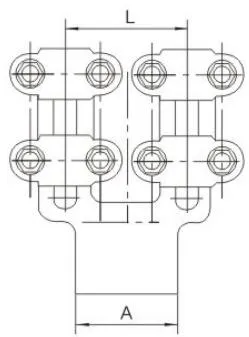
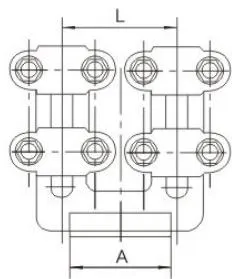
SLSG is the twin variant you order when the conductors are ACSR and the terminal is copper. The two bodies that grip the conductor are aluminium alloy with a conductor groove; the plate that lands on the equipment is copper, brazed on — the factory sheet says so in the title of each of its three tables.
Four sizes, two spacings, three angles
The code SLSG-6C-200 carries three separate choices:
| Part | Meaning |
|---|---|
SLSG |
bolted twin clamp, aluminium bodies with a brazed copper plate |
4 / 5 / 6 / 7 |
the clamp size — it is the conductor range, not a section area |
A / B / C |
plate angle: 0°, 30°, 90° |
-120 or -200 |
spacing between the two conductor grooves |
The numbers 4 to 7 are size codes, and they map to conductor ranges: 4 is LGJ-185240, 5 is LGJ-300400, 6 is LGJ-500~630, 7 is LGJ-800. Do not read them as 4 mm² or 40 mm².
Size 7 exists only at 200 mm spacing. Sizes 4, 5 and 6 come in both 120 and 200. That gives 3 + 4 = 7 rows per angle, 21 in total across A, B and C.
Technical parameters
| Model | Conductor | Main dimensions (mm) | Reference weight (kg) | |||
|---|---|---|---|---|---|---|
| A | B | H | L | |||
| SLSG-4A-120 | LGJ-185~240 | 80 | 16 | 80 | 120 | 2.1 |
| SLSG-5A-120 | LGJ-300~400 | 100 | 16 | 100 | 120 | 2.25 |
| SLSG-6A-120 | LGJ-500~630 | 125 | 20 | 125 | 120 | 3.85 |
| SLSG-4A-200 | LGJ-185~240 | 80 | 16 | 80 | 200 | 2.21 |
| SLSG-5A-200 | LGJ-300~400 | 100 | 16 | 100 | 200 | 2.45 |
| SLSG-6A-200 | LGJ-500~630 | 125 | 20 | 125 | 200 | 4.2 |
| SLSG-7A-200 | LGJ-800 | 125 | 22 | 125 | 200 | 5.7 |
| SLSG-4B-120 | LGJ-185~240 | 80 | 16 | 80 | 120 | 2.1 |
| SLSG-5B-120 | LGJ-300~400 | 100 | 16 | 100 | 120 | 2.25 |
| SLSG-6B-120 | LGJ-500~630 | 125 | 20 | 125 | 120 | 3.85 |
| SLSG-4B-200 | LGJ-185~240 | 80 | 16 | 80 | 200 | 2.21 |
| SLSG-5B-200 | LGJ-300~400 | 100 | 16 | 100 | 200 | 2.45 |
| SLSG-6B-200 | LGJ-500~630 | 125 | 20 | 125 | 200 | 4.2 |
| SLSG-7B-200 | LGJ-800 | 125 | 22 | 125 | 200 | 5.7 |
| SLSG-4C-120 | LGJ-185~240 | 80 | 16 | 80 | 120 | 2.1 |
| SLSG-5C-120 | LGJ-300~400 | 100 | 16 | 100 | 120 | 2.25 |
| SLSG-6C-120 | LGJ-500~630 | 125 | 20 | 125 | 120 | 3.85 |
| SLSG-4C-200 | LGJ-185~240 | 80 | 16 | 80 | 200 | 2.21 |
| SLSG-5C-200 | LGJ-300~400 | 100 | 16 | 100 | 200 | 2.45 |
| SLSG-6C-200 | LGJ-500~630 | 125 | 20 | 125 | 200 | 4.2 |
| SLSG-7C-200 | LGJ-800 | 125 | 22 | 125 | 200 | 5.7 |
All dimensions in millimetres. 21 orderable codes, identical across A, B and C apart from the letter.
Exactly 5 mm shorter than SLS
The same finding as on the compression twins, and it is worth stating because it is so regular: A, B and L are identical between SLS and SLSG at every one of the 21 rows, and H is 5 mm shorter on the copper version every time.
| Plate | SLS H (mm) | SLSG H (mm) |
|---|---|---|
| size 4 | 85 | 80 |
| size 5 | 105 | 100 |
| size 6 | 130 | 125 |
| size 7 | 130 | 125 |
Weights run 0.1 to 0.15 kg heavier on SLSG. So a swap onto the same bolt holes works at the same spacing and the same plate width, but the plate stops 5 mm short — check the pad edge before you promise a like-for-like replacement.
The reason is the braze fillet: it occupies part of the plate, so the copper plate is drawn shorter than the aluminium one it replaces.
What it is made of
The factory note on all three sheets: “clamp body and gland are aluminium alloy, other parts are hot-dip galvanised steel.”
Note what the sentence does not cover: the copper plate. It is only named in the table titles — “copper-aluminum double conductor terminal clamp (brazed)” — so the note is about the fasteners, not about the bimetallic joint.
So the two castings that grip the conductor are aluminium alloy and the bolts and keep plates are galvanised steel. That is the normal arrangement and it matters in two ways:
- The bolts are not stainless. On a coastal or industrial site, specify a finish upgrade or expect to replace them at first maintenance.
- The aluminium castings are the conductive path, so the conductor-to-body contact is what carries the current; the steel only provides the clamping force.
The brazed plate
- Do not heat it. A site torch on the plate undoes a braze well before anything looks hot.
- Do not bend it to fit. A braze is a lap-type joint; a plate bent cold on site cracks along the fillet.
- Inspect the fillet. A sound braze is an even collar round the joint. A lumpy or gashed one was made cold.
- Crimp and bolt are unaffected. Only the plate end is bimetallic; the conductor groove is plain aluminium alloy.
Fitting it
- Eight bolts, cross pattern, same torque on both bodies — a pair at different torques rocks the plate on the pad.
- Grease the conductor, not the threads. The aluminium oxide is the contact resistance.
- Check the plate against the pad before assembly. 5 mm of missing plate is not adjustable on site.
- Not a spacer — the plate carries current, not the bundle tension.
The rest of the family
- SLS — the all-aluminium version with the longer plate.
- SSLG — heat-resistant conductor, copper plates.
- SLG — the single-conductor copper-aluminium clamp.
- SSYG — the compression twin with copper plates.
Note: Quote the size code, the angle and the spacing, e.g. SLSG-5A-120, and confirm the terminal is copper.