WCJB Plum Blossom Copper Connection Clamp
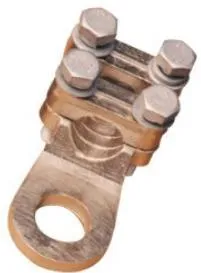
A copper clamp with a flat palm at one end and a multi-petal grip at the other, made from red copper plate — the factory note says plate, not casting, which is why the palm and the grip are one piece with no joint between them. The photograph shows four bolts, arranged two by two.
The petals are the reason for the name: the grip has several shallow arcs rather than one semicircular groove, so the same clamp closes onto a range of conductor diameters instead of one size.
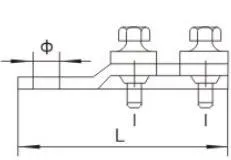
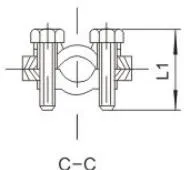
Dimensions
| Model | Conductor (mm²) | Main dimensions (mm) | ||||||
|---|---|---|---|---|---|---|---|---|
| L | L1 | B | B1 | H | H1 | Φ | ||
| WCJB-1 | 16~25 | 39.5 | 16 | 25 | 16.5 | 13.0 | 13.0 | 8.5 |
| WCJB-2 | 25~35 | 45.0 | 16 | 22 | 18.0 | 13.0 | 13.0 | 8.5 |
| WCJB-3 | 35~50 | 52.5 | 18 | 24.5 | 22.0 | 13.5 | 13.5 | 10.5 |
| WCJB-4 | 50~70 | 61.0 | 20 | 31 | 23.0 | 18.5 | 18.5 | 10.5 |
| WCJB-5 | 70~95 | 69.0 | 25 | 35 | 23.5 | 20.0 | 20.0 | 10.5 |
| WCJB-6 | 95~120 | 74.0 | 30 | 42 | 28.5 | 22.5 | 22.5 | 13.5 |
| WCJB-7 | 120~150 | 74.0 | 30 | 41 | 27.0 | 24.0 | 24.0 | 13.5 |
| WCJB-8 | 150~185 | 76.0 | 30 | 42 | 28.0 | 24.5 | 24.5 | 13.5 |
| WCJB-9 | 185~240 | 80.0 | 32 | 44 | 30.0 | 25.0 | 25.0 | 13.5 |
What each letter measures
Taken from the two drawings above:
- L — overall length, from the end of the palm to the far end of the grip.
- L1 — the vertical height over the bolts, head to tail. It is larger than H on all nine rows, which is what you expect if H is the body and L1 includes the bolts standing proud of it.
- B — overall width of the grip across the body.
- B1 — the width of the grip across the petals, narrower than B, so B includes the side lugs.
- H — body height of the grip.
- Φ — the clearance hole in the flat palm, the one dimension on the drawing sitting in the pad rather than the grip.
H and H1 are the same number on all nine rows. They are printed as two columns but the values are identical every time, so H1 adds nothing — read H and ignore H1. This is not a typo in one row, it is the same value on 1 through 9.
Φ has only three values
The palm hole does not follow the conductor:
| Φ (mm) | Models | What it takes |
|---|---|---|
| 8.5 | WCJB-1, WCJB-2 | M8 |
| 10.5 | WCJB-3, WCJB-4, WCJB-5 | M10 |
| 13.5 | WCJB-6, WCJB-7, WCJB-8, WCJB-9 | M12 |
Three hole sizes across nine clamps for 16 to 240 mm². So the palm is not sized to the conductor — it is sized to the bolt that ties it down, and the same M12 clears an 95 mm² clamp and a 240 mm² clamp. If your structure has M10 studs, WCJB-6 to WCJB-9 will not fit them whatever the conductor is. Check the bolt, not the conductor, when you match this clamp to existing hardware.
Sizes 6 and 7 are the trap
| Model | Conductor | L | B | H |
|---|---|---|---|---|
| WCJB-6 | 95~120 | 74.0 | 42 | 22.5 |
| WCJB-7 | 120~150 | 74.0 | 41 | 24.0 |
Identical length, different everything else. WCJB-7 is 1 mm narrower and 1.5 mm taller than WCJB-6. Two clamps the same length that will not substitute for each other, because the petals sit at a different radius. If a drawing gives you L = 74 and nothing else, that does not identify the part — you need the conductor range as well.
WCJB-8 goes back out to B = 42 and 76 mm long, so B does not increase steadily with size either:
- WCJB-1 is 25 mm wide, WCJB-2 is 22 mm. The smaller clamp is the wider one.
- WCJB-6 is 42 mm, WCJB-7 is 41 mm. Same again, one size down.
L, L1 and H do rise steadily from 1 to 9. B does not. Do not interpolate B.
Conductor ranges touch at one point
Every boundary lands on exactly one size:
1625 · 2535 · 3550 · 5070 · 7095 · 95120 · 120150 · 150185 · 185~240
So 25 mm² is covered by both WCJB-1 and WCJB-2, 35 by both 2 and 3, and so on up to 185 which is in both 8 and 9. Only the two extremes — 16 and 240 — have a single choice. Where two clamps take the conductor, quote whichever your schedule names; we will not substitute one for the other without asking, because the palm hole and the envelope differ.
Copper only
The clamp is red copper plate throughout. On aluminium conductor it will corrode at the contact in wet air and the joint fails there rather than in the conductor. For an aluminium run use an aluminium clamp — the JBG parallel groove clamp or the JB range — and for a copper-to-aluminium connection use a bimetallic clamp such as the JBTL flash-welded parallel groove clamp.
For a plain copper terminal with a single barrel instead of a grip, see the DTM copper terminal. For a copper splice with no palm at all, the JDT single groove clamp covers 16 to 120 mm².